The 1964 GTO did more than launch a new trim line, it ignited Detroit’s muscle car era and reshaped American performance culture. Collectors now chase those first-year cars for their blend of raw speed, clean styling, and a market trajectory that keeps climbing. Buyers who understand the origin story, the hardware, and the current value trends can navigate this fast moving corner of the classic car world with confidence.
The birth of the 1964 GTO legend
Enthusiasts often describe the 1964 GTO as the moment mid size American cars discovered serious horsepower. Engineers took the humble Pontiac Tempest and turned it into a street fighter that dealers could sell in real volume. The project team built a running prototype, then refined the package until it felt ready for showrooms, a process that later coverage described as a key research step for the new performance model and its “Soon after, a running prototype was completed” development arc, which helped define the emerging GTO formula.
Designers did not create the name in a vacuum, they borrowed racing prestige from Europe. Enthusiasts point to The Ferrari 250 G as the inspiration, and a later account notes that The Ferrari 250 GTO, a favorite owned by John DeLorean, influenced the choice of the GTO badge for the new Pontiac GTO, tying Detroit’s street machine to a car with professional racing status and giving the American coupe instant cachet through that John connection.
From Tempest option to muscle car template
The first GTO did not arrive as a standalone model, it started as an option package on the Pontiac Tempest. Factory literature describes the 1964 Pontiac Tempest LeMans GTO as a Tempest LeMans fitted with a specific performance group, which included visual cues like unique grille inserts and dual hood scoops that signaled intent on the street and helped distinguish the Pontiac Tempest based package from ordinary intermediates.
Engineers priced that transformation aggressively, which helped the car slip under corporate radar and into customer driveways. The US division offered The US $295 package (equivalent to $2,990 in 2024) that bundled a 389 cu in (6.4 L) V8 rated at 325 hp (242 k W) at 4,800 rpm, a dual exhaust system, and heavy duty suspension parts, creating a template that other brands soon copied and cementing the first generation The US performance recipe.
Key specs that made the 1964 GTO special
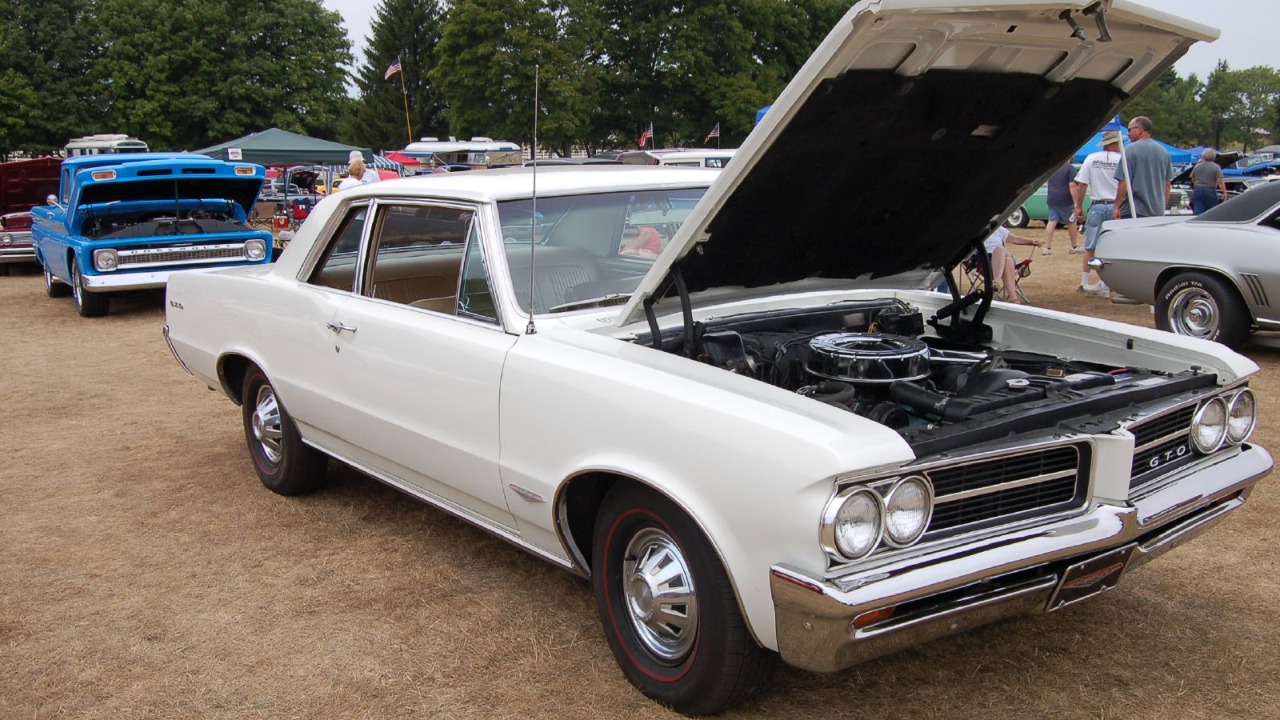
Under the skin, the 1964 GTO combined a big engine with a relatively compact body, a formula that defined the muscle era. The first generation GTO used a front engine, rear drive layout on the compact sized Ventura and Tempest platform, which kept weight manageable while the 389 delivered strong torque, a configuration that helped The Pontiac GTO stand apart from heavier full size performance cars and gave the new GTO a more agile feel.
Buyers could choose several body styles and power levels, which broadened the car’s appeal. The package included the high output 389 with optional Tri Power carburetion, and factory records describe a Power engine producing 348 horsepower when so equipped, while the chassis specification listed a convertible or cabriolet configuration with two doors and a front mounted engine that supplied power to the rear wheels, details that later technical summaries of The Pontiac GTO captured in their breakdown of weight, torque, and gearing for the 1964 GTO.
Body styles, pricing, and how they drive
Shoppers in 1964 could tailor their GTO to taste and budget, a flexibility that still shapes values today. The Coupe started at $2,491, the Hardtop at $2,556 and the Convertible at $2,796, figures that placed the car within reach of younger buyers while still leaving room for options, and period testers praised Performance as impressive for the time, with Moto style road tests highlighting strong acceleration and solid braking for the mid size Performance.
Modern technical digests help quantify how those numbers feel on the road. One detailed specification sheet notes that the Pontiac GTO is a convertible or cabriolet with two doors and a front mounted engine that sends power to the rear axle, and it lists torque output and gearing that explain the car’s strong mid range pull, giving current drivers a clear sense of how the 1964 setup compares with later muscle machines through that Feb era data.
How collectors value the first year GTO today
Market watchers now track the 1964 GTO as one of the most closely watched American classics. Valuation tools that focus on the 1964 Pontiac LeMans GTO show condition based pricing for coupes, hardtops, and convertibles, and they document how buyers pay clear premiums for correct drivetrains and original trim on these early cars, with the main Hagerty guide giving a baseline for current asking prices.
Analysts who study broader Pontiac trends see similar momentum. One valuation overview notes that GTO models in general are on the rise, and According to the Hagerty Price Guide, all GTOs in condition 3, or good value, have gained over recent years, with a cited condition 3 value of $18,800 that underscores how even driver quality examples of the classic GTO no longer trade as cheap entry points.
Rising demand and real world sale examples
Insurance quoting data confirms that interest in these cars extends beyond auction headlines. A recent quoting snapshot notes that Quoting Trends for Pontiac show strong enthusiasm, and The GTO ranked as the second most popular quoted Pontiac model at Hagerty in 2024, with just over 6,000 quotes, a figure that signals broad demand for coverage and hints at a deep pool of owners and shoppers focused on the Pontiac nameplate.
Individual sales help translate that enthusiasm into hard numbers. Earlier this year, a 1964 Pontiac GTO Sport Coupe Tri Power 4 Speed for sale on a major online platform sold for $70,500 on June 10, 2025, recorded as Lot 195,423, a result that illustrates how well documented, correctly optioned early cars can command strong money in the current market and gives buyers a concrete benchmark for similar Auctions.
Why the 1964 GTO still matters
Collectors do not chase the 1964 GTO only for nostalgia, they also value its role as a turning point. The car showed that a mainstream brand could bolt a big V8 into a mid size shell, price it competitively, and create a new performance category that rivals would rush to copy, a legacy that modern histories of the Pontiac GTO highlight when they trace the first generation on the compact sized Ventura and Tempest chassis and explain how that decision reshaped the American Pontiac GTO landscape.
Buyers who study the origin story, understand the specs, and watch the valuation data can approach these cars with clear eyes. The combination of documented history, distinctive engineering, and rising prices suggests that the first year GTO will remain a cornerstone of serious American muscle collections, especially when examples retain their Pontiac Tempest roots, correct GTO option content, and the kind of provenance that valuation tools and heritage archives now reward, as seen in the detailed coverage of the 1964 Pontiac Tempest LeMans GTO within the official GTO collection records.