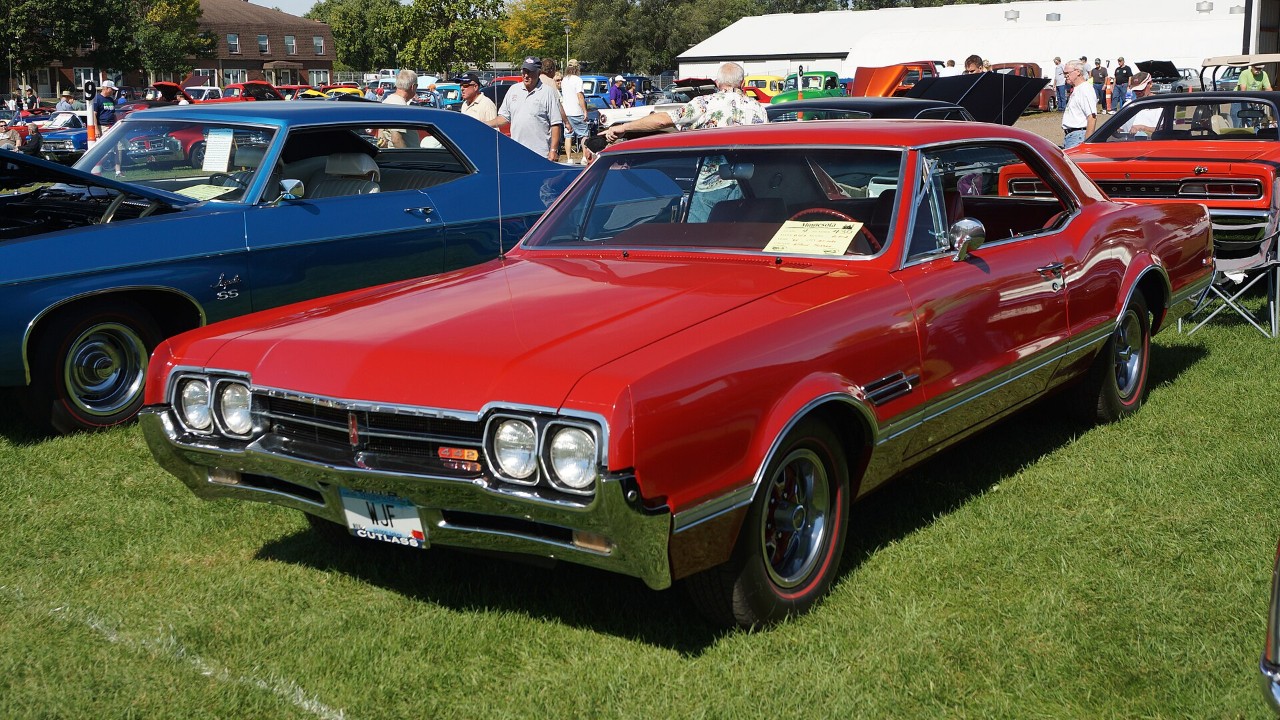
Oldsmobile’s Lansing plant built only 54 cars with the 1966 442 W-30 package. Each one pulled cold air through two ducts under the front bumper, and the battery had to move to the trunk to make room. As a result, the factory version ended up far scarcer than the 442 it was based on.
The W-30 was not a styling option. Instead, it was a racing package built on top of the 442’s tri-power engine. Most buyers never saw one, because so few left the factory.
Here is what the package added, why the battery ended up in the trunk, and how the 54 cars fit into a year when Oldsmobile sold nearly 22,000 442s. Every figure below comes from published references and period road tests quoted by them.
What the 442 name meant by 1966
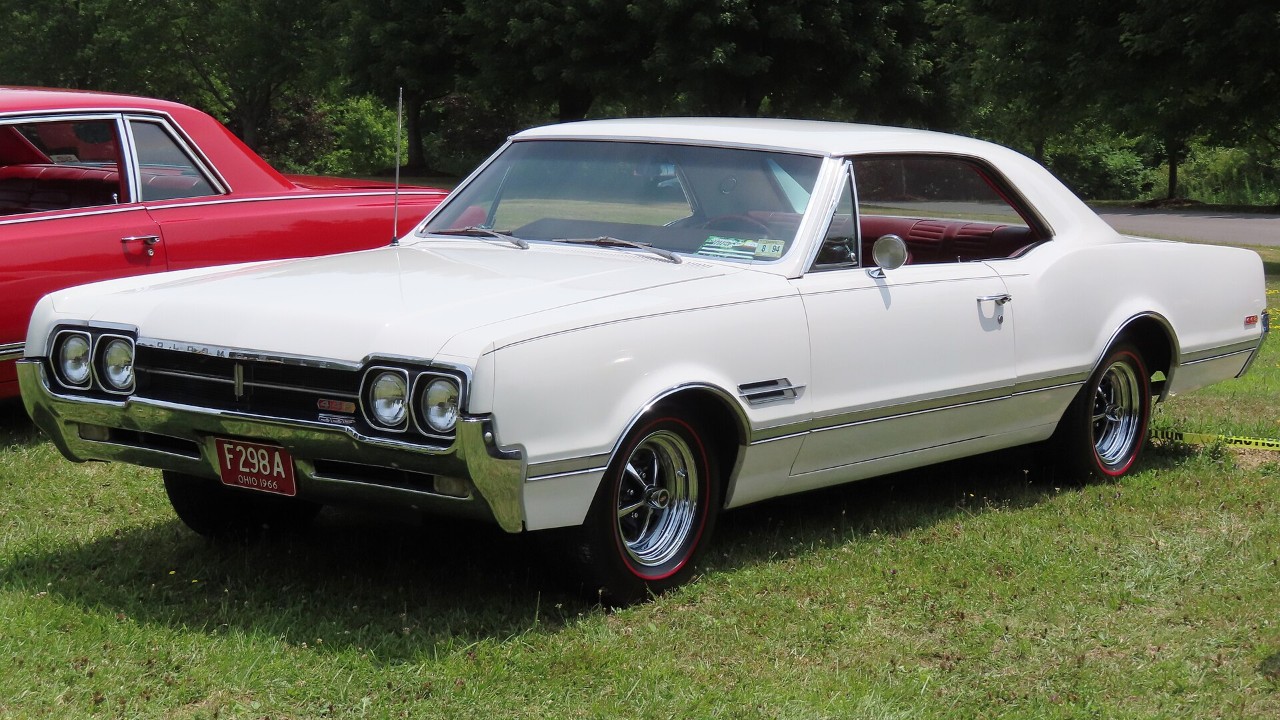
The 442 began as an option package on the mid-size F-85 and Cutlass. According to autoevolution, the number first stood for a four-barrel carburetor, a four-speed manual and dual exhaust. By 1966, however, automatics were available, so the name was read as 400 cubic inches, four-barrel and dual exhaust.
Demand was strong but not huge. Both autoevolution and the Australian reference site Unique Cars and Parts put 1966 production at 21,997 cars. Unique Cars and Parts adds that the 442 still made up only about 10 percent of Cutlass sales.
The standard engine that year was the L78 400. Unique Cars and Parts lists it at 350 horsepower and 440 lb-ft of torque with a single four-barrel carburetor.
The L69 tri-power engine underneath
The W-30 started with the L69 option. In place of the single four-barrel, the L69 carried three Rochester 2GC two-barrel carburetors on a progressive linkage, according to Unique Cars and Parts. Oldsmobile rated it at 360 horsepower and 440 lb-ft of torque.
That setup was a one-year item on the 442. Autoevolution notes that 1966 was the only season for tri-power on this platform. It also says production records show 2,129 cars with the L69 that year.
The L69 was not cheap, either. Unique Cars and Parts gives its price as $264.54. Also, buyers could only pair the L69 with a manual transmission.
How the 1966 442 W-30 breathed
The heart of the 1966 442 W-30 was its air supply. Autoevolution calls the setup the Force-Air system and describes two ducts leading from under the front bumper straight to the air cleaner. The ClassicCars.com Journal describes the same thing as two scoops in the bumper cavities.
Cold air is denser than hot air under the hood, so it helps an engine make power. The scoops also changed the front of the car. According to the ClassicCars.com Journal, they moved the parking lights toward the center of the bumper.
The ducts also needed room in the engine bay. That is why the battery moved to the trunk, which autoevolution and Unique Cars and Parts both report. Unique Cars and Parts adds that the trunk battery kept the package off convertible models.
Cam, gears and a rating that looked low
The W-30 went further inside the engine. The ClassicCars.com Journal lists a factory blueprint, a special 308-degree cam, modified combustion chambers and high-strength valve springs. It also lists 4.11 gears, and it says the package required a four-speed manual.
Even so, Oldsmobile gave the W-30 the same 360-horsepower rating as the L69. Unique Cars and Parts calls that figure “rated – or, more likely, underrated.” Meanwhile, autoevolution cites the same advertised 360 horsepower and 440 lb-ft.
Period magazines tested the tri-power cars. Both references quote Car Life at 6.3 seconds from 0 to 60 mph and 14.8 seconds in the quarter mile at 97 mph. By comparison, autoevolution says Motor Trend’s stock car ran 7.2 seconds to 60 and the quarter in 15.16 seconds.
Only 54 from the factory
Three separate references agree on the headline number. Unique Cars and Parts says, “Only 54 W30s were built by the factory.” The ClassicCars.com Journal also says only 54 were built, and autoevolution says the Lansing plant produced 54 factory cars.
Autoevolution adds that the 54 covered both F-85 and Cutlass bodies. In fact, it counts only 16 Cutlass hardtops with the W-30 and L69 combination.
Dealers sold more of the parts than the factory did. Unique Cars and Parts says another 97 cars got the package as dealer installations, although autoevolution only says dealers received limited kits. The ClassicCars.com Journal calls the dealer version the Track-Pac and says Oldsmobile introduced the racing package in May 1966.
Those 54 factory cars came out of a 442 run of 21,997, which works out to about one car in every 400. Oldsmobile built them in Lansing in 1966, and that is where the W-30 story began.
More from Fast Lane Only
- Unboxing the WWII Jeep in a Crate
- 15 rare Chevys collectors are quietly buying
- 10 underrated V8s still worth hunting down
- Police notice this before you even roll window down
This article was created with the help of AI and was reviewed and edited by Fast Lane Only editors before publication.