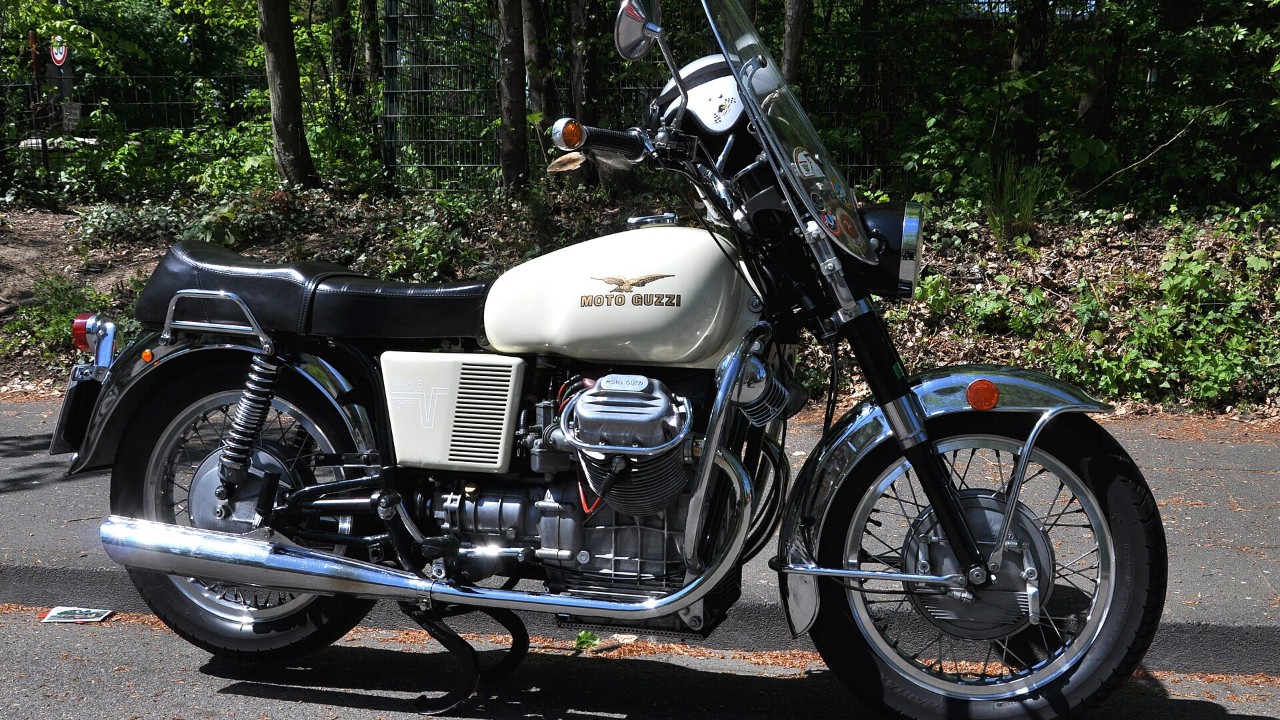
The Moto Guzzi V7 of 1967 is easy to spot because its two cylinders stick out sideways, one on each side of the tank. That layout did not start on a motorcycle. Its engine family had already powered a three-wheeled mountain vehicle for Italy’s Alpine troops, and before that it was meant for a small Fiat.
The man behind it was Giulio Cesare Carcano, Moto Guzzi’s engineer at its Mandello del Lario works. He designed an air-cooled 90-degree V-twin, and the company kept finding new jobs for it. One of those jobs became a police motorcycle, and then a road bike.
Here is how the engine moved from a car project to a military “mule” and finally into the V7.
A V-twin first meant for a Fiat 500
According to Piaggio Group’s history of the V7, Carcano first designed his 90-degree air-cooled V-twin for a sports version of the Fiat 500. Piaggio, which owns Moto Guzzi today, says that car was meant to reach 140 km/h.
However, the deal never happened. Piaggio says Fiat’s leadership liked the engine, but chairman Vittorio Valletta wanted annual quantities beyond what the Mandello del Lario plant could build. As a result, “the agreement came to nothing,” and Carcano’s twin needed another home.
The three-wheeled military mule
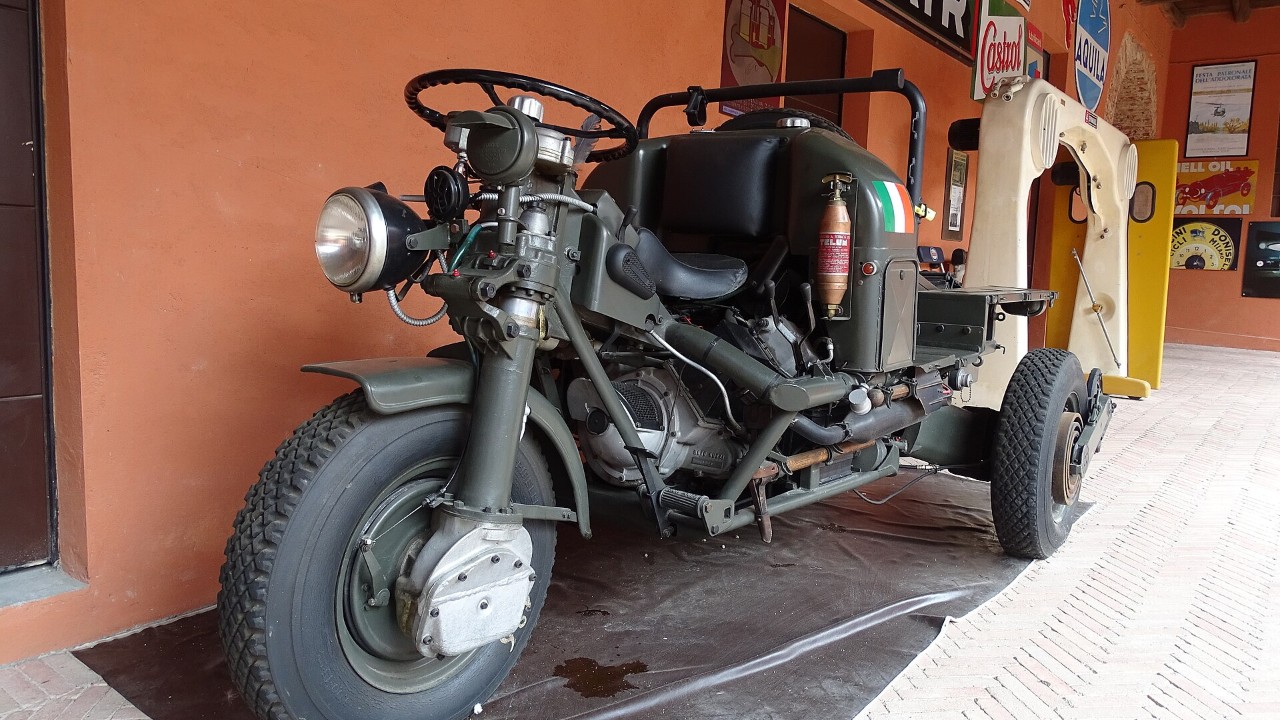
Eventually, that home turned out to be a strange machine. Piaggio says Carcano enlarged the twin to 754cc for the “3X3,” a variable-track vehicle with three-wheel drive for Alpine troops. Its Italian label was Il Mulo Meccanico, or the Mechanical Mule.
The magazine The Classic MotorCycle gives a slightly different size. Instead of 754cc, it lists 745cc, from an 80mm bore and 75mm stroke, with 20 bhp at 4,000 rpm. Either way, the engine sat across the frame as a transverse V-twin, the same layout the V7 would later use.
The Mule itself was unusual, too. The Classic MotorCycle says it had shaft drive to all three wheels and a gearbox with six forward speeds plus reverse. In addition, a small auxiliary wheel behind each rear wheel could drop to the ground, and a caterpillar track could fit over the rear wheels.
Also, the magazine puts its payload at 1,102 lb, not counting the driver. Fully laden, the Mule could reach 31 mph. Between 1960 and 1963, the Italian Army’s Alpine regiment took delivery of about 200 Mules, the same source says.
How a police tender put the twin in a Moto Guzzi V7
Meanwhile, Italy’s government went shopping for motorcycles. Piaggio says a ministerial tender sought bikes for the Highway Police. The winner would be the machine that could cover 100,000 km with the lowest maintenance costs.
That brief suited a simple, air-cooled twin, so Guzzi had an obvious candidate. In Piaggio’s words, “It was the ideal occasion to mount Carcano’s twin-cylinder engine on a motorcycle, the Moto Guzzi V7.” Commissioning of the V7 700 began in 1964, and mass production followed in 1966, according to the same history.
The Canadian Biker account of the 1967 V7 draws the same line back to the Mule. It says the 700cc V-twin “famously traces its roots to the Mulo Meccanico.” In addition, it credits Carcano with designing both the Mule and its engine, an air-cooled 90-degree V-twin with overhead valves.
What the 1967 Moto Guzzi V7 offered riders
Piaggio’s “Generation V7” history dates the bike’s public arrival to 1967. It calls the V7 “the first Italian maxi-moto” and says it marked the debut of the transverse 90-degree V-twin, at 703cc. Piaggio’s origins article gives the V7 700 a 703.3cc engine, 40 hp and a weight of 230 kg. It also says the bike sold in Italy in 1967 for 725,000 lira.
The power figure varies by source, though. Canadian Biker says the V7 had 50 hp and a dry weight of 500 lb (226 kg). It adds that Carcano used a four-speed gearbox and a dry single-plate clutch. Final drive was by a shaft that formed one leg of the swingarm, so the Mule’s shaft-drive idea carried over as well.
Meanwhile, the styling looked west. Canadian Biker says the V7 was “intended to satisfy American tastes,” with deeply valanced fenders, crash bars and a cast-alloy speedometer housing.
Where the sideways twin went next
After that, the engine kept growing. Piaggio says Moto Guzzi’s engineers raised the transverse V-twin from 703cc to 757cc in 1969. Lino Tonti, who joined the company in 1967, developed the V7 Special that year. Later, his V7 Sport of 1971 used 748.3cc and more than 52 hp, Piaggio says.
The police connection also crossed the Atlantic. According to Piaggio, the Los Angeles Police Department selected the Moto Guzzi V7 Police for its fleet in 1970, three years after the first V7 appeared.
More from Fast Lane Only
- Unboxing the WWII Jeep in a Crate
- 15 rare Chevys collectors are quietly buying
- 10 underrated V8s still worth hunting down
- Police notice this before you even roll window down
This article was created with the help of AI and was reviewed and edited by Fast Lane Only editors before publication.