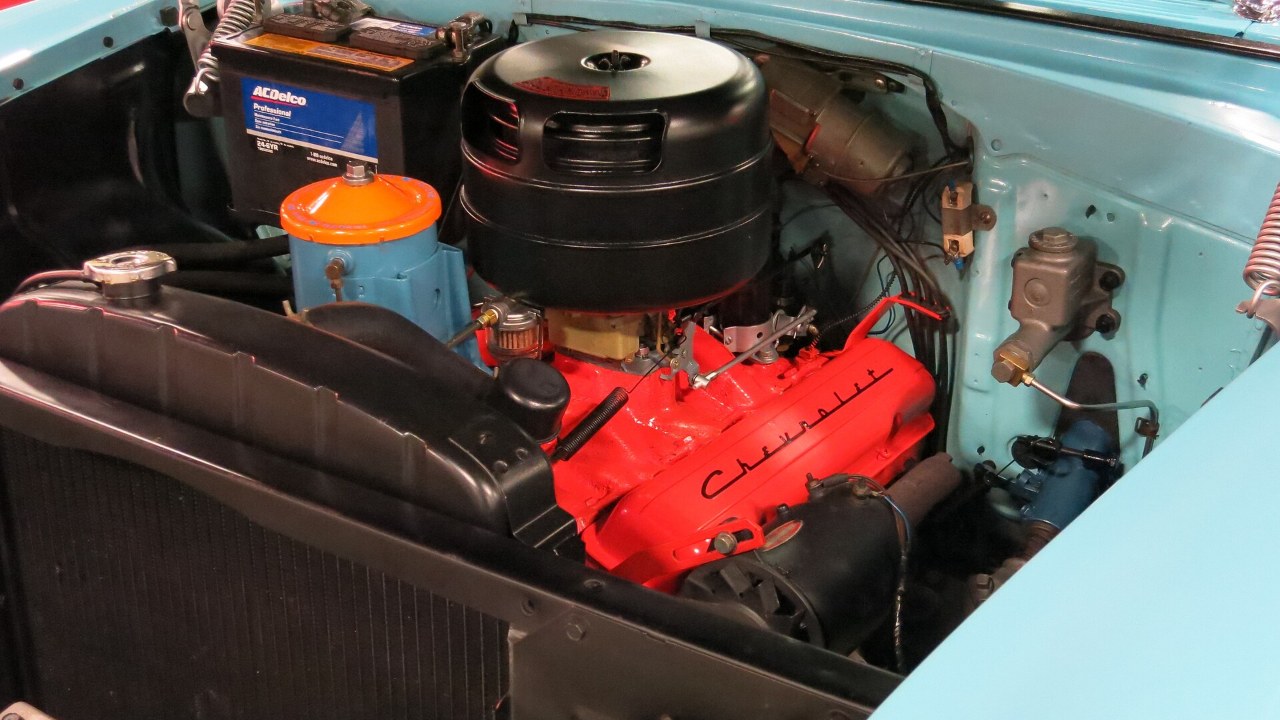
The Chevrolet 265 V8 arrived for 1955, and it started a family of engines that GM went on to build more than 100 million times. In its first form, it displaced 265 cubic inches and made 162 horsepower at 4,400 rpm. That was with a two-barrel carburetor and a single exhaust.
Those numbers look modest now. Even so, the design behind them was light, compact and cheap to build. It also left room to grow.
Here is what Chevrolet built in 1955, who designed it, and why the basic layout lasted. Every figure below comes from the sources linked in each section.
Why Chevrolet needed a new V8
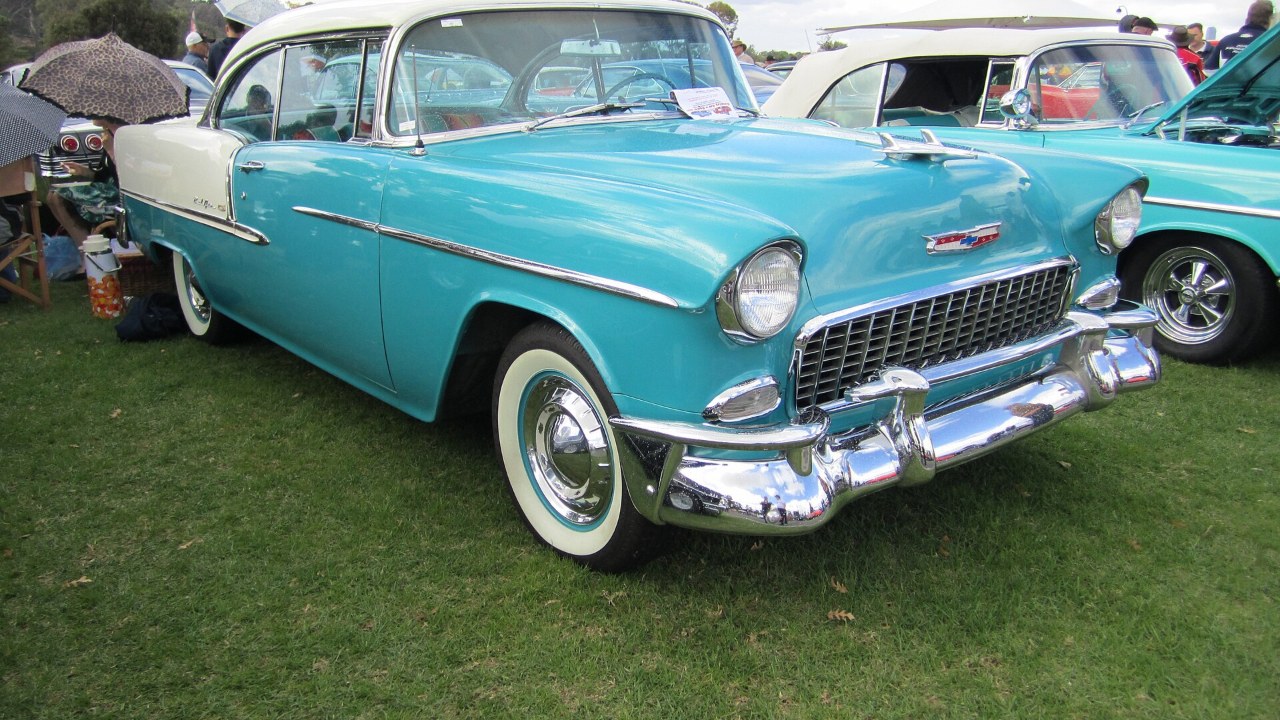
Until the V8 arrived, Chevrolet’s engine was an inline six, known to owners as the “Stovebolt” six. The new V8 had to beat it. In the end, Old Cars Weekly says, the V8 turned out physically smaller, 50 pounds lighter and more powerful than that six.
Above all, the man behind it was Ed Cole. According to Hagerty’s history of the small-block, Cole had already helped design Cadillac’s first overhead-valve V8, which was ready for introduction in 1949. He moved to Chevrolet in 1952 and became its chief engineer. Then he grew the engineering staff from 850 to 2,900 people.
Credit for the 265 itself depends on the source. Hagerty says Al Kolbe oversaw the engine design, while John Dolza led manufacturing methods. Meanwhile, a Spokesman-Review collector-car column describes Cole, Harry Barr and Zora Arkus-Duntov as the trio behind it. Either way, both sources put Cole at the center.
The work went fast. Hagerty says the team completed the design in three months. Three weeks later, they assembled the first prototype engine. By early 1954, just 15 months after the design effort began, the tooling was ready.
The Chevrolet 265 V8 by the numbers
First, the 265’s dimensions explain a lot about its character. It used a 3.75-inch bore and a 3.00-inch stroke, according to Hagerty. In other words, the bore was larger than the stroke. The Spokesman-Review credits that bore-and-stroke ratio for high revs and reliability.
Chevrolet also spaced the cylinder bores 4.40 inches apart. That bore-center figure is one of the small-block’s most important numbers, because GM was still using it more than 50 years later. Inside, the Spokesman-Review lists five main bearings, aluminum pistons and a forged steel crank.
Weight was a selling point, too. Hagerty puts the new V8 at 531 pounds, which it says was 40 pounds less than Chevrolet’s inline six. By comparison, Old Cars Weekly puts the saving at 50 pounds. Either figure meant the V8 weighed less than the six it joined.
What made the design different
Surprisingly, the cleverest parts were small ones. Each rocker arm had a concave surface stamped into it that rode on half of a steel ball, Hagerty explains. That idea came from Clayton Leach at Pontiac. Hagerty calls the result “lighter, cheaper, self-aligning, and low in friction.”
Oiling followed the same simple thinking. Hagerty notes that hollow pushrods carried oil up from the valve lifters to the rockers. It also points out that this idea was not new. In addition, the two cylinder heads were the same casting, so either one could fit either side of the engine.
The block itself was easier to make, too. Chevrolet cast it in green, or uncured, sand. According to Hagerty, that method cut the number of cores from 22 in the Cadillac block to 12 in the small-block. For the crankshaft, Chevrolet chose forged steel instead of the more common cast iron.
The first version did have a weak spot, however. The Spokesman-Review calls the oiling design the 1955 engine’s “Achilles heel,” because it did not yet have a spin-on full-flow filter.
Three versions of the 265 in 1955
In the 1955 passenger cars, the base V8 used a two-barrel carburetor. That version made 162 horsepower at 4,400 rpm, the figure Hagerty cites from dyno tests. Chevrolet sold 1.7 million cars for 1955, according to Hagerty, though not all of them had the V8.
Buyers who wanted more could order the Power Pack. According to the Spokesman-Review, it added a four-barrel carburetor and dual exhaust, and it raised output to 180 horsepower. Hagerty puts that peak at 4,600 rpm.
Finally, the strongest Chevrolet 265 V8 that year went into the Corvette. The 1955 Corvette V8 delivered 195 horsepower at 5,000 rpm, Hagerty reports.
Where the small-block went next
After 1955, Chevrolet kept enlarging the same basic engine. For 1957, it opened the bore to 3.875 inches and raised all small-blocks to 283 cubic inches, according to Hagerty. With Rochester mechanical fuel injection, the 283 made one horsepower per cubic inch. Later, in 1962, displacement grew again to 327 cubic inches.
The family kept growing for decades. In 2011, GM built its 100-millionth small-block engine, Hagerty says. Old Cars Weekly reported that the milestone engine was a 638-horsepower supercharged LS9 for the Corvette ZR1. GM assembled it at its Performance Build Center in Wixom, Michigan.
Even then, the original bore spacing survived. In the same report, GM said its fifth-generation small-block would keep 4.4-inch bore centers. That figure traces straight back to the 265.
The total has kept climbing since. In its history of the engine, Hagerty says more than 108 million small-blocks have been sold.
More from Fast Lane Only
- Unboxing the WWII Jeep in a Crate
- 15 rare Chevys collectors are quietly buying
- 10 underrated V8s still worth hunting down
- Police notice this before you even roll window down
This article was created with the help of AI and was reviewed and edited by Fast Lane Only editors before publication.