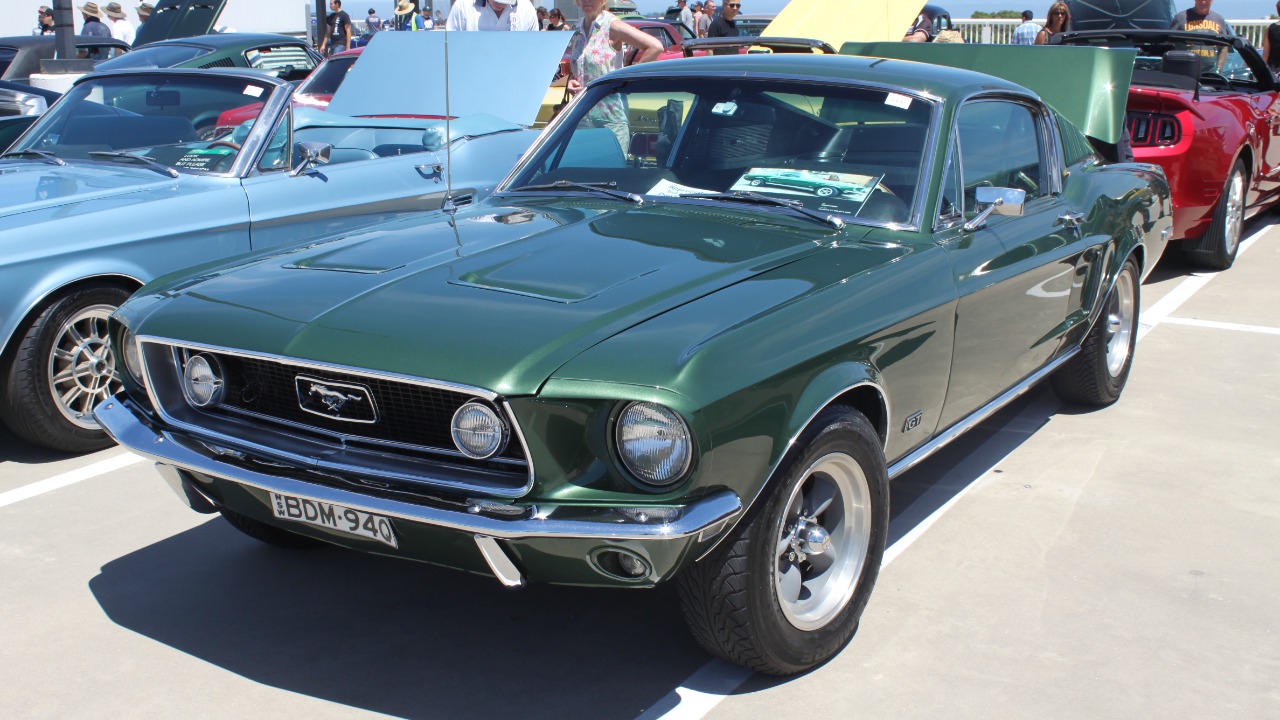
The 1968 Mustang GT Fastback arrived as a so‑called “pony car,” but it did not stay in that neat little box for long. With more power, a tougher stance, and a growing cultural footprint, it pushed past the lightweight image of the early cars and moved straight into muscle territory. You see that shift not only in its hardware, but in the way enthusiasts still chase, restore, and drive these cars today.
When you look closely at the 1968 GT Fastback, you are really watching the Mustang grow up in real time. The car kept the approachable proportions and price that defined the original, yet it layered on serious performance options and a more mature style that spoke to drivers who wanted more than a commuter with stripes. That evolution is why the model now sits at the crossroads of two worlds: nimble pony car and full‑blooded American muscle.
The pony car template, stretched to its limits
If you trace the story back, the whole idea of a pony car starts with the original Mustang, which set the pattern for a compact, stylish coupe that could carry four people and be optioned up for performance. The 1965 Mustang defined that formula so clearly that the entire segment took its name from it. By 1968, the GT Fastback still rode on that first‑generation foundation, but it was already straining against the class rules, with more displacement, more grip, and a more aggressive personality than the original commuter‑friendly coupes.
You can feel that tension in the way the 1968 Ford Mustang is described by enthusiasts: still part of the first generation, but already wearing subtle design and performance updates that made it look and feel more serious. The GT package, especially on the Fastback body, sharpened that impression with upgraded suspension and visual cues that signaled you were no longer dealing with a basic runabout. In other words, the car kept the pony car silhouette, yet its intent had shifted toward something far more muscular.
From stylish cruiser to American muscle
By the late 1960s, you were not just buying style when you ordered a 1968 Mustang GT Fastback, you were buying into the American muscle car power race. Enthusiasts today still talk about the 1968 Ford Mustang as a symbol of American performance and style, a car that answered growing demand for straight‑line speed without abandoning its everyday usability. That dual identity is exactly what nudged it beyond its pony car roots and into the same conversation as bigger, heavier muscle machines.
Under the broader Ford performance umbrella, the Mustang was evolving alongside more extreme hardware. Earlier in 1968, a street‑legal version of the 428 cid V8 CJ “Cobra Jet” drag car arrived in the Shelby lineup, with the Shelby GT‑500KR package Inspired by racing in Rhode Island. Even if your own GT Fastback did not carry that 428, the presence of engines like the Cobra Jet within the same family changed expectations. Buyers started to see the Mustang not just as a stylish coupe, but as a platform that could host serious drag‑strip hardware, and the GT badge on a Fastback signaled that you were leaning into that side of its personality.
Design that looked faster than “pony”
Visually, the 1968 GT Fastback also stepped away from the lighthearted pony image. The long hood and short rear deck that defined the Mustang were still there, but the Fastback roofline and GT details gave the car a more purposeful stance. You can see the roots of that look in the 1967 Mustang GT Fastback, whose long hood, short deck, and restrained chrome already exuded an aggressive kind of beauty. The 1968 GT Fastback built on that template, tightening the lines and leaning harder into a muscular silhouette that looked ready to pounce.
That evolution continued into the following year, when the 1969 Mustang retained the iconic long‑hood, short‑deck proportions but added sharper, more aggressive styling cues that helped distinguish it from its 1969 predecessor, as fans of the 1969 Ford Mustang point out. When you park a 1968 GT Fastback in that timeline, it becomes the bridge between the playful early pony cars and the more overtly muscular later models, a car that still looks compact but carries itself with the confidence of a full‑size bruiser.
Powertrains that backed up the attitude
Of course, style only gets you so far if the engine bay does not deliver. The 1968 GT Fastback could be ordered with serious V8 power, and that mechanical substance is a big part of why you now think of it as more than a simple pony car. Enthusiasts still celebrate high‑spec examples, like an S‑code 1968 390 4‑speed Mustang that pairs a 390 cubic‑inch engine with a factory GT package, or a 67 M convertible S code that shows how far the platform could be pushed. Those combinations gave the Mustang the torque and soundtrack to run with bigger muscle rivals while staying on a smaller, more agile footprint.
At the top of the food chain, the broader Ford performance catalog was already flirting with drag‑strip levels of power, from the 428 Cobra Jet to the Shelby GT variants that sat just above the regular GT Fastback in the hierarchy. When you ordered a 1968 GT, you were tapping into that same engineering mindset, even if your own car did not carry the wildest engine codes. That is why modern buyers still treat the 1968 Mustang as a serious performance classic rather than a mere styling exercise, and why the GT Fastback in particular commands so much attention in the marketplace.
From showroom option to global cult object
The 1968 Mustang GT Fastback did not just grow out of its pony car origins in the spec sheet, it did so in the culture. The Fastback shape, especially in GT trim, became a global shorthand for American performance and style. You can see that in the way the 1968 Ford Mustang Fastback is still praised as one of the most iconic muscle cars ever built, known for its sleek lines and raw power. That reputation has traveled far beyond American borders. Australian Geoff Buchanan, for example, tracked down a 1968 Fastback in an American museum, bought it, and shipped it to Australia, turning his car into a rolling ambassador for American automotive heritage every time he drives it, as he explains in a video.
Pop culture only amplified that effect. The Highland Green GT Fastback associated with Steve McQueen has become a legend in its own right, to the point that a single 1968 Ford Mustang GT finished in Highland Green can be described as a one‑of‑one build preserved for its authenticity. The story of the Bullitt cars even includes a twist that took investigators 40 years to fully unravel, with a two‑car secret that still fascinates fans, as retold in a Sep documentary. When a car becomes the subject of decades‑long detective work, you know it has escaped the confines of its original market segment.
More from Fast Lane Only