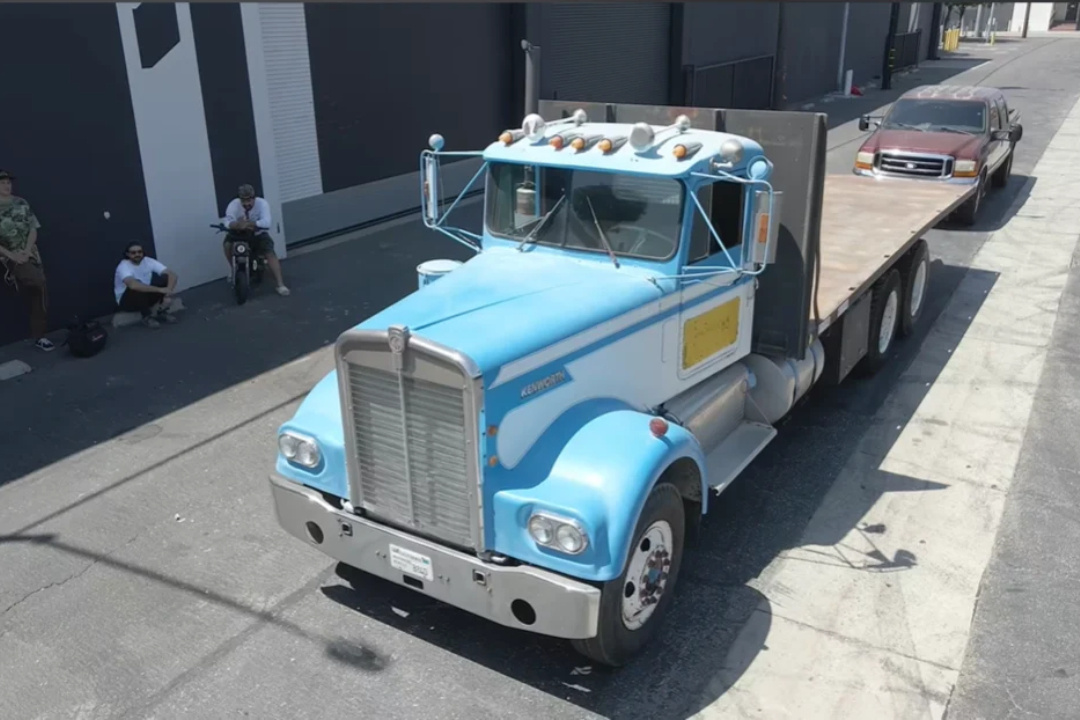
Almost sixty years of accumulated grease, grime, and road dirt don’t come off with a garden hose. When the crew at BigTime decided to clean up a 1969 Kenworth W925, a vintage semi-truck they’re planning to give away for free, they didn’t reach for soap and a scrub brush. They brought in Tar, a professional ice blasting operator from Polar X, along with his $50,000 Cold Jet PCS 60 dry ice blaster, and set out to answer a genuinely practical question along the way: could a $1,500 knockoff version of the same tool, bought straight from China, actually compete with professional-grade equipment costing more than thirty times as much.
Dry ice blasting works by firing pellets of frozen carbon dioxide at high pressure against a surface, where the extreme cold causes contamination like grease, rust, or grime to contract and pop off, generally without abrading the surface the way manual scrubbing can. Professional-grade equipment has traditionally carried a price tag steep enough to keep it out of reach for casual or small-scale use, at least by the hosts’ own reasoning going into the test. A sub-$2,000 alternative showing up online looked, at least on paper, like it might finally close that gap.
Two blasters, one very different nozzle
Side by side, the difference in build quality was obvious before either machine even got switched on. Tar’s Cold Jet unit offered adjustable ice particle size, controllable flow rate, adjustable PSI, and an 80-pound hopper capacity, the kind of fine-tuned control this particular professional-grade machine was built around. The Chinese blaster, by comparison, came with what Tar diplomatically called a “baby nozzle,” a fixed, much smaller output with none of the Cold Jet’s adjustability. The budget unit, notably, needed something it didn’t include out of the box: a genuinely large air compressor, rated between 30 and 90 CFM, forcing the crew to rent a diesel compressor just to get it running at all.
Early testing on basic contamination, rust on chrome and painted steel, grime on plastic and rubber components, showed the two machines were closer than the price gap suggested. Both blasters stripped surface rust effectively, though the process also took paint off along with it, and neither could restore metal to a fully like-new finish once actual corrosion had eaten into it. Both handled plastic and rubber reasonably well on shop tools, and the budget blaster in particular did a surprisingly good job cleaning a pair of Crocs during its own test segment. The real difference wasn’t capability so much as speed. The professional blaster consistently finished identical tasks in a fraction of the time the budget unit needed.
Where the cheap blaster actually held its own
Moving into genuinely dirty car parts told a more interesting story than a simple “expensive wins” narrative. On a 30,000-mile LS piston coated in carbon buildup, the professional blaster cleared it in roughly 32 seconds, leaving a surface Tar and the hosts both called genuinely impressive. The Chinese blaster, tackling a similarly grimy brake pad and wheel, took noticeably longer but still produced results the crew called legitimately good, at one point specifically praising it as “a ripper” for parts of that size. On a greasy hub, the professional blaster stripped the grime completely but left the polished aluminum surface visibly dulled, a cosmetic tradeoff that would require additional polishing to fully correct.
The budget blaster’s real limitation wasn’t cleaning power. It was labor. Where the professional Cold Jet unit could be operated by one person with full control over ice flow and pressure, the cheaper model needed two people at all times, one constantly churning ice into the hopper by hand while the other actually aimed the nozzle. As the hosts pointed out bluntly, that requirement effectively cuts any potential profit in half before a single job gets billed, a detail easy to overlook when comparing sticker prices alone.
A breakdown at exactly the wrong moment
The test that mattered most was cleaning underneath an actual car, tackling thick, caked-on grease and rubber buildup around a rear axle that had clearly never been properly cleaned. Tar’s professional unit made quick, visibly dramatic work of it, clearing large sections in single passes and leaving a stark, easy-to-see before-and-after contrast on the shop floor beneath the car.
The budget blaster made it partway through a comparable job before failing outright. Its internal stirring mechanism, the same nozzle assembly responsible for feeding dry ice through a rotating disc, got physically pinched and jammed, and once ice built up around the blockage, the unit essentially froze itself solid. By the time the crew managed to disassemble it, thaw it out, and diagnose the problem, they discovered the machine had been silently dumping dry ice through an internal bypass valve rather than actually pushing it through the hose, meaning it had stopped functioning properly well before anyone noticed. The failure landed at close to the worst possible moment, right as their rented air compressor’s rental window was expiring.
What a $1,500 tool actually ends up costing
With the budget blaster sidelined, Tar stepped in to finish the day’s biggest challenge alone: the engine bay of the 1969 Kenworth itself, carrying decades of accumulated grime that had never been properly addressed. Working solo with the professional equipment, he cleared the worst of it in roughly ten to fifteen minutes, knocking thick, caked grease off in single passes that would have taken hours of manual scrubbing to match.
Once the dust settled, the hosts ran the actual math on what a “budget” ice blasting setup really costs to operate. The blaster itself came to $1,570.19 after tax. Renting the necessary diesel air compressor ran $155 per day, plus another $15 per day for the required hose, putting two days of rental fees at $387.42 on top of the tool itself. Then came the dry ice: a mandatory minimum purchase of 500 pounds at $2.50 per pound, adding another $1,250 regardless of how much was actually used. Add in the reality of needing two operators for every job, and the total cost of ownership climbed dramatically past the initial $1,500 sticker price that made the tool look appealing in the first place.
Tar, for comparison, had bought his own $50,000 professional unit secondhand for around $25,000, alongside a $3,000 compressor and roughly $7,000 trailer, a serious upfront investment that nonetheless pays for itself relatively quickly at typical professional job rates. The hosts’ conclusion landed firmly on the side of paying for reliability. A cheap tool that breaks down mid-job, requires double the labor, and still demands hundreds of dollars in supporting equipment and consumables isn’t actually saving anyone money or time, and for anyone seriously considering ice blasting as a business, the advice was straightforward: skip the shortcut and save for the real thing.
More from Fast Lane Only
- Unboxing the WWII Jeep in a Crate
- 15 rare Chevys collectors are quietly buying
- 10 underrated V8s still worth hunting down
- Police notice this before you even roll window down
*Research for this article included AI assistance, with all final content reviewed by human editors.