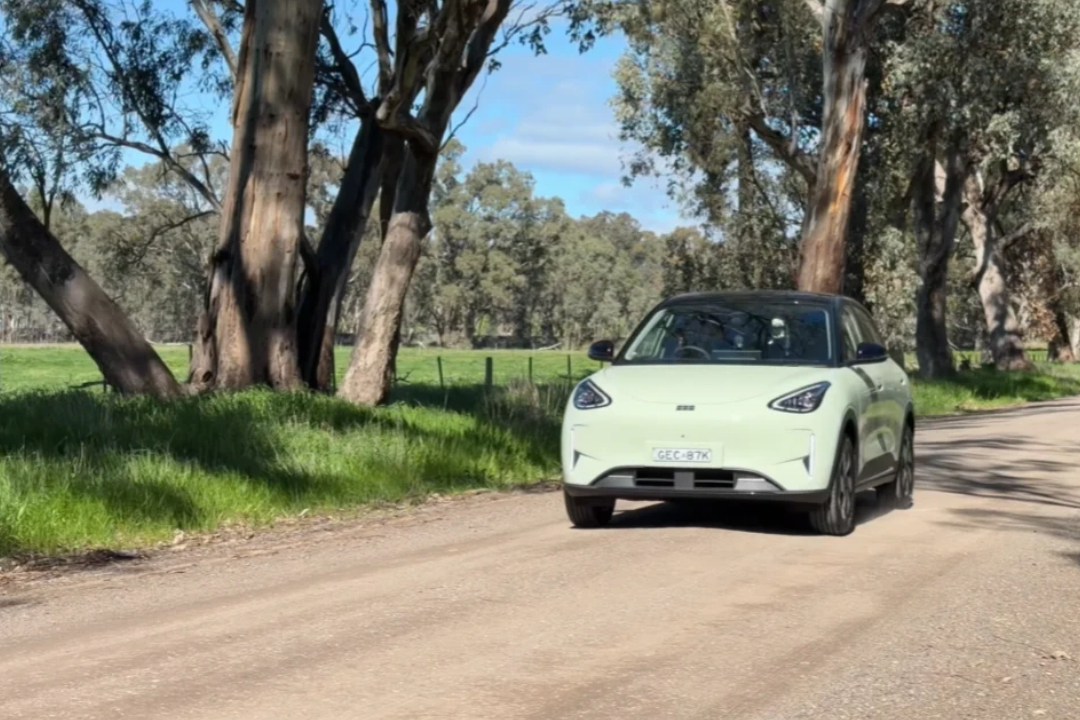
Taking a small city-focused EV on a nearly 420-mile road trip sounds like a good way to find its limits. That was exactly what CarSauce host Matt Brand wanted to do with the Geely EX2, driving from Melbourne to Albury and back in a single day.
The EX2 has a 47.1-kWh LFP battery and a claimed 345 km of WLTP range. Brand expected highway driving, cold weather, two people and camera equipment to make life difficult. Instead, the car itself turned out to be surprisingly capable. The biggest problems came when it was time to charge.
The little Geely was more efficient than expected
Brand started the trip with the EX2 showing 97% charge and an estimated 287 km of range based on its current usage. The first leg to Euroa was roughly 150 km, with the car traveling at typical Australian highway speeds.
The conditions were not particularly favorable for a small city EV. The car was carrying two people and camera equipment, the air conditioning was running and the GPS speed reached about 113 km/h. Even so, the EX2 averaged 15.6 kWh per 100 km during the early part of the drive, with the previous 50 km showing just 14.3 kWh per 100 km. Brand had expected something closer to 17 or 18 kWh per 100 km on the freeway.
He was also impressed with the ride and cabin comfort. The adaptive cruise control and lane centering worked well, while the car remained relatively quiet at highway speeds. The EX2 was proving to be much better suited to the long highway run than Brand expected.
Charging was where things got complicated
The first charging stop at Euroa immediately showed the downside of relying on public infrastructure. The EX2 can accept up to 80 kW of DC charging, but the charger they found was limited to about 40 kW.
Things got worse when the charging station began throwing network errors. The first attempt ended almost immediately, with the car showing that charging had stopped. After trying again, it eventually began pulling around 39 kW. Brand spent about 40 minutes charging to 90%.
The small battery helped here. Because the EX2 does not have a huge battery to fill, even a slower charger did not completely derail the trip. Brand also pointed out that a larger-battery EV could spend much longer waiting at the same charging speed.
The return trip exposed the real problem
After reaching Albury with 29% battery remaining, the EX2 was still performing well. Over the 324 km drive there, it averaged about 16.4 kWh per 100 km despite the high speeds and cold conditions.
The second charging stop was a much better experience. The EX2 pulled around 79 to 80 kW consistently, reaching full charge in about 40 minutes. Brand said the charging performance was impressive, particularly because the car maintained close to its maximum rate for much of the session.
The problems returned later on the drive home. As temperatures dropped after sunset, efficiency worsened. The trip computer showed 19.5 kWh per 100 km over one 50-km stretch, while the overall figure was around 17.1 kWh per 100 km. With the battery down to 16%, Brand was starting to cut things close.
Then he reached another charging station and found the available chargers occupied. After waiting and moving charging cables around, the station turned out to have more capacity than its display initially suggested. Once plugged in, the car again ran into a communication error and stopped charging. After another attempt, it finally worked.
The Geely made it home, but charging needs work
After 671 km of driving, the EX2 made it back to Melbourne with 30% battery remaining. The entire day lasted around 11 and a half hours, including 7 hours and 20 minutes of actual driving and 2 hours and 7 minutes spent charging.
Brand’s final calculations put the car’s real-world consumption at about 19 kWh per 100 km for the entire trip. That included high highway speeds, winter temperatures, two occupants, camera equipment and a headwind on the return trip. Around town, the EX2 was considerably more efficient, using roughly 11.6 kWh per 100 km.
The result was not the EV failure the test could have produced. The EX2 handled the distance, remained comfortable and never suffered a mechanical or battery failure. The frustrating part was finding reliable public chargers and getting them to work consistently. For a car designed primarily for city driving, the Geely EX2 proved it could handle a much longer trip. The charging network was the part that struggled to keep up.
More from Fast Lane Only
- Unboxing the WWII Jeep in a Crate
- 15 rare Chevys collectors are quietly buying
- 10 underrated V8s still worth hunting down
- Police notice this before you even roll window down
*Research for this article included AI assistance, with all final content reviewed by human editors.