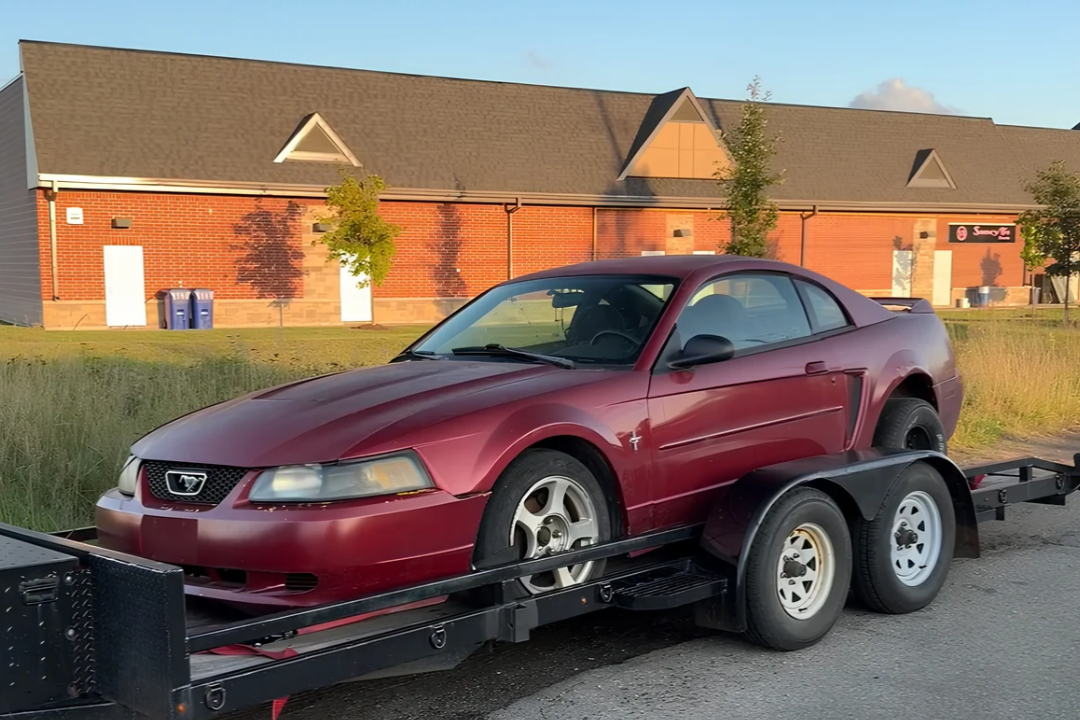
Facebook Marketplace listings rarely undersell how bad a car actually looks in person, but this one somehow still managed to surprise its buyer. A red Ford Mustang, listed at $1,000 with paint faded and chipped enough that the buyer wondered whether yellow was showing through underneath, had been sitting parked on blocks long enough to grow cobwebs on its wheels. The seller claimed it had only been sitting for a week. Nobody looking at it believed that for a second.
The buyer, a YouTuber who runs the channel Clue Cars, wasn’t looking for a clean project car. He was chasing a specific formula that had already worked for him once: buy something cheap and rough, fix it up just enough to move, then trade upward, car by car, toward something considerably nicer. Years earlier, that exact process had taken him from a 350Z to his current Nissan GT-R. This time, the target sitting at the end of the chain was a C7 Corvette, and the Mustang was meant to be step one.
Talking a $1,000 asking price down to $350
Negotiating in person went about as well as the car’s condition suggested it should. The seller opened by explaining his own pricing logic bluntly: list it at $1,000 so people show up to look, then quietly accept less. Recognizing a car this rough wasn’t worth anywhere near the sticker number, the buyer pushed back hard, countering at $300 cash. After a short back-and-forth landing briefly at $350, the two settled there, walking away with a genuine barn-find manual Mustang, dead battery, dented fender, mismatched paint, and a busted tail light included, for barely a third of the original asking price.
The manual transmission mattered more than it might sound. This particular Mustang runs a V6 rather than a V8, a detail the buyer had already resigned himself to before ever seeing the car in person, but the manual gearbox was a pleasant surprise that added genuine appeal for a future buyer looking specifically for something to drift.
A car that fought back before it even started
Getting the Mustang loose from where it sat turned into its own separate ordeal. The car was parked directly on blocks, wheels not touching the ground, and freeing it required an electric winch mounted on the trailer along with a crowbar to physically pry it loose once the winch hook got wedged awkwardly into the frame. Loading it onto the trailer nearly pushed the winch past its limits, straining hard enough that it sounded, by the buyer’s own description, like it was about to fail outright.
The trip back to the shop came with its own absurd complication. With the hood already shut and the battery completely dead, there was no way to pop it open once the car was strapped to the trailer, and the driver’s door design left him physically trapped inside the cabin for the entire ride back, unable to climb out through either the door or the trunk.
Getting it to run, then immediately breaking it
Back at the shop, actually starting the engine meant working through a genuine mystery. A booster pack provided the initial jolt of power, but the car refused to fire until a hidden kill switch, discovered almost by accident, was located and disengaged. Once it finally caught, the engine ran, though it sounded, in the buyer’s own words, like a tractor rather than a Mustang.
That small victory didn’t last long. While addressing the car’s mismatched wheels, a missing tire eventually turned up in the trunk, along with a spare muffler and a broken tail light nobody had budgeted time for. But it was the radiator that delivered the real setback. Mid-repair, coolant started pooling visibly underneath the car, accompanied by smoke, confirming the radiator had blown entirely. The car got one quick test drive anyway, blown radiator and all, mostly out of stubborn curiosity rather than any real plan.
Cleaning up a car nobody had touched in years
With the mechanical basics sorted enough to move the car under its own power, attention shifted to simply making the interior tolerable. The cabin had been packed with old trash and grime thick enough that the buyer doubted the seller’s one-week timeline entirely, guessing the car had more likely sat neglected for years, possibly closer to a decade. A thorough wipe-down with all-purpose cleaner and microfiber cloths took roughly twenty minutes and left the interior in noticeably better shape, even if the exterior paint damage, dents, and mismatched panel work remained untouched for a future session.
None of what’s been fixed so far makes the Mustang anywhere close to trade-ready. A new radiator, proper fender replacement, and paint correction all remain firmly on the to-do list. But for $350 spent on a car that arrived on blocks with a dead battery and a hidden kill switch, simply getting it running, driving, and clean enough to sit in without flinching counts as a legitimate first step toward whatever eventually gets traded for a Corvette.
More from Fast Lane Only
- Unboxing the WWII Jeep in a Crate
- 15 rare Chevys collectors are quietly buying
- 10 underrated V8s still worth hunting down
- Police notice this before you even roll window down
*Research for this article included AI assistance, with all final content reviewed by human editors.