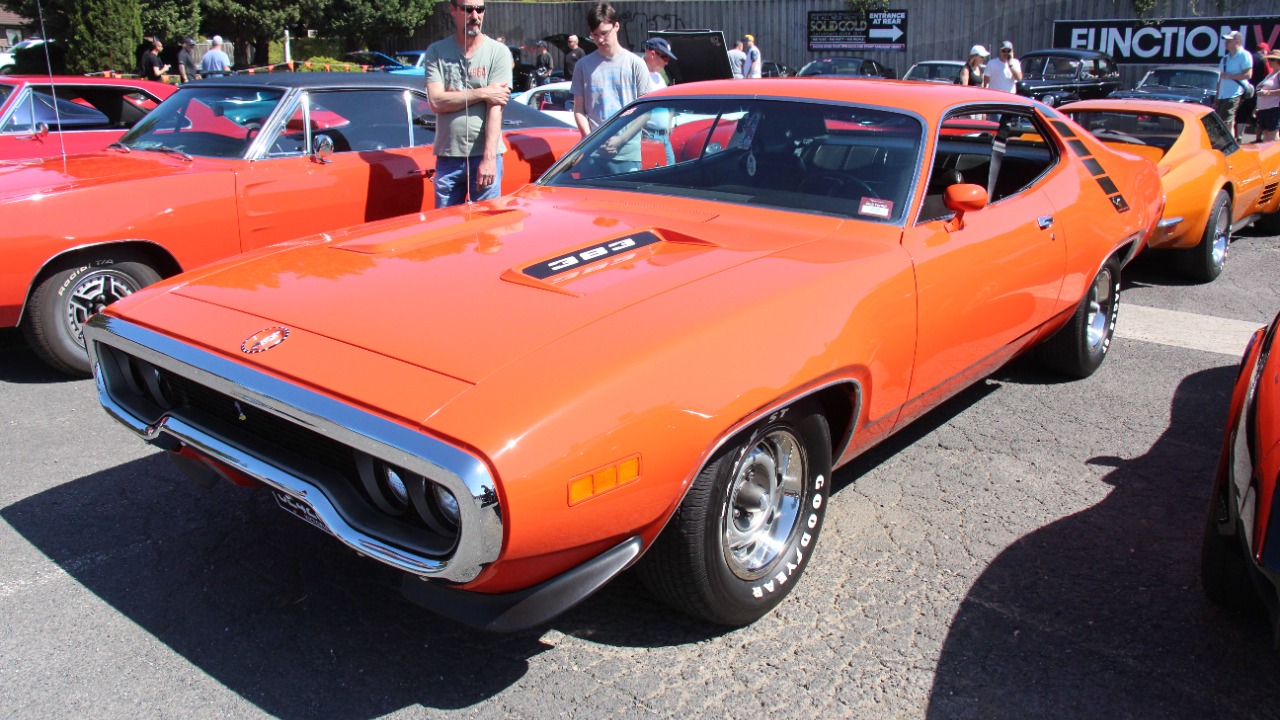
The 1971 Road Runner Hemi arrived just as the original muscle-car wave was cresting, and it did something that still stings for anyone who loves street performance: it priced itself out of the everyday world it was built to dominate. You were no longer looking at a cheap, bare‑bones bruiser, but at a limited, expensive weapon that only a handful of buyers could justify. That shift, more than any single regulation or insurance chart, is why this car now lives mostly in collections and auction tents instead of prowling the boulevard.
If you trace how the Road Runner started as a budget street brawler and ended the Hemi era as a rare, high‑dollar option, you can see the whole story of American muscle in fast‑forward. The numbers, from the original $3,120 base price to modern six‑figure offers, tell you how quickly a working‑class performance car became an unattainable object, even as its legend kept growing.
The budget brawler that got expensive in a hurry
You have to start with the original mission to understand why the 1971 Hemi version feels like a betrayal of its own roots. The Plymouth Road Runner was introduced as a stripped, affordable way to get serious performance, a car that cut frills so you could afford speed. By 1971, that formula was under pressure from rising insurance premiums and tightening emissions rules, yet the factory still offered the legendary Hemi as the ultimate option. The catch was that the engine and mandatory supporting hardware pushed the sticker far beyond the basic street‑racer crowd the nameplate was built for.
Period pricing makes the shift clear. Contemporary specs list the 1971 Plymouth Road Runner with a base Price of $3,120, a figure that did not yet account for the costly Hemi option and other extras listed under Options. Once you layered on that engine, heavy‑duty driveline parts, and the required performance equipment, you were no longer shopping in the same aisle as a basic small‑block Road Runner. You were in the realm of specialty hardware that a typical young buyer, already facing higher insurance, could barely touch.
Why the 426 HEMI turned from street hero to rare privilege
Under the hood, the car’s character was defined by the same Hemi that had terrorized drag strips for years. The big‑chambered V8 was rated at a nominal 425 bhp in earlier applications, and the Auto Editors of describe how that same basic Hemi architecture carried into the 1971 package. By then, the engine’s reputation was so outsized that it almost guaranteed higher premiums and a narrower buyer pool. You were paying not just for parts, but for the privilege of owning a street‑legal version of a racing engine.
That exclusivity was baked into the production run. Reporting on a Plum Crazy survivor notes that Plymouth built only 200 Hemi cars that year, split among 55 Road Runners, 30 GTXs, and 115 Cudas, with Each car carrying the same dual four‑barrel setup and brutal torque. When you realize that only 55 Road Runners left the factory with this engine, it becomes obvious why you rarely saw one idling at a stoplight. The Hemi had effectively moved from being a wild option you might actually order to a near‑mythical configuration that most enthusiasts only heard about.
1971 as the last true HEMI Road Runner year
By the early 1970s, the writing was on the wall for big‑cube, high‑compression street engines. Enthusiasts now look back at 1971 as a turning point, and not by accident. A widely shared Collectability note spells it out plainly: 1971 was the last year for the 426 HEMI in the Road Runner, which makes those versions especially valuable. Once that engine disappeared from the order sheet, the car’s identity shifted from raw, race‑bred terror to a more conventional performance coupe trying to survive in a changing market.
The same pattern shows up across the Mopar lineup. A broader look at the golden age of muscle points out that the 1971 Plymouth Hemi ‘Cuda marked the Final year for the 426 Hemi in production cars. When you connect that fact to the Road Runner’s own cutoff, you see how quickly the entire Hemi program retreated from the street. The engine that had once been a calling card for accessible performance became a short‑run swan song, and the 1971 Road Runner Hemi sits right at the center of that exit.
How rivals and regulations boxed the Hemi Road Runner in
Even as the Hemi era was winding down, the broader muscle‑car field was still trying to keep big‑block performance alive. Coverage of the period notes that There were a few big‑block machines that came later, most notably the 1973‑74 Pontiac SD 455 Firebirds and Trans Ams. Those cars, wearing the Pontiac SD badge, tried to thread the needle between emissions compliance and performance, but they also signaled that the era of wild compression ratios and race‑spec cams was ending. Against that backdrop, the 1971 Hemi Road Runner looks less like a mainstream product and more like a last stand.
At the same time, the Road Runner’s own pricing and positioning made it harder for you to justify as a daily driver. The Hemi option was never cheap, and when you add the reality that insurers were targeting cars with the HEMI name and Road Runner reputation, the total cost of ownership ballooned. The Base price of $3,120 was only the starting point, and once you layered in the Hemi and other Options, you were well into a territory where a more sensible big‑block or even a rival Pontiac SD package might look like a better compromise. The result was predictable: very few buyers stepped up, and the Hemi Road Runner quietly slipped out of the showroom catalog.
From $3,100 sticker to six‑figure temptation
Ironically, the same factors that kept the 1971 Hemi Road Runner off the street are what make it so coveted now. A widely shared survivor story describes an original owner who Paid $3,100 for his Hemi Road Runner and later Refused an offer of $750 From World Biggest Moparhead, a shorthand way of capturing a much larger six‑figure bid. When someone turns down that kind of money, it tells you the car has crossed from transportation into heirloom territory. You are no longer talking about what it costs to own one, but what it means to let one go.
That leap in value is tied directly to how few of these cars were built and how quickly the 426 HEMI disappeared from regular production. Enthusiasts now treat the 1971 Hemi Road Runner as one of the last true golden‑era muscle cars, a machine that was already too expensive and too specialized for the average street scene even when new. If you are lucky enough to see one outside a museum or auction, you are looking at a car that started life as a pricey outlier and ended up as a blue‑chip collectible, proof that sometimes a car really can price itself out of the street and into legend.
More from Fast Lane Only