For a brief moment in the late 1970s, a bright red Dodge pickup with chrome stacks and gold lettering became the unlikeliest performance hero in America. The Dodge Lil’ Red Express arrived just as muscle cars were fading, used a regulatory loophole to outgun sports cars, then disappeared almost as quickly as it had roared onto the scene. Its strange rise and quiet fall trace not only the story of a single truck, but also the end of an era in American performance.
Today the Lil’ Red Express is remembered as both a clever act of corporate rebellion and a precursor to the modern performance pickup. Its production run lasted only two model years, yet its mix of outlaw attitude, marketing flair, and genuine speed has given it a legacy far larger than its build numbers suggest.
A loophole, a pickup, and the “last American hot rod”
The Lil’ Red Express was born out of a regulatory gray area at a time when emissions rules were strangling traditional muscle cars. Dodge realized that trucks over a certain gross vehicle weight rating were exempt from some passenger-car emissions requirements, including the need for catalytic converters, and that gap in the rulebook became the foundation for a factory hot rod pickup. Contemporary accounts describe how Dodge used this opening so the Lil’ Red Express did not have catalytic converters, effectively sidestepping the strictest controls that had dulled performance elsewhere.
That decision gave the truck real power at a moment when horsepower figures were collapsing. The specially tuned 360 cubic inch V8 in the Lil’ Red Express produced 225 horsepower and 295 pound-feet of torque, numbers that stood out in a landscape of detuned engines and low compression ratios. Period pricing put The MSRP on the LRE in 1978 at “almost $7,000,” positioning it as an attainable performance vehicle rather than an exotic toy. Later enthusiasts would describe the Lil’ Red Express as the “Last American Hotrod,” a label that captured how it kept the spirit of big-engine, small-body performance alive just as that formula was vanishing from showrooms.
From “Little Red Truck” to outlaw style icon
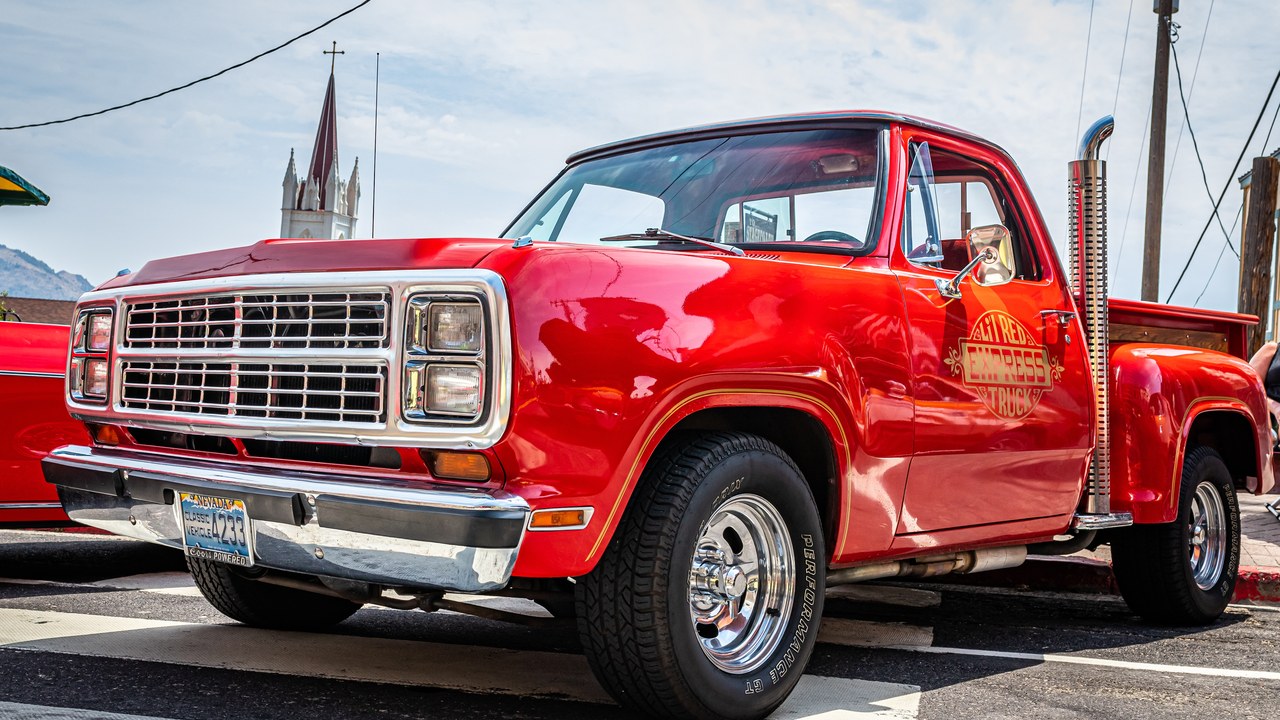
Even before anyone checked the spec sheet, the Lil’ Red Express made a statement visually. Early marketing material simply called it the “Little Red Truck,” a name that emphasized its playful, almost cartoonish appearance. The production trucks wore vivid red paint, gold door graphics, bright chrome bumpers, and polished slotted wheels, details that set them apart from workaday pickups. Behind the cab, twin vertical exhaust stacks rose above the bed rails, giving the truck a semi-truck silhouette that signaled its intent even at idle.
Those stacks were not just decoration. The exhaust system used Two-and-a-half-inch pipes that ran into Hemi-style mufflers, then turned upward into the chrome chimneys that defined the truck’s profile. The setup gave the Lil’ Red Express a distinctive bark and helped cement its reputation as a street brawler, even if some trucks reportedly ran afoul of local noise standards. Combined with wood-trimmed bed sides and period graphics, the package turned what could have been a simple loophole special into a rolling billboard for Dodge’s rebellious streak.
Faster than a Corvette, and officially the quickest American vehicle
For all the visual drama, the Lil’ Red Express would not have become a legend if it had been slow. Testing in 1978 showed that The Dodge Lil’ Red Express was the fastest American made vehicle from 0 to 100 MPH as tested by Car and Driver, a remarkable feat for a pickup that weighed more than many coupes. Other period reports noted that, though it may not have looked like it was faster than a Corvette, the Red Express was reported to be the quickest American vehicle of its day in certain acceleration measures. In an era when performance badges often masked mediocre numbers, the truck’s straight-line speed backed up its swagger.
The secret lay in the combination of that uncorked 360 V8, relatively short gearing, and the absence of catalytic converters that sapped power in rival models. Dodge’s decision to exploit the emissions classification for heavier trucks meant the Lil’ Red Express could breathe more freely than contemporary sports cars that had to comply with stricter standards. The result was a vehicle that could out-accelerate some of the most recognizable performance nameplates of the period, a fact that has fueled its reputation as a sleeper pickup that “ruled the streets” despite its flamboyant appearance.
A two-year run and a swift regulatory reckoning
Despite its performance and publicity value, the Lil’ Red Express was never destined for a long production life. Dodge released the Li’l Red Express Truck between 1978 and 1979, and the first year’s run was modest by mass-market standards. A total of 2,188 were built for the truncated 1978 model year, a figure that reflects both the experimental nature of the project and the uncertainty around how buyers would respond to such a specialized pickup. Those early trucks featured single round headlights and the full benefit of the emissions loophole that had inspired the program.
For 1979, Dodge revised the styling with quad rectangular headlights, an altered grille and hood, and other detail changes that made the second-year trucks visually distinct from their predecessors even though the basic concept remained the same. Behind the scenes, however, regulators were closing in. The over-3-tons-no-cats exemption that had allowed the truck to run without catalytic converters was permanently sealed for most light-duty vehicles, and with that change the foundation of the Lil’ Red Express program disappeared. Without its regulatory advantage, the truck would have become just another mildly warmed-over pickup, and Dodge quietly ended production after the 1979 model year.
Legacy: cult classic and performance-truck ancestor
The Lil’ Red Express slipped out of showrooms as quickly as it had arrived, but its influence has lingered. Later commentators have described Meet the Dodge Lil’ Red Express as a fierce “last American hot rod” that challenged the narrative of muscle’s demise in the late 1970s, and that framing helps explain its enduring appeal among collectors. The truck’s combination of vivid styling, authentic performance, and a backstory built on outsmarting the EPA has turned it into one of the most discussed classic pickups of its era. Some enthusiasts argue that The Dodge Li’l Red Express is among the most underrated American trucks ever sold, noting that values and recognition have often lagged behind its historical importance.
Beyond nostalgia, the Lil’ Red Express can be seen as an early template for the factory-built performance trucks that would follow in later decades. Later analysis has called the Dodge Li’l Red Express the grandfather of factory-built performance trucks, crediting it with showing that there was a market for pickups that were as much about speed and image as payload. Modern sport trucks, from street-tuned half-tons to supercharged halo models, owe a conceptual debt to that short-lived Dodge experiment. The strange rise and quiet fall of the Lil’ Red Express, compressed into just two model years, left behind a legacy that still rumbles through the performance truck world today.
More from Fast Lane Only