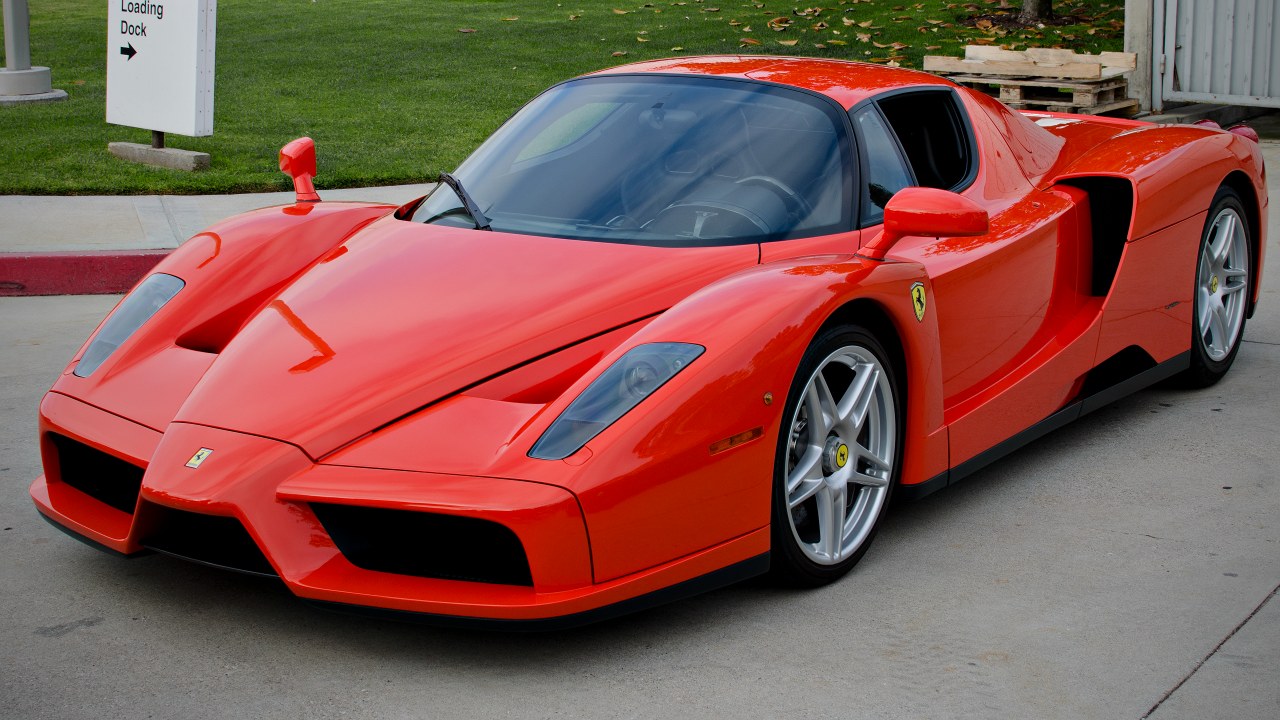
The 2002 Ferrari Enzo marked a turning point for Maranello’s road cars, taking the rarefied “halo” concept and rebuilding it around a full carbon fiber structure. Instead of simply borrowing styling cues from Formula 1, Ferrari used the Enzo to transplant core race technologies into a road‑legal chassis in a way it had never done before. The result was a limited production flagship that reset expectations for how extreme, and how technically pure, a Ferrari road car could be.
By the time the Enzo reached customers for the 2003 model year, Ferrari had already experimented with composites on earlier specials, but none had gone as far in making carbon fiber the backbone of the car. The Enzo’s construction, aerodynamics, and powertrain were all engineered around that lightweight tub, turning the car into a rolling demonstration of what happened when Formula 1 thinking met a street registration plate.
From F40 and F50 to a carbon fiber revolution
Ferrari did not arrive at the Enzo’s carbon structure overnight, and the car sits at the peak of a clear development arc that began with the turbocharged 288 GTO and F40. Those earlier flagships used tubular steel frames with composite bodywork, and in the case of the F40, Ferrari strengthened key areas with materials such as Kevlar to increase rigidity without a huge weight penalty. Reporting on Ferrari’s flagship line notes that the 288 GTO’s abandoned Group B racing design was repurposed for the F40, with Pininfari reshaping it into a road car and Ferrari layering in composite reinforcements where the steel needed help.
The next step was the F50, which moved closer to Formula 1 practice by adopting what Ferrari describes as an F1‑like carbon fibre monocoque for a road car. In official material on the Ferrari GTO’s replacement, Ferrari highlights that the F50 was among the first road‑legal models to use a carbon fibre monocoque similar to that used in single‑seaters, and it also introduced carbon fibre‑reinforced ceramic brake discs to the series. That car still blended its carbon tub with other structural elements, but it set the template: the halo Ferrari would no longer be just a powerful engine in a steel frame, it would be a technology carrier for the company’s most advanced materials.
The Enzo’s full carbon fiber monocoque
With that groundwork laid, the Ferrari Enzo became the first Ferrari road car to commit fully to a carbon fiber monocoque as its core. A detailed history of Ferrari and carbon fiber notes that the Enzo, built between 2002 and 2004, was the first road‑going Ferrari to feature a full carbon fiber monocoque, taking direct inspiration from the company’s Formula 1 chassis design. Instead of treating carbon as a supplement to metal, Ferrari made it the primary load‑bearing structure, which allowed engineers to chase both stiffness and weight reduction in ways that were not possible with the earlier tubular frames.
Ferrari’s own technical description of the model lists the frame as a carbon‑fibre and Nomex honeycomb monococque, a construction that sandwiches lightweight Nomex cores between carbon skins to create a very rigid yet relatively light tub. That structure formed the central safety cell around the driver and passenger, with the engine and suspension mounted to it, mirroring the layout of contemporary Formula 1 cars. The front suspension used independent push‑rod, unequal‑length wishbones with coil springs and telescopic dampers, again echoing single‑seater practice and taking full advantage of the stiffness that the carbon tub provided.
Formula 1 technology at its sharpest
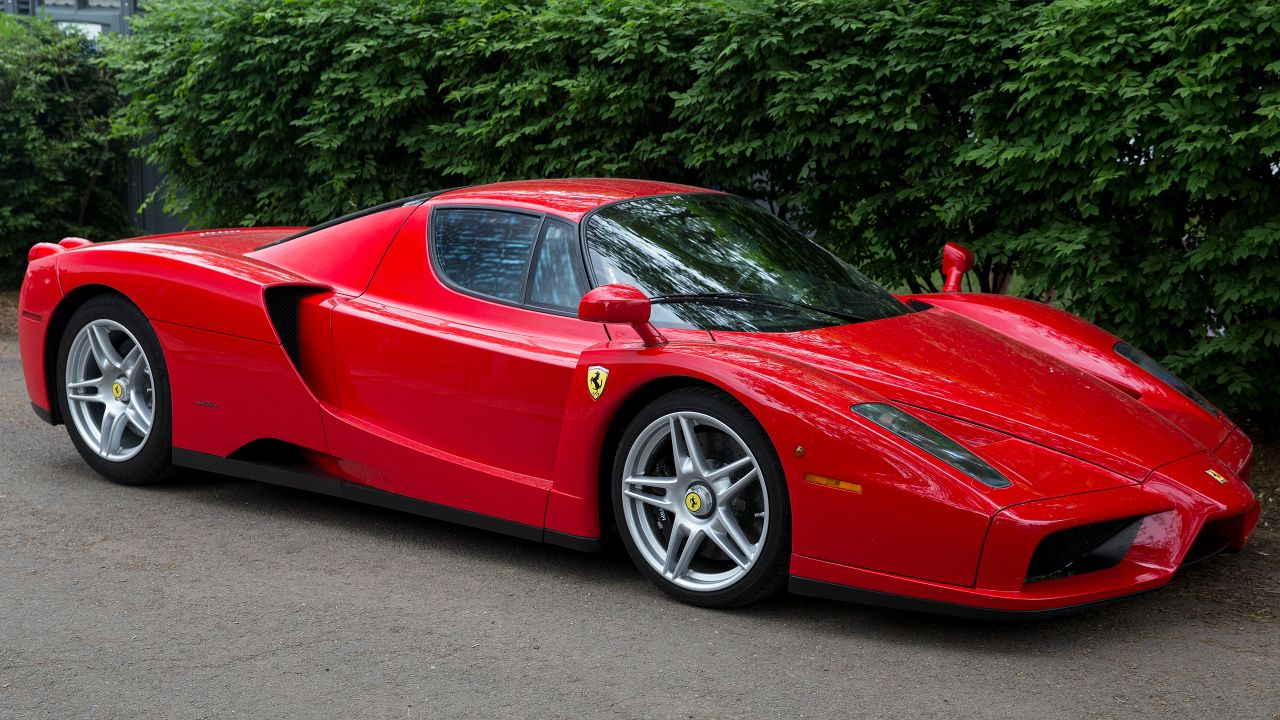
The Enzo arrived at a moment when Ferrari’s Formula 1 program was technically dominant, and the car reflects that timing in its engineering choices. Contemporary commentary on the model notes that The Ferrari Enzo was built when Formula 1 technology was at its sharpest, and that its chassis is a full carbon‑fiber tub with race‑inspired suspension and packaging. I see that as crucial context: the car was not simply styled to look like a racer, it was conceived as a road‑legal expression of the same design logic that shaped Ferrari’s single‑seaters of the era.
Financial and enthusiast analyses of the model underline how deeply that F1 thinking ran. One review describes the Enzo as a mid‑engine machine that, like other Ferrari supercars, borrowed heavily from F1 experience in its chassis layout and materials. The piece highlights F1 Chassis Tech as a defining trait, noting that the Enzo’s structure and suspension geometry were direct beneficiaries of Ferrari’s racing research since the late 1990s. Combined with the carbon‑fibre and Nomex honeycomb monococque detailed in Ferrari’s own specifications, those reports support the view that the Enzo was less a traditional grand tourer and more a detuned prototype racer adapted for public roads.
High‑tech halo: performance built around the tub
The Enzo’s performance envelope only makes sense when viewed through the lens of that carbon structure. A retrospective on the High Tech Halo Ferrari Enzo notes that the car launched in 2002 for the 2003 model year with a clean‑sheet design that did not have to work around legacy packaging constraints. By starting with the carbon tub and building outward, Ferrari’s engineers could position the mid‑mounted V12, fuel system, and cooling hardware exactly where they wanted for weight distribution and airflow, rather than compromising to suit a steel frame that had been adapted from another model.
Ferrari’s official data underline how comprehensively the car’s dynamics were tied to its structure. The carbon‑fibre and Nomex honeycomb monococque provided the rigidity needed for very aggressive suspension tuning, with the independent push‑rod front suspension and matching rear layout calibrated to exploit the tub’s stiffness. Performance figures such as the quoted 0 to 1000 meters in 19.60 seconds are not just a function of engine output, they are the product of a chassis that can put that power down efficiently while keeping the car stable at very high speeds. In my view, that is what justifies calling the Enzo a halo car built around carbon fiber: the material is not a marketing flourish, it is the foundation of the entire performance package.
Legacy in Ferrari’s carbon fiber story
Looking back from today, the Enzo’s most enduring contribution is how it normalized a full carbon monocoque for Ferrari’s top‑tier road cars. The history of Ferrari and carbon fiber explicitly identifies the Ferrari Enzo as the first road model to use a full carbon fiber monocoque, and positions it as a bridge between earlier experiments and the later generation of hybrids and hypercars. By proving that customers would accept, and pay for, a road car whose structure was essentially a race tub with number plates, The Enzo gave Ferrari the confidence to keep pushing composites deeper into its lineup.
That legacy also reframes the earlier specials. The narrative that runs from the 288 GTO through the F40 and F50 to the Enzo, described in coverage of Ferrari’s flagship machines, shows a steady migration from steel frames strengthened with Kevlar and other composites to full carbon tubs. Its Ferrari GTO replacement, the F50, had already introduced an F1‑style carbon monocoque, but it was the Enzo that made carbon fiber the non‑negotiable core of a Ferrari halo car. When I look at the company’s subsequent use of carbon in both limited‑run flagships and more mainstream models, it is clear that the 2002 Enzo was not just another supercar, it was the moment Ferrari committed its road‑car future to the same composite technology that had defined its Formula 1 success.
More from Fast Lane Only: