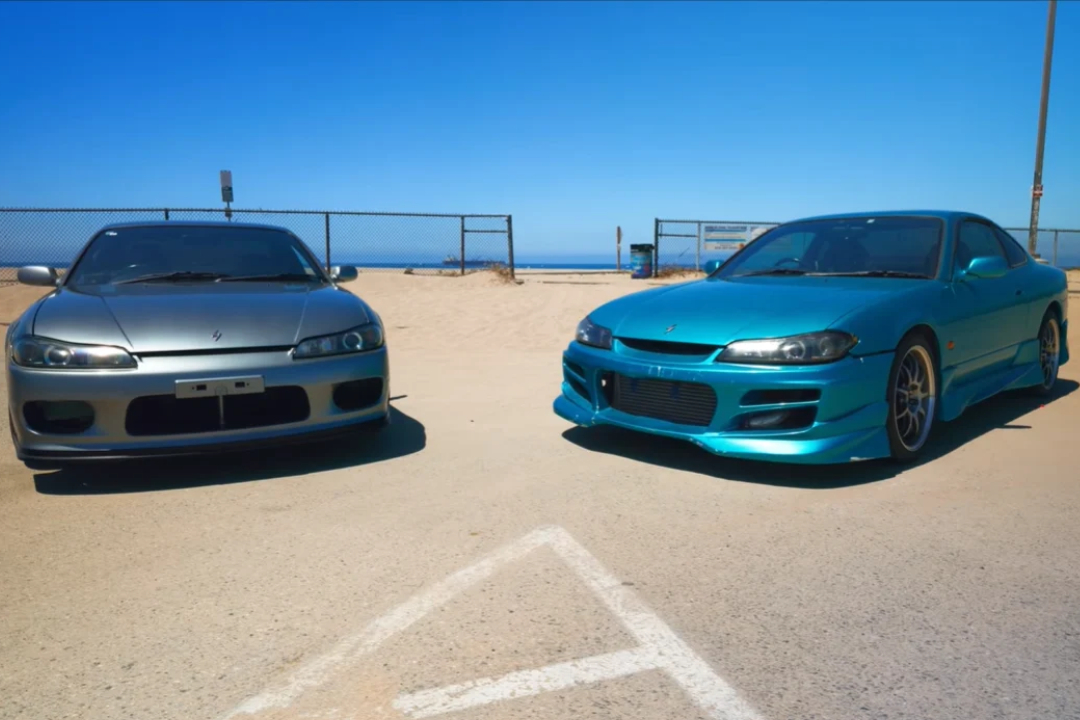
For years, the Nissan Silvia S15 was one of those Japanese cars Americans could only admire from a distance. Now that early examples are old enough to legally import, buyers have a choice: spend serious money on a professionally sourced car or take a gamble on a cheaper example from a salvage auction.
Donut decided to find out whether paying nearly $50,000 really gets you that much more car. The team bought two nearly identical S15s, with one coming from specialist importer Top Rank for about $48,000 and the other coming from Copart for $18,000, or about $21,000 after taxes and fees. Then they drove them, put them on a lift and strapped both to a dyno.
The $18,000 S15 came with plenty of baggage
The Low Car is a 2001 Nissan Silvia with about 160,000 kilometers. Donut paid $18,000 for it through Copart and ended up around $21,000 all-in. It immediately showed why it was so much cheaper. The bumper was damaged, cracks ran through much of the body kit and the interior had plenty of wear. Still, there were signs that someone had cared about the car before it reached the auction, including Work wheels and other modifications. The team felt the car had good bones, but driving it revealed a much rougher experience than the expensive S15.
The clutch felt heavy and squishy, while the car was noticeably louder and rattlier. When the team put it on the lift, Low Car showed more rust than High Car, along with a damaged tie-rod end that was leaking. Various lines and components underneath also looked weathered. It was not a disaster, but it was clearly going to need attention before it could match the condition of the other S15.
The $48,000 S15 was expensive for a reason
High Car is a 2000 Nissan Silvia Spec R with around 150,000 kilometers. Donut bought it through Top Rank, a specialist JDM importer, for about $48,000. That is a huge amount of money for a roughly 25-year-old Japanese sports car, but the team quickly showed what the premium bought. Top Rank had vetted the car before it left Japan, giving the buyer a level of confidence that is difficult to get from an auction listing.
The S15 itself looked excellent. The paint was in great condition, the tail lights were clean, and it had a Nismo exhaust, HKS coilovers and a stock engine. The underside received an eight out of 10 from the team, and the car drove exactly how an expensive import should. The clutch, pedals, throttle, turbo and suspension all felt good, with one host calling it a “good ass car.”
Then the dyno made things awkward
The compression test was where the cheap S15 started fighting back. High Car recorded 150, 125, 145 and 145 psi across its cylinders. The second cylinder was slightly outside the team’s preferred range, but the overall result was still considered healthy. Low Car came back with 150, 140, 145 and 145 psi, giving the salvage-auction car an unexpectedly strong result.
Then came the dyno. High Car initially made 192 wheel horsepower and 182 lb-ft of torque before eventually cracking 200 hp. Low Car had an ugly 173-hp run, but the team found a silencer welded into its exhaust. After removing that restriction, the car produced 202 wheel horsepower. Low Car ended up with slightly more mid-range power and torque, while the top-end figures were almost identical.
The cheap car won the dyno, but not the whole comparison
That left Donut with a ridiculous result: Low Car made one more horsepower while costing about $27,000 less. The auction S15 had also proven that its engine was healthy, despite its rough appearance and questionable history. For a car that cost around $21,000 all-in, that was a pretty impressive showing.
But the dyno could not erase the condition gap. Low Car still had a bad clutch issue, a damaged tie rod, a battered body kit and weathered components underneath. High Car was essentially ready to enjoy. That is the real argument for spending the extra money on a professional import. You are not just paying for horsepower, you are paying to avoid inheriting somebody else’s problems.
The HiLow experiment is far from over, though. Donut plans to keep modifying both S15s throughout the season, with Low Car’s body kit needing repairs and the team looking for more power. High Car may have cost $27,000 more, but after making one fewer horsepower, its owner has already been given a pretty awkward target to beat.
More from Fast Lane Only
- Unboxing the WWII Jeep in a Crate
- 15 rare Chevys collectors are quietly buying
- 10 underrated V8s still worth hunting down
- Police notice this before you even roll window down
*Research for this article included AI assistance, with all final content reviewed by human editors.