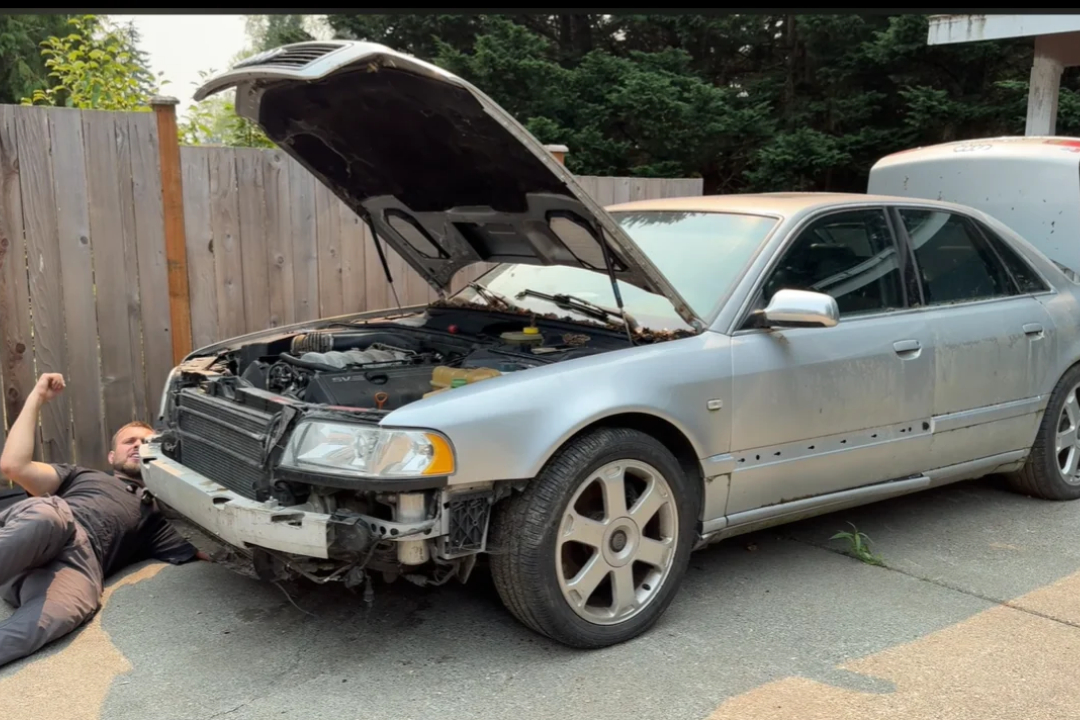
Some cars get abandoned because they’re genuinely broken. This one got abandoned because somebody gave up looking. A 2002 Audi S8 sat parked for eight years over a coolant leak nobody could find, eventually collecting rats, mold, and a thick layer of moss before showing up on Facebook Marketplace for $500. The seller had fifty people lined up to look at it. The buyer showed up at 7 a.m. anyway, sight mostly unseen, betting that whatever killed this car couldn’t be worse than the price suggested.
The reality on arrival was worse than the listing photos, and not because of anything mechanical. A rat jumped out from under the hood during the first walkaround. The interior carried what looked like black mold across the headliner, chewed wiring ran through the engine bay, and the trunk held a small parts store’s worth of spare components, head gaskets, a timing belt, intake and exhaust gaskets, exactly the kind of inventory that suggests a previous owner had already tried and failed to fix something serious. According to the seller, the car ran fine mechanically. It had simply been parked over a coolant leak described as too difficult to reach, rather than actually repaired.
A short circuit before anything else
Getting the car running at all started with basics that quickly turned complicated. The original battery wouldn’t hold a charge, so a $47 reconditioned unit went in as a temporary fix. The moment it connected, the battery terminals and cables started heating up immediately, a clear sign of a short somewhere in the system. Cleaning corrosion off the ground connection helped somewhat, but the real culprit turned out to be the alternator itself, found internally melted and shorting the entire electrical system every time the engine ran.
Sourcing a replacement came with an unexpected discount. The S8’s alternator shares a part number with the one used in the Lamborghini Gallardo, a coincidence that would normally mean paying close to $1,000 for a replacement. Listed under its Audi A8 designation instead, the same part cost roughly $260. A small locator pin had to be transferred from the melted original to the new unit using a spare bolt, but once the 40-foot serpentine belt went back on, the battery terminals stayed cool this time, a strong sign the alternator really had been the source of the original short. A faint burning smell still turned up briefly once the engine ran for a stretch, which the pair debated without reaching a firm conclusion, guessing it might be old accessory bearings or just grease on the new alternator burning off as it broke in. Whatever it was, it faded on its own and didn’t return.
The leak that shouldn’t have existed
With the electrical system largely sorted, the coolant leak that supposedly justified eight years of parking became the next mystery, and it refused to show itself easily. A pressure tester attached to the expansion tank held pressure far better than expected for a car with a supposedly serious leak, dropping only slowly while a small amount of water seeped out near the front of the radiator. That was a confusing result. The car already had a replacement radiator installed, which meant the actual failure point had to be something else entirely, something the previous owner apparently never found either.
The answer arrived violently. While the system sat pressurized, the upper radiator hose blew off completely, spraying hot water everywhere. Inside the hose, wedged where the clamp should have been sealing cleanly, was a leftover fragment of the old radiator’s plastic neck, mixed with dried silicone gasket maker from a previous repair attempt. Someone had reattached the hose without removing broken debris first, guaranteeing it would eventually fail. Trimming about three-quarters of an inch off the damaged hose and reattaching it directly solved the problem outright, a fix that took minutes once the actual cause was visible.
A misdiagnosis worth thousands
What followed was a car that increasingly refused to behave like anything worth abandoning. The temperature gauge on the dashboard stayed stuck on cold no matter how long the engine ran, which looked alarming until a diagnostic scanner showed the actual coolant temperature holding steady between 88 and 90 degrees Celsius, comfortably within the normal range. The gauge itself was likely a wiring problem rather than an engine problem, quite possibly more rat damage between the sensor and the cluster, though that wiring was never physically traced to confirm it.
Every other sign pointed the same direction. No smoke on startup, no water mixing into the oil, no overheating under sustained driving, and a transmission that shifted smoothly all the way to redline. Roughly 13 gallons of eight-year-old gasoline came out of the tank via a slow transfer pump, replaced with fresh fuel that noticeably smoothed out a rough idle within minutes. The car did stall once, coasting the last few feet into a gas station on fumes after the old fuel finally ran completely dry, but it started right back up once fresh gas reached the system.
None of this matched a car that had supposedly been sidelined by a serious, unfixable problem. The spare head gaskets sitting in the trunk suggested a previous mechanic had assumed the worst once a new radiator failed to solve the leak, jumping to a much more expensive diagnosis rather than tracing the actual fault to a mishandled hose repair. A twenty-five-mile test drive afterward turned up nothing to contradict that theory: strong acceleration, a working heater, stable temperatures, and no further leaks.
What had been written off as a $500 parts car with a fatal coolant problem turned out to be a running, driving Audi S8 for the cost of a battery, an alternator, and a few dollars in hose clamps. Whether the original diagnosis was simple bad luck or genuine incompetence, the car that rolled out of eight years of storage ended up worth considerably more than anyone expected, listed afterward for roughly $8,000.
More from Fast Lane Only
- Unboxing the WWII Jeep in a Crate
- 15 rare Chevys collectors are quietly buying
- 10 underrated V8s still worth hunting down
- Police notice this before you even roll window down
*Research for this article included AI assistance, with all final content reviewed by human editors.