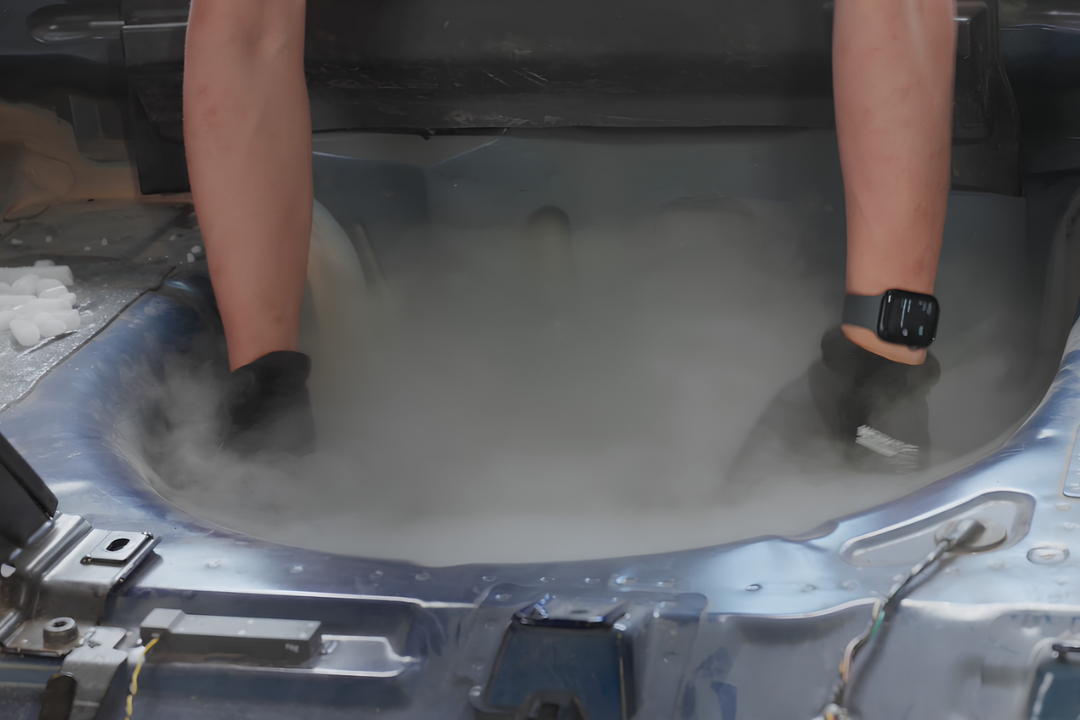
A Ford Fiesta is not exactly the car you expect to see covered in dry ice. But Stan and Ryan were not trying to preserve the interior. They were trying to get rid of it.
The future rally car started at 2,821 pounds, and the Gravel Co. duo wanted to find out how much of that weight they could remove without making the Fiesta completely undrivable. Their plan involved pulling the doors, seats, airbags, interior trim and even the sound-deadening material from the floor.
The strange part was that the sound deadening was one of the hardest things to remove, until they brought out the dry ice.
The Fiesta started with 2,821 pounds to lose
Before reaching for the tools, Stan made a baseline run. The Fiesta managed 0 to 100 in 8.38 seconds, giving the pair something to compare against once the stripping was finished.
Then the teardown began. The battery was disconnected before they started removing the airbags, all four doors came off, and the factory front seats were pulled out. Those two seats alone weighed around 90 pounds. The rear seats, subwoofer, headliner and various interior panels followed.
The doors were especially useful for the project because the car is being prepared for rally competition. The rear doors can eventually be gutted, while the front doors have to retain more of their original structure for the class they are targeting.
Then they froze the sound deadening
The biggest surprise came when they reached the thick bitumen sound-deadening material bonded to the Fiesta’s floor. Removing it normally would have been a miserable job, so the pair tried a trick they had never used before: dry ice.
They spread the dry ice across the metal floor and waited for the material to become extremely cold and brittle. Once frozen, sections of the sound deadening could be chipped away with hammers and scrapers. It was still tedious, but the trick worked, and they eventually pulled 6.5 pounds of the material from the car.
They also removed the side curtain airbags before replacing the factory seats with motorsport bucket seats. Planted Technology supplied chassis-specific brackets for the Fiesta, along with 90-degree side mounts and sliders, so the new seats could be installed without drilling new holes.
The Fiesta lost 454 pounds
With the interior stripped and the new seats installed, the Fiesta went back onto the corner-weight scales. The number was dramatically lower than the 2,821-pound starting point.
The final weight came in at 2,367 pounds, meaning the pair had removed 454 pounds from the car. There was still a problem, though. The Fiesta had no doors or normal mirrors, and the pair wanted to take it out for dinner. They decided the missing doors were not the biggest concern, but the lack of mirrors was. Small convex blind-spot mirrors were attached to the car so they could see behind them.
The lighter Fiesta was about a second quicker
The real test came when Stan repeated the acceleration run. The stripped Fiesta was roughly one second quicker from 0 to 100 than the original 8.38-second run. Ryan pointed out that gaining a full second through weight reduction is comparable to adding a significant amount of horsepower. And for a rally car that will eventually be throwing itself through corners, the benefit goes beyond acceleration.
The Fiesta is still far from its final rally specification. A cage, rally wheels, tires, skid plates and other equipment will add weight back to the car. But the 454-pound reduction gives Stan a much lighter starting point, and the dry ice helped remove one of the more stubborn pieces of unnecessary weight along the way.
More from Fast Lane Only
- Unboxing the WWII Jeep in a Crate
- 15 rare Chevys collectors are quietly buying
- 10 underrated V8s still worth hunting down
- Police notice this before you even roll window down
*Research for this article included AI assistance, with all final content reviewed by human editors.