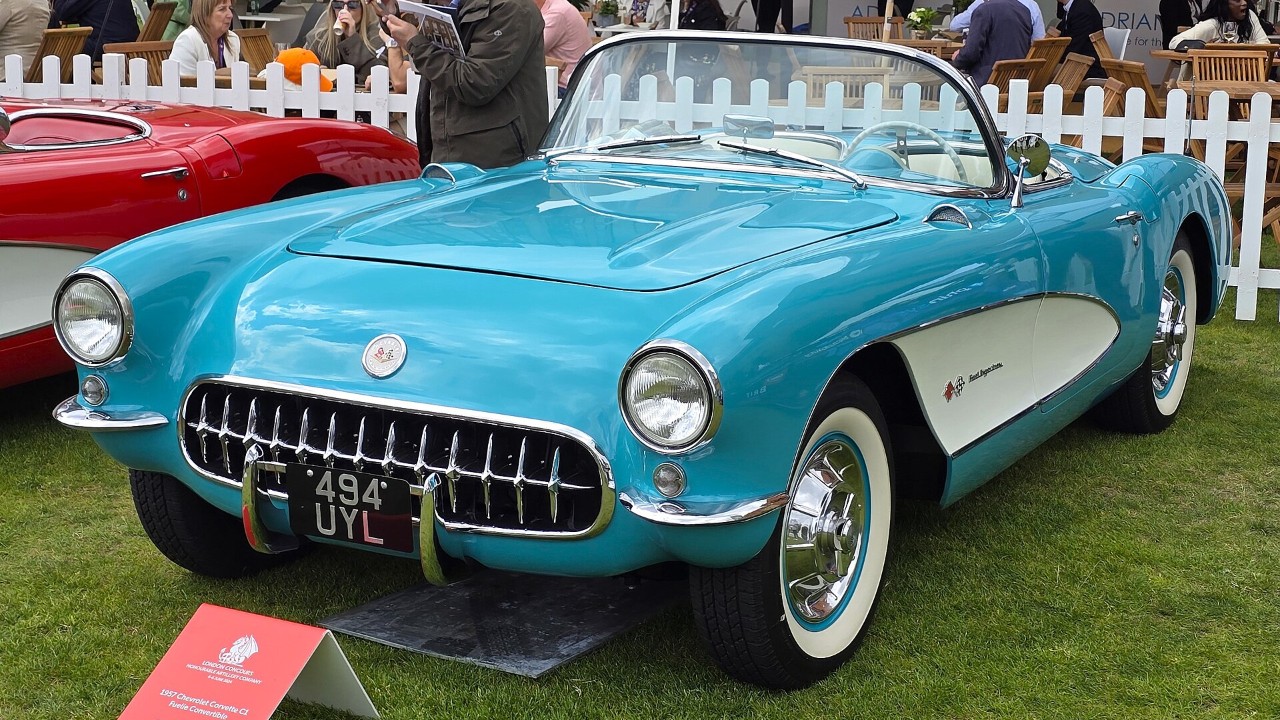
Of the 6,339 Corvettes Chevrolet built for 1957, just 43 left the factory with a fiberglass cold-air box. Enthusiasts call it the 1957 Corvette airbox. It fed cooler outside air to the new fuel injection, and it came bundled with heavy-duty racing parts.
Those 43 cars were, in effect, race cars sold through a Chevrolet order form. They also had no heater and no radio. Here is what the box did, what came with it, and how many reportedly survive.
Fuel injection arrives for 1957

First, the airbox only makes sense next to the engine it fed. For 1957, Chevrolet offered Ramjet fuel injection on the 283-cubic-inch V8. The top version carried a 283 hp rating, so the company could advertise one horsepower per cubic inch.
The National Corvette Museum describes the “283-h.p. senior engine in the Corvette line” and the one-horsepower-per-cubic-inch claim. It also records total 1957 production as 6,339 cars, all convertibles. Hagerty also adds that 1,040 of those Corvettes carried the extra performance options. However, Hagerty’s valuation guide says the 283 hp figure was a promotional rating, and it puts the top fuel-injected engine at 290 hp.
Fuel injection cost extra. RM Sotheby’s catalog for a 1957 fuel-injected car calls it a $500 option that 1,040 buyers ordered. So by that count, the 43 airbox cars were about 4% of the fuel-injected Corvettes. The same catalog credits Zora Arkus-Duntov, who joined the Corvette team a month before production began in 1953, with turning the car into a serious sports car.
What the 1957 Corvette airbox did
On a regular fuel-injected car, the engine breathed hot air from under the hood. The airbox, however, changed that. According to Corvettes.nl, the system used “somewhat crude, practically hand laid up” fiberglass ductwork attached to the left inner fender.
A hole in the left side of the radiator support let outside air into the duct. Cooler air is denser, so the idea was more power from the same engine. Meanwhile, the same site notes that all other 1957 fuel-injected engines drew hot air straight from the engine compartment.
CorvSport describes the same part as a fiberglass intake plenum on the driver-side inner fender. It also calls the package a “special sealed air intake system” built for racing.
A race package on the order form
The airbox came as part of a package rather than on its own. Corvettes.nl says the 43 cars carried both RPO 579E, which included the airbox, and RPO 684. In other words, the buyer got heavy-duty everything.
Meanwhile, CorvSport lists what RPO 684 added. It brought heavier front coil springs, an extra rear leaf spring, finned brake drums with metallic linings and “elephant ear” brake scoops. CorvSport also says the airbox option was available only with the new Borg-Warner four-speed manual. The site calls that gearbox Chevrolet’s first four-speed.
The rest of the specification was just as focused. LSX Magazine lists a 283-cubic-inch V8 with Rochester Ramjet fuel injection, 283 hp at 6,200 rpm and 300 lb-ft at 3,000 rpm. It also gives a Positraction rear axle with a 4.11:1 ratio and an 8,000 rpm tachometer.
Comfort items, by contrast, went away. In fact, both LSX Magazine and CorvSport list the heater and radio as deletions. Corvettes.nl also says a clamp held the tachometer on the steering column. CorvSport also notes revised spark plug wire routing, without the shielding used on regular-production cars.
Under the hood, CorvSport describes the engine as a “Duntov-cammed” fuel-injected 283. Put together, the airbox car paired the range-topping fuel-injected engine with RPO 684’s heavier chassis parts and the new four-speed.
How rare the airbox cars are
In the end, all three sources agree on 43 cars. LSX Magazine puts it plainly: “Only 43 of the 6,339 Vettes made in 1957 were sold with the ‘airbox’ option from the factory.” That works out to well under 1% of the year’s production.
Most of them went racing. CorvSport says most of the 43 were “destined for competition.” Still, the code itself causes some confusion, because one CorvSport summary prints the option as 579D while its spec list says 579E.
Survivors are scarce. LSX Magazine says “only 17 or 18 of these original ‘airbox’ cars” survive, though no second source read for this story confirms that count. Its SEMA 2017 report showed one of them at the Chevrolet Performance booth, and the headline credits that car to Rick Hendrick.
For comparison, a regular fuel-injected car is already valuable. RM Sotheby’s sold a fuel-injected 1957 Corvette, not described as an airbox car, at Hershey in 2018 for $159,500.
More from Fast Lane Only
- Unboxing the WWII Jeep in a Crate
- 15 rare Chevys collectors are quietly buying
- 10 underrated V8s still worth hunting down
- Police notice this before you even roll window down
This article was created with the help of AI and was reviewed and edited by Fast Lane Only editors before publication.