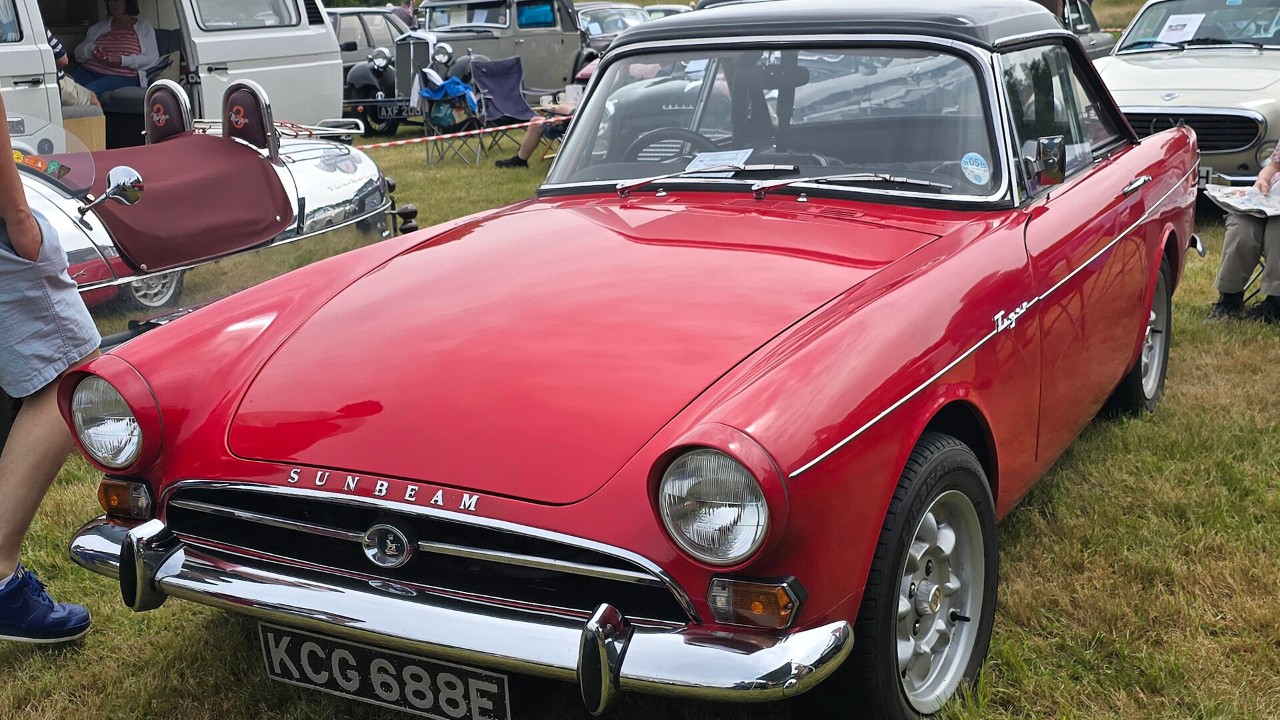
Sunbeam Tiger production lasted barely three years, and its ending came down to a corporate takeover. Rootes built the V8 roadster from 1964 to 1967, using a Ford engine. Then Chrysler took control of Rootes, and a Chrysler-owned company selling a Ford-powered car did not last long.
That is the short version. In fact, the full story has two threads, because new American safety and emissions rules were also on the way. Here is how both played out, and what happened to the very last car.
What the Sunbeam Tiger was
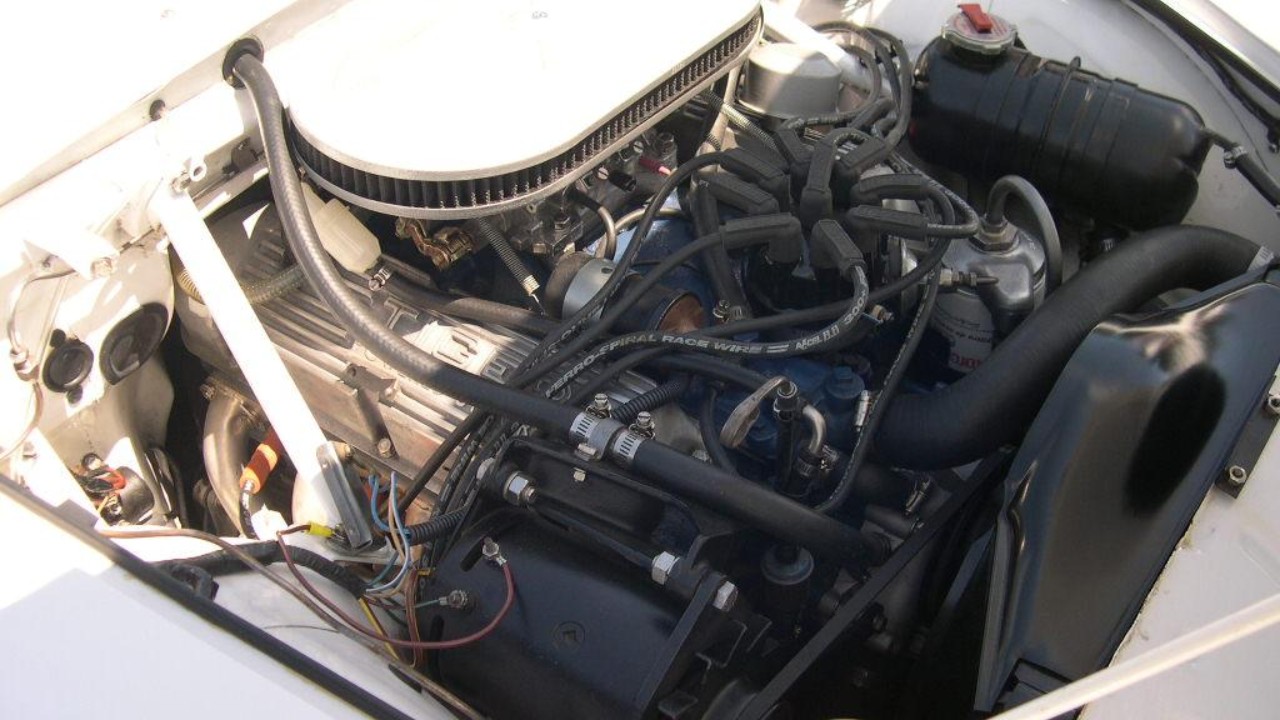
The Tiger started as a Sunbeam Alpine, a small British roadster, with a V8 squeezed under the hood. Ian Garrad pushed the idea inside Rootes. First, Ken Miles built a quick prototype in about a week, using a Series II Alpine and a Ford V8. Later, Carroll Shelby built a more polished prototype with a four-speed manual, and Rootes approved it.
That development story comes from the Wikipedia history of the Tiger. Meanwhile, RM Sotheby’s catalog notes agree that Garrad convinced Rootes to hire Shelby, the man behind the Cobra. The first cars used Ford’s 260-cubic-inch V8.
A second RM Sotheby’s catalog, for a 1967 Mk II, fills in the rest. It describes Garrad as Rootes’ US West Coast sales manager and calls the $3,500 car “somewhat of a budget Cobra.” It also says the first cars paired a 164 hp, 260 cu. in. Ford V8 with a Borg-Warner T-10 four-speed.
Rootes did not build the Tiger itself. Instead, Jensen assembled the cars in West Bromwich, according to Classic & Sports Car. Wikipedia adds that Rootes’ own Ryton factory lacked the capacity.
Chrysler takes over the Sunbeam Tiger’s maker
Chrysler took over the Rootes empire in January 1967, according to Hagerty UK. That created an obvious problem. Every Sunbeam Tiger on the line carried an engine from Chrysler’s rival, Ford.
Hagerty UK says Chrysler did not want to keep making a car with a rival’s engine. Similarly, RM Sotheby’s writes that Chrysler, which also acquired Simca in France, was “mildly embarrassed” by the Ford-powered Tiger after the takeover. Classic & Sports Car calls the car “a victim of corporate politics following the Chrysler takeover of Rootes Group.”
Why the Ford V8 could not simply be swapped
The obvious fix would have been a Chrysler V8. However, that was not practical, according to Wikipedia’s account of the model. Chrysler did not have a suitable replacement engine, and its 273-cubic-inch V8 would not fit the engine bay without major changes.
Chrysler let the car run out instead. The same account says it ordered production to stop once Rootes’ stock of Ford V8s ran out. In other words, nobody redesigned or replaced the Tiger. It simply ran until the engines ran out.
Safety and emissions rules were coming too
Chrysler’s ownership was not the only factor. Hagerty UK also says Rootes was “compelled to end the Tiger’s short life in 1967 because of upcoming Federal safety and pollution laws.” That mattered, because Rootes built the Tiger largely for the North American market.
Hagerty UK puts the two pressures side by side. By contrast, Wikipedia’s account focuses on Chrysler and the engine supply. Either way, both reasons pointed at 1967.
The Mk II and the end of Sunbeam Tiger production
The final version was the Mk II. It swapped the 260 for Ford’s 289-cubic-inch V8, and Classic & Sports Car says Mk II production was left-hand drive only. Sources differ on how many Rootes built. RM Sotheby’s says 633, while Classic & Sports Car puts it at 534.
The sources also disagree on total production. Hagerty UK says “just over 7000,” RM Sotheby’s says fewer than 7,100, and Classic & Sports Car gives 7,085. Still, all three land in the same narrow range.
The last Tiger of all was a right-hand-drive Mk II, chassis B382100633, painted Orchid Green. According to Classic & Sports Car, it went to Roy Thompson Ltd in Aberdeen on 27 June 1967. It received the registration HRS 121E on 3 July 1967. Club members, the magazine says, nicknamed that shade “goose poop” green.
The car’s later history is well documented too. John Day acquired it in 1986 and restored it, according to Classic & Sports Car. Graham Vickery then bought it in the early 1990s.
When the magazine profiled it, Vickery was vice-chairman of the Sunbeam Tiger Owners’ Club. That club dates from 1975, per Hagerty UK. More recently, RM Sotheby’s sold that 1967 Mk II catalog car at Amelia Island in 2020 for $95,200.
More from Fast Lane Only
- Unboxing the WWII Jeep in a Crate
- 15 rare Chevys collectors are quietly buying
- 10 underrated V8s still worth hunting down
- Police notice this before you even roll window down
This article was created with the help of AI and was reviewed and edited by Fast Lane Only editors before publication.