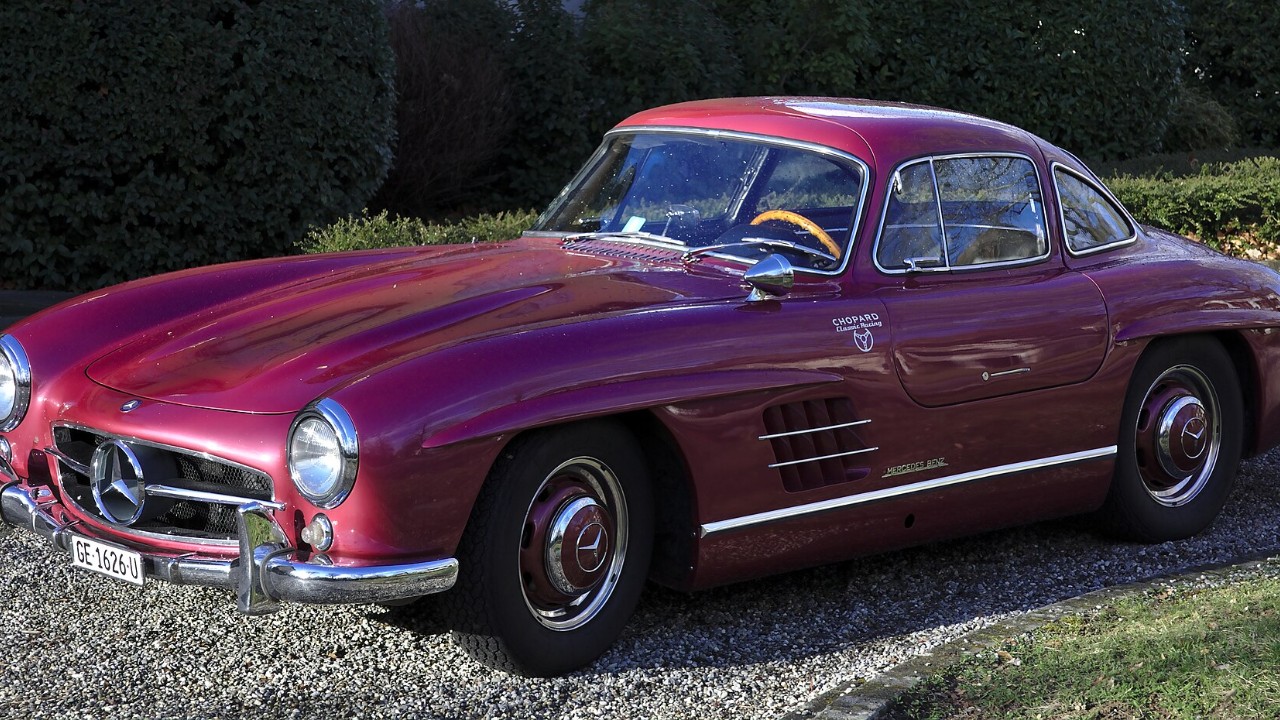
The Mercedes-Benz 300 SL arrived in 1954 with an idea most cars would not adopt for decades. Its 300 SL fuel injection system used a Bosch mechanical pump to spray gasoline straight into each cylinder, rather than mixing it with air in a carburetor first. That choice helped turn a racing car into a road car that people still talk about.
The car made its public debut at the New York International Auto Show in February 1954. Under the long hood sat a 3.0-liter straight six fed by a Bosch injection pump. Here is how that pump did its job, why Mercedes chose it, and what it cost owners in daily use.
First, a note on what this story does not claim. The 300 SL was not the first car with gasoline direct injection. Bosch had already put the idea on a small German two-stroke three years earlier, as the history below shows.
Where the 300 SL fuel injection came from

Bosch started its petrol injection work long before the 300 SL. According to PistonHeads’ history of direct injection, Bosch’s system first ran on the Daimler-Benz DB 601 aircraft engine in 1935. It reached series production by February 1937. Because fuel went straight into the combustion chamber, there was no mixture in the intake to freeze or explode.
After the war, Bosch scaled the idea down for cars. In April 1951, Goliath showed its direct-injected GP700 Sport at the first Frankfurt motor show, PistonHeads reports. Power rose by 10 percent over the carbureted engine, while fuel consumption fell by 32 percent. However, Goliath built only 27 of those little coupes.
From race engine to road car
Mercedes engineers then applied the same thinking to a much bigger engine. Karl Ludvigsen, writing in The Star, the Mercedes-Benz Club of America magazine, says direct injection gave an experimental six 214 horsepower at 5,960 rpm by December 1952. That became the target for the M198 engines built for the 1953 competition 300 SL. Later, Mercedes adopted the system for the production car in 1954.
Wikipedia’s 300 SL entry notes that the earlier W194 racing cars used carburetors. The road car’s M198 swapped them for the Bosch direct-injection system, and output rose as a result. That engine displaced 2,996 cc, per the same entry.
How the Bosch pump fed each cylinder
The heart of the system was a plunger-type injection pump. Graham Robson, in his article “First in Fuel Injection” for The Star, explains that Mercedes mounted it low, on what was effectively the underside of the engine.
The clever part was where the fuel came out. On earlier Mercedes sixes, the spark plugs had used ports in the cylinder block. On the M198, the injection nozzles took over those positions, and the plugs sat in the cylinder head instead. Robson adds that engineers machined the block-to-head joint at a slant so the head could stay flat.
Ludvigsen describes the spray pattern, too. The nozzles fired from the hot side of the chamber toward the cool side, across the faces of the valves, during the intake stroke. Meanwhile, an electric pump purged the system of leftover fuel vapor, he notes.
Why the engine leaned over
The six also sat at a steep angle. Wikipedia says Mercedes tilted it 50 degrees toward the driver’s side so it fit under the low body. Robson’s article gives the cant as 40 degrees, so the exact figure depends on the source. Either way, the tilt made room for a large intake manifold and a lower hood line.
The engine also used dry-sump lubrication. That kept oil flowing in hard cornering, and it lowered the engine by removing the deep oil pan, according to Wikipedia.
The 300 SL fuel injection numbers
Power ratings for this engine vary with the method used, so each figure needs its label. Wikipedia lists 240 hp SAE gross at 6,100 rpm, up from 175 hp SAE gross for the carbureted racing engine. On the German DIN scale, the same table shows 215 PS at 5,800 rpm.
Robson’s article lines up with that spread. It gives 215 brake horsepower net, says American sources usually quoted 240 SAE hp, and notes some European sources cited 195 hp. In other words, the engine never changed. Only the measuring stick did.
What it cost owners
The mechanical pump had one well-known flaw. Because it ran whenever the engine turned, it kept injecting fuel in the moment between switching off the ignition and the engine coming to rest. Wikipedia says that extra gasoline washed oil off the cylinder walls and diluted the oil.
Short trips made the problem worse, since the oil never got hot enough to burn the fuel off. As a result, owners could block airflow to the oil cooler or follow a 1,600 km oil-change interval, the entry adds. Robson also notes that the injection system was harder to service than carburetors.
Even so, the idea outlived the car. PistonHeads points out that direct injection stayed rare until Mitsubishi launched its modern Gasoline Direct Injection system in 1996.
How many were built
Mercedes built 1,400 of the gullwing coupes from 1954 through 1957, according to Wikipedia. Then 1,858 roadsters followed from 1957 to 1963, for 3,258 cars in all. When new, the coupe cost $6,820 in the United States, the same entry records.
More from Fast Lane Only
- Unboxing the WWII Jeep in a Crate
- 15 rare Chevys collectors are quietly buying
- 10 underrated V8s still worth hunting down
- Police notice this before you even roll window down
This article was created with the help of AI and was reviewed and edited by Fast Lane Only editors before publication.