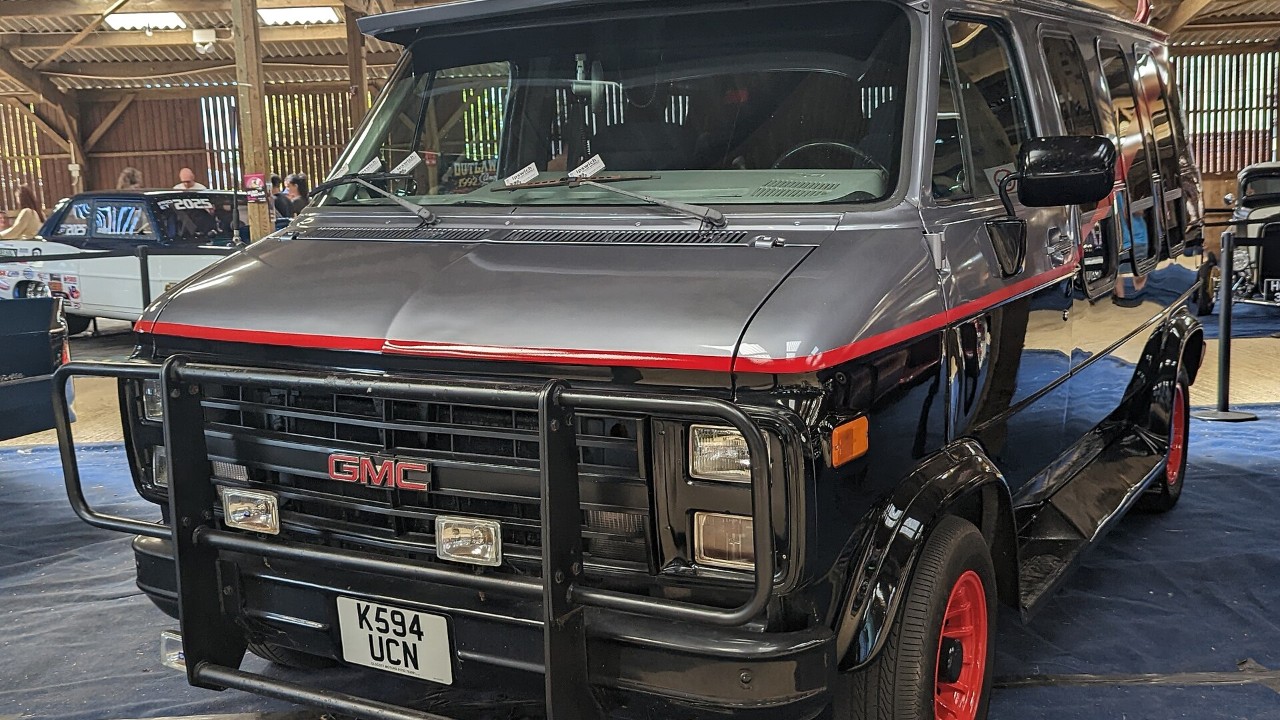
The A-Team van was a 1983 GMC Vandura, a full-size work van dressed in black and metallic gray with a red stripe, red turbine-style wheels and a spoiler on the roof. Mr. T’s B.A. Baracus drove it, fixed it and guarded it. For five seasons, it was arguably the most recognizable van on television.
The show premiered on NBC in January 1983 and ran until March 1987. By then, the van had survived accidents, gun battles and jumps that would have finished any real delivery van. However, the story behind it is more practical than the stunts suggest.
Here is what GMC built, what the show’s crew added, how many vans it took, and what happened when Hollywood came back for a second try in 2010.
What the A-Team van started as
Underneath the paint was GMC’s G-Series, the van line General Motors built across three generations from 1964 to 1996, Silodrome explains. The Vandura name arrived in 1971 with the third generation. GMC even styled it “VANdura” from 1977 to 1982. Buyers could pick 1500, 2500 or 3500 payload classes, and a 6.2-liter diesel V8 joined the options in 1982.
The show used a 1983 GMC Vandura with a 5.7-liter, 350-cubic-inch V8, according to Silodrome. Classic TV Cars lists the van as a G-15 with a two-barrel carburetor and an automatic transmission. Auto123 also calls it a G15 Vandura.
That choice made sense for a series about ex-soldiers on the run. A van could carry four men and their gear. It also blended in at a truck stop, at least until someone noticed the stripe.
The paint, the wheels and the roof spoiler
The look did the real work. Silodrome describes two-tone paint in black and metallic gray. A red stripe ran from the hood line back to the rear spoiler, and red turbine mag wheels and auxiliary lights on the grille and roofline finished the job. Meanwhile, Classic TV Cars lists a full front brush bar, fog lights, a sun visor, a quad-tip exhaust and heavy-duty rear air shocks.
The roof spoiler was pure style. A rear wing on a full-size van did little for a vehicle shaped like a shoebox, and Auto123 called it “somewhat pointless.” Still, it is the detail every fan remembers. Without it, the van would look like any other Vandura in a contractor’s driveway.
Inside, Classic TV Cars describes white bucket seats, shag carpet, a mobile telephone and radio, and a custom case for B.A.’s gear. That fan site also lists BFGoodrich Radial T/A tires. So the van was dressed for the camera inside and out, even if most viewers only ever saw it from the curb.
How many vans the A-Team really used
There was never just one van. Silodrome says the production used several Vanduras. At least one had a sunroof for standard shots, while another had none for stunt work. As a result, sharp-eyed viewers can spot small differences from scene to scene.
The count grows with each source. Hagerty reports that Craig Baxley, the show’s stunt coordinator and a director, said there were at least eight vans. Two handled first-unit filming, and six were stunt vans. Another account cited by Hagerty counts five regular vans plus a couple with a mid-mounted engine for jumps.
Then there were the vans viewers met in person. Universal Studios licensed six promotional vans to Hollywood Productions Incorporated, Hagerty says. Those vans toured the United States and Canada from 1983 to 1987 to promote the series. In fact, Hagerty notes, these were not the vans used in the show.
Why B.A.’s van became a pop culture icon
The van worked because it belonged to a character. B.A. Baracus was the team’s mechanic, and the van was his. Classic TV Cars notes that the team’s ride was “stripped apart and abused in just about every imaginable way,” only for B.A. to put it back together. That cycle became part of the show’s formula.
The timing helped too. The pilot aired on NBC on January 23, 1983, Silodrome notes. Then the first regular episode aired on January 30, right after Super Bowl XVII. That slot put the black van in front of a Super Bowl audience in its first week.
By the end, the series had run five seasons and 98 episodes, closing on March 8, 1987. The shape stayed in the culture long after the reruns. Today, builders keep turning ordinary G-Series vans into A-Team replicas. Silodrome recently covered a 1980 G20 converted in the United Kingdom, with matte black paint, a red stripe and 15-inch turbine-style wheels.
The 2010 movie van and where the G-Series ended
When the A-Team returned as a feature film in 2010, it brought a newer van. The film used a 1994 G-Series, Silodrome says, so the boxy face of the original gave way to the later front end. An A-Team van also took pride of place in the entryway of the 2010 New York auto show, Autoblog reported.
That 1994 van came near the end of the line. A 6.5-liter diesel V8 had replaced the 6.2 that year, according to Silodrome. Two model years later, the run was over.
The van that started it all is now a period piece, and that is part of its charm. It came from an era when a GMC work van could be a hero car with nothing more than paint, a stripe, wheels and a roof wing. GM ended the G-Series after the 1996 model year and replaced it with the Savana and Chevrolet Express, Silodrome notes, which makes every surviving 1983 Vandura a reminder of how B.A. rolled.
More from Fast Lane Only