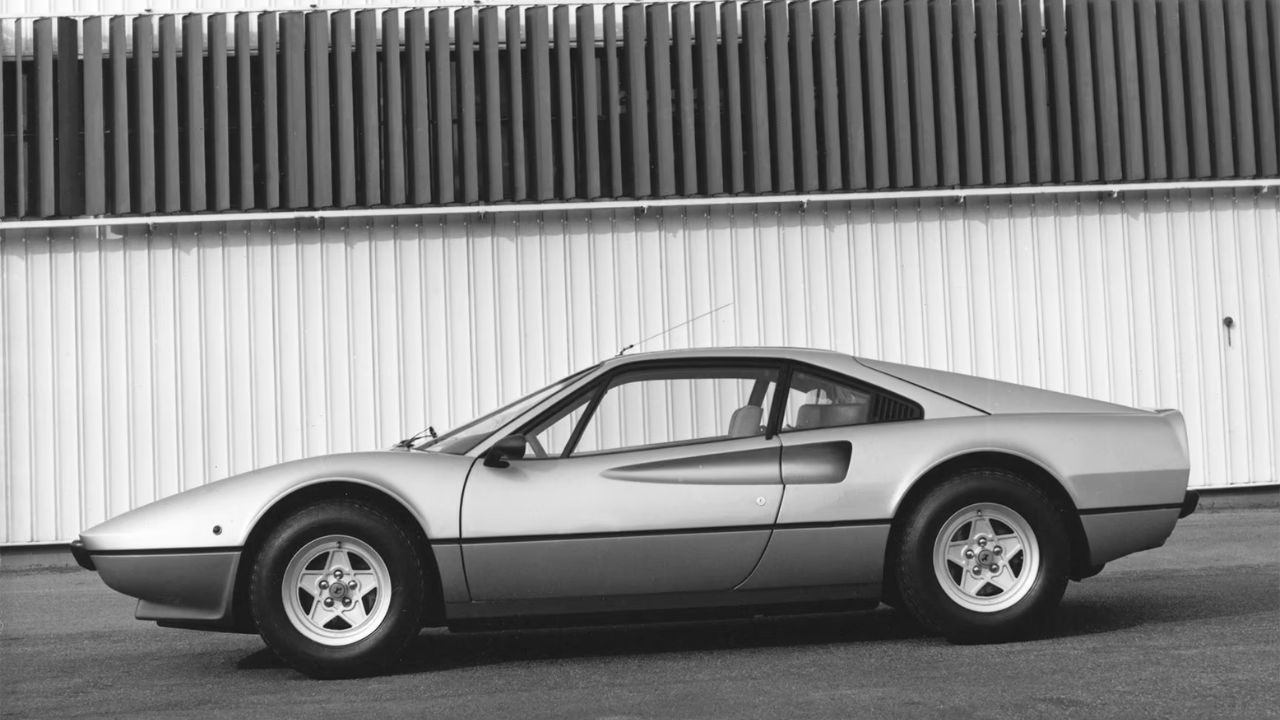
The first steel-bodied 308 GTB rolled out of Maranello in 1975 as a compact, mid‑engined V8 coupe that looked like a junior supercar but behaved like a precision tool. Half a century later, the earliest 308s still feel like they were built for people who care more about steering feel and throttle response than lap times or touchscreen menus. Among Ferrari road cars, few models capture that idea of a “driver’s car” as cleanly as the original 1975 308 GTB.
Launched into a decade of tightening emissions rules and economic anxiety, the 308 GTB could easily have been a compromised product. Instead, it became a benchmark for how much engagement a relatively modestly powered sports car could deliver when weight, visibility, and feedback all pull in the same direction.
What happened
Ferrari introduced the 308 GTB in 1975 as a replacement for the Dino 246 GT and as a more focused companion to the 2+2 Dino 308 GT4. The new model used a transverse 2.9‑liter V8 mounted behind the seats, paired with a five‑speed gated manual and wrapped in a compact Pininfarina body that sat lower and shorter than the GT4. Early cars were built with glass‑reinforced plastic bodywork, a choice that kept weight low and gave the first series a distinct character before production moved to steel panels.
Period coverage of the 308’s 50th anniversary notes that the original fiberglass cars, introduced in 1975, weighed roughly 1,050 kilograms and were produced in small numbers before Ferrari switched to heavier but easier to manufacture steel shells for regular production. That change, described in detail in a retrospective on the model’s first half century, marked a shift from a quasi‑homologation feel toward a more conventional road car, yet the basic layout and mechanical package remained the same. The early V8 delivered around 255 horsepower in European trim, which, combined with the low mass of the fiberglass body, gave the first series a notably lively power‑to‑weight ratio compared with later variants.
The 308 GTB did not appear in a vacuum. It followed the Dino 308 GT4, which had already introduced Ferrari’s first production V8 in a mid‑engined layout. Contemporary driving impressions of the GT4 describe a car that thrives on revs and rewards precise inputs, with one long‑term test calling even a tired example of the Dino 308 GT4 “a driver’s delight” for its steering, balance, and willingness to be worked hard. That same engine and transaxle package, refined and restyled, formed the backbone of the 308 GTB, which traded the GT4’s angular Bertone lines and small rear seats for a two‑seat Pininfarina coupe silhouette that aligned more closely with Ferrari’s traditional design language.
Over the following years Ferrari evolved the 308 platform with fuel injection, four‑valve cylinder heads, and incremental chassis changes. A later test of a 1977 308 GTB described how the car “bucks tradition in the best ways” by combining the mid‑engined layout of Ferrari’s racing machines with the usability of a compact grand tourer. Reviewers highlighted the light, accurate steering, the communicative chassis, and the way the V8’s power delivery encouraged drivers to explore the upper half of the tachometer. Those same traits still define how enthusiasts talk about the car today.
By the early 1980s the 308 GTB had gained Bosch fuel injection and, in Quattrovalvole form, four valves per cylinder. A period road test of a 1984 308 GTB QV recorded strong performance for the time and emphasized how the engine’s freer‑revving nature and improved reliability made the car easier to live with. That test also underlined how the 308’s basic package had aged gracefully, with the gated shifter, compact dimensions, and relatively simple cabin all contributing to a sense of mechanical honesty that was already becoming rare in performance cars of the era.
The 308 family also branched into the open‑topped GTS, which gained pop‑culture fame as the red targa‑roof car driven by Thomas Magnum on television. Coverage of that car’s cultural impact notes how the 308 GTS became a shorthand for exotic aspiration in the late 1970s and early 1980s, especially in the United States, where it appeared on prime‑time television every week. Although the Magnum car was a GTS rather than a GTB, the shared mechanical core meant that the coupe’s reputation for being a driver‑centric Ferrari benefited directly from that exposure.
Why it matters
Measured purely by numbers, the 1975 308 GTB does not look especially dramatic today. Modern hot hatchbacks can match its acceleration and exceed its grip. Yet enthusiasts and historians keep returning to the earliest 308s as reference points for what a usable, engaging sports car can feel like. That persistence has several roots, starting with the way the car balances performance, size, and visibility.
In period and in later retrospectives, testers praised the 308 GTB for its clear sightlines, relatively thin pillars, and compact footprint. The driver sits low, but the hood drops away and the fenders are visible, which makes it easy to place the car on narrow roads. The steering, unassisted at low speeds, lightens as the pace builds and feeds back road texture rather than isolating it. Combined with a curb weight that, in early fiberglass form, stayed close to a metric ton, the result is a car that feels alert without being nervous.
Modern writers who revisit the 308’s V8 roots often start by driving its older sibling, the Dino 308 GT4, because that car shares the same basic engine and transaxle. One widely cited test of a well‑used GT4 describes how, even with cosmetic flaws and mechanical wear, the chassis still communicates clearly and invites the driver to lean on the front end, adjust the line with the throttle, and enjoy the process rather than chase raw speed. That sense of mechanical conversation carries straight into the 308 GTB, which adds a more focused driving position and a slightly shorter wheelbase to sharpen the experience.
The 308 also marked a turning point for Ferrari’s road‑car strategy. By committing to a V8 mid‑engined platform for its “entry” model, Ferrari created a template that would run through the 328, 348, F355, and beyond. A detailed 50th‑anniversary feature on the 308 points out that the car’s combination of transverse V8, gated manual, and compact two‑seat layout effectively defined the brand’s junior sports car formula for decades. In that sense, the 1975 308 GTB is not just a pretty shape but the starting point for a whole bloodline of driver‑focused Ferraris.
Contemporary road tests from the late 1970s reinforce that view. A thorough evaluation of a carbureted 1977 308 GTB found that the car delivered a rare mix of comfort and involvement. The ride quality was firm but compliant enough for long trips, the cabin quieted wind noise better than some rivals, and yet the steering and chassis never felt detached. Reviewers noted that the engine’s torque curve encouraged drivers to work the gearbox, which made the polished metal gate and long, precise shift action central to the experience. That interplay between engine, gearbox, and driver is a large part of why the model still resonates with enthusiasts who value interaction over statistics.
Later coverage of the 308 GTB QV in the mid‑1980s shows how the platform matured without losing its core appeal. The Quattrovalvole’s four‑valve heads improved breathing, which in turn sharpened throttle response and extended the useful rev range. Testers observed that the QV felt more eager to spin past 7,000 rpm and more forgiving in traffic, yet the essential ingredients remained the same: a naturally aspirated V8 behind the driver, a manual gearbox with a metal gate, and a chassis tuned for balance rather than outright softness or stiffness. That continuity makes it easy to trace a straight line from the first fiberglass GTB to the last QV coupes.
Culturally, the 308’s impact stretched beyond the coupe. The targa‑roof GTS, with its removable panel and more extroverted feel, became the poster car for a generation of viewers who watched Magnum cruise around Hawaii in a bright red Ferrari. A detailed feature on that television car explains how the 308 GTS, through repeated exposure on screen, helped fix the idea of a mid‑engined Ferrari as both exotic and attainable. For many viewers, the 308 was the first Ferrari they could identify by name, and that recognition helped cement the brand’s image in key export markets.
The 308’s significance also emerges when it is compared with its closest relatives. Commentators who drive both the Dino 308 GT4 and later V8 Ferraris often argue that the GT4, with its 2+2 layout and slightly softer setup, feels like a precursor to modern front‑engined GTs such as the Roma. One such comparison explicitly calls the 308 GT4 the “true ancestor” of Ferrari’s current V8 grand tourer, because of its mix of practicality and performance. Against that backdrop, the 308 GTB stands out as the purer sports car, a machine that sacrifices rear seats and some luggage space in pursuit of a more intimate connection between driver and machine.
The car’s place in enthusiast culture has evolved as well. Coverage of collector trends notes that the 308 GTB has long lived in the shadow of more expensive Ferraris, but that its combination of classic looks, usable performance, and relative affordability has turned it into a favorite among drivers who want to use their cars rather than store them. Some modern buyers are drawn specifically to the first‑series fiberglass cars for their rarity and lower weight, while others prefer the later QV models for their improved drivability and corrosion resistance. Across those variants, the underlying appeal remains the same: a compact, analog Ferrari that rewards skill more than budget.
Media retrospectives on 1980s performance cars often single out the 308 family for its enduring cool factor. One survey of standout cars from the late 1970s and early 1980s lists the Ferrari 308 among the decade’s most desirable shapes, citing its wedge profile, pop‑up headlights, and association with television and film. That kind of recognition matters because it shows how the 308 managed to cross from specialist automotive circles into broader popular culture, which in turn helped keep interest alive long after production ended.
What to watch next
As the 308 GTB approaches and passes its 50th birthday, attention is shifting from simple preservation to thoughtful use and modification. Owners and specialists face choices about how closely to stick to factory specification, especially with early fiberglass cars that some collectors regard as historically significant. The tension between originality and drivability is likely to sharpen as more 308s move from enthusiast garages into curated collections.
Mechanical support remains a key factor. The 2.9‑liter V8 and its associated transaxle are robust when maintained, but they demand regular belt services, careful carburetor tuning on early cars, and attention to cooling systems that were designed for European climates of the 1970s. Articles that profile long‑term ownership of related models, such as the Dino 308 GT4, stress the importance of preventative maintenance and of finding specialists who understand period Ferrari quirks. As the pool of technicians with hands‑on experience shrinks, the cost and complexity of keeping a 308 in peak driver condition may rise.
More From Fast Lane Only: