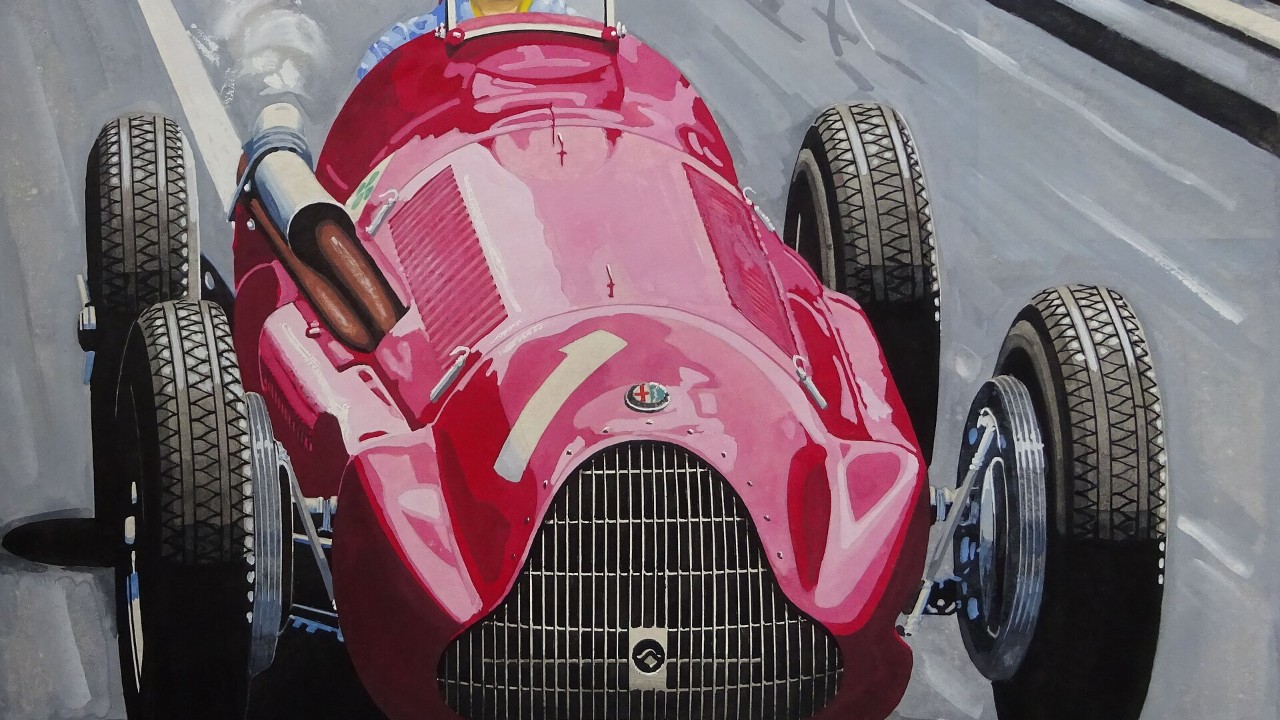
The Alfa Romeo 158 was already 12 years old when Formula 1’s world championship began. Yet on 13 May 1950 at Silverstone, three of them finished first, second and third. Giuseppe “Nino” Farina won, Luigi Fagioli came home 2.6 seconds behind him, and Reg Parnell took third. No other car finished on the same lap.
That result is the first entry in the championship record book. It also says a lot about the car. Alfa Romeo designed the 158 in 1938 for a 1.5-liter class, and the company kept refining the same basic design for more than a decade.
So how did a prewar design end up beating everyone in a brand-new championship? The answer starts with a small engine, a big supercharger and a factory that refused to let its cars disappear during the war.
How the Alfa Romeo 158 was built
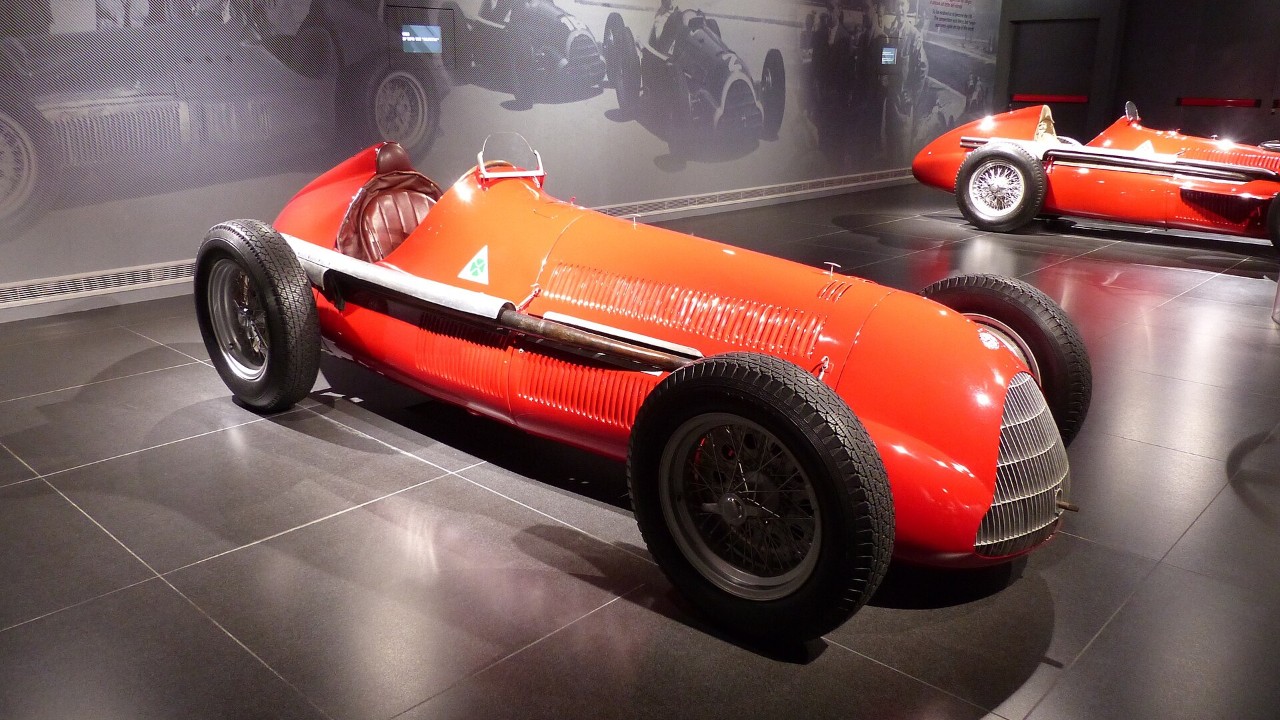
The Museo Alfa Romeo describes the engine as an innovative straight-eight in light alloy with screw-in steel bores. It used twin overhead camshafts, and a Roots supercharger fed the fuel system. The gearbox sat in one unit with the differential on the rear axle, which helped balance the car’s weight.
The museum credits a team led by Gioachino Colombo with the design, and Colombo sketched the car’s lines himself. Today, Alfa Romeo’s own museum and heritage pages still call it by its nickname, the “Alfetta.”
At first, the engine made 195 hp, and the car could reach 232 km/h, according to the museum. It made a strong first impression, too. At its debut in the 1938 Coppa Ciano, the 158 took first and second place.
Hidden through the war, then faster every year
Racing stopped when the Second World War began. Alfa Romeo then hid its race cars in Melzo, near Milan. The museum says they sat on a pig farm “under a fake wood-pile.” A Stellantis heritage release tells the same story: the cars survived the conflict hidden on a farm.
Meanwhile, the engine kept growing stronger. Output had reached 225 hp by 1939. After the war, two-stage supercharging lifted it to 275 hp in 1947, with a top speed of 270 km/h. By 1950, the museum lists 350 hp and 290 km/h.
The Stellantis heritage release adds the engine speed: 350 hp at 8,500 rpm. That is a remarkable figure, especially from 1.5 liters. By comparison, the 1938 car had produced 195 hp from the same displacement, so the factory found roughly 155 extra horsepower without changing the basic layout.
Alfa Romeo also dominated in 1947 and 1948, according to Stellantis. However, the company withdrew from Grand Prix racing for 1949. That year away gave the factory time to prepare for the new championship.
Silverstone, 13 May 1950
The first championship round was also run as the Grand Prix d’Europe, as Formula 1’s own history notes. Twenty-one cars started on the 4.6 km Silverstone circuit, lined up in a 4-3-4 grid. King George VI watched from a royal box with Queen Elizabeth and Princess Margaret. Up to 120,000 spectators reportedly came as well.
Alfa Romeo entered four 158s. Its regular drivers were Farina, Fagioli and Juan Manuel Fangio, a trio the museum says fans called the “Fa-Fa-Fa” team. The fourth car went to the British driver Reg Parnell. In qualifying, the four Alfas took the top four places, with Farina on pole.
Ferrari did not compete. As a result, the 158’s closest rivals were Talbot-Lagos and Maseratis. Farina led from the start, according to the GrandPrix.com race report, with Fagioli and Fangio behind him.
The result: an Alfa Romeo 158 podium sweep
Farina covered the 70 laps in 2 hours, 13 minutes and 23.6 seconds. Fagioli finished in 2:13:26.2, and Parnell finished third in 2:14:15.6. Fangio retired after 62 laps. Formula 1 says a broken oil pipe stopped him, possibly after he clipped a straw bale at Stowe.
Parnell’s run also had an odd moment. A hare struck his car and dented its cowling, but he still finished third. Behind the Alfas, Yves Giraud-Cabantous and Louis Rosier placed fourth and fifth in Talbot-Lagos. Both were two laps down after 68 laps.
Age was no barrier, either. Fagioli was 51, and Farina was 43. Formula 1 puts the average age of the field at 39.
The rest of the 1950 season
Silverstone set the pattern. According to the museum, the 158 won six of the seven official championship races in 1950. That seventh race was the Indianapolis 500, which Alfa Romeo skipped along with the other European teams. On top of that, the car dominated five non-championship Grands Prix that year.
Stellantis counts the season another way. Its release says the team won 11 races out of 11, which includes the non-championship events. Either way, the 158 was unbeaten in the races it entered from Silverstone onward, according to the museum.
Farina became the first Formula 1 world champion, ahead of his teammates Fangio and Fagioli. Engineer Giuseppe Busso later summed up the season in one line. “The main problem was deciding which of the three drivers should win the race,” he said, as quoted by the museum.
From 158 to 159
For 1951, Alfa Romeo reworked the car so heavily that it got a new name, the Tipo 159. Stellantis lists 425 hp at 9,300 rpm from 1,479 cc, a weight of 710 kg and a top speed of 305 km/h. The company built four 159s by modifying 158s.
Fangio then won the 1951 title, clinching it at the Spanish Grand Prix. Finally, Alfa Romeo chose to leave Grand Prix racing for 1952. According to Stellantis, it withdrew unbeaten, two world championships after a 12-year-old design won the very first round at Silverstone.
More from Fast Lane Only