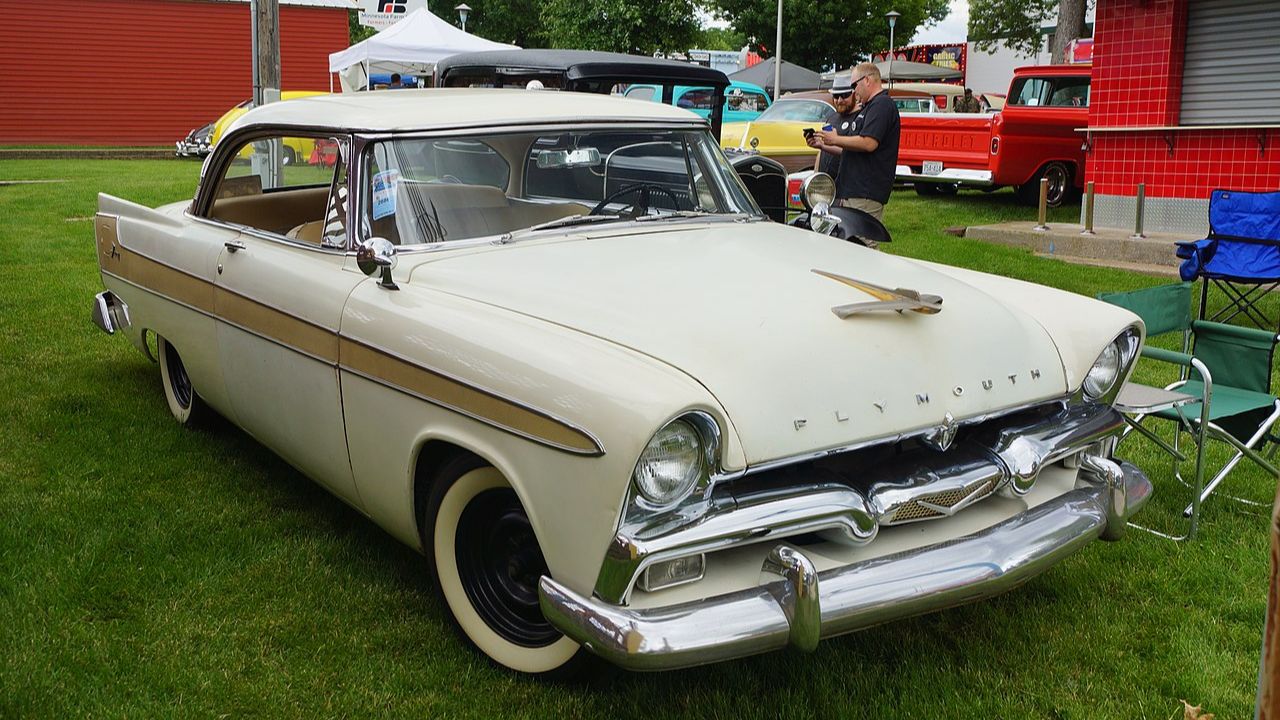
Plymouth had a name for reliable, slow, boxy cars. Then, at the 1956 Chicago Auto Show, it rolled out the first Plymouth Fury: an eggshell white hardtop with gold anodized trim and a 240-horsepower V8. Plymouth built 4,485 of them that year, and the name went on to outlive the car that introduced it.
The Fury arrived in the middle of the model year as a limited-production hot rod. Also, it wore a price that made it the costliest Plymouth in the showroom. It also came with something few American cars of the day had, a tachometer.
Here’s what Plymouth put into those 4,485 cars, and how the Fury changed once the 1956 run ended.
How the first Plymouth Fury looked
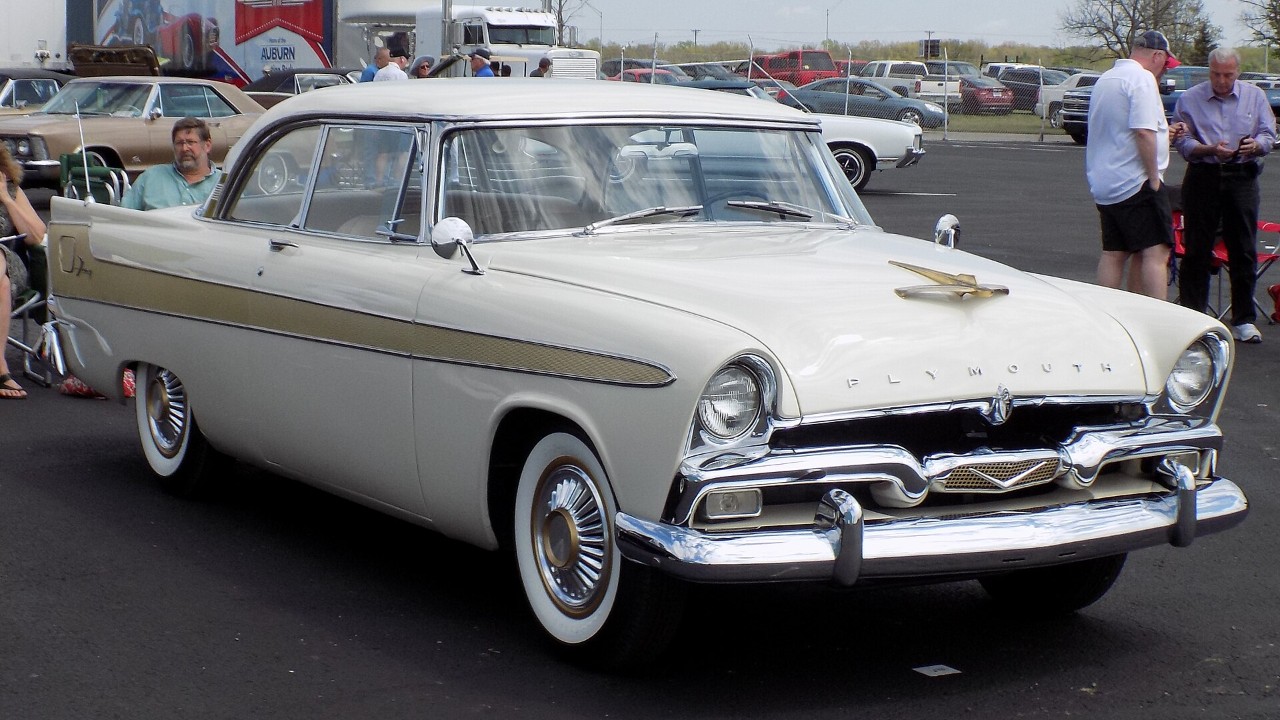
Plymouth built the Fury on the hardtop coupe body of its high-line Belvedere, according to automotive writer Dan Jedlicka. The paint was a custom eggshell white. Down each side ran a full-length sweepspear of gold anodized aluminum.
The gold didn’t stop there. Plymouth also gave the grille a gold-finished center and fitted gold anodized “spoke” wheel covers, Conceptcarz notes. Dual outside mirrors, back-up lights and variable-speed wipers rounded out the package.
Inside, the theme carried on. The upholstery mixed eggshell white and black, with gold metallic beads running through it, Conceptcarz reports. In other words, the cabin matched the body, which suited a car meant to be noticed.
The 303 V8 under the hood
Plymouth’s own 277 V8 wasn’t the engine in the Fury. Instead, the car used a 303-cubic-inch “polyhead” V8 from Chrysler’s Canadian line, Jedlicka writes. Plymouth picked it over Chrysler’s Hemi partly because it qualified for a NASCAR racing class.
Next, Plymouth worked it over. Jedlicka lists a high-performance camshaft, solid valve lifters, domed pistons, higher-compression heads and free-flowing dual exhausts. Conceptcarz puts compression at 9.25:1. The result was 240 horsepower, which Jedlicka calls high for a mid-size car of the time.
A three-speed manual was standard, according to Jedlicka. Buyers could also order Chrysler’s two-speed PowerFlite automatic, worked by pushbuttons on the dash. Hagerty’s valuation guide adds that a heavy-duty suspension, police brakes and the tachometer came standard.
124 mph on the sand at Daytona
Plymouth wanted proof of speed, so it took the first Plymouth Fury to the beach. A pre-production Fury coupe ran the flying mile at Daytona Beach at 124.01 mph on January 10, 1956, Conceptcarz reports. Jedlicka notes that the run came on the same day as the Chicago introduction.
Plymouth didn’t stop there, either. The following month, a further-modified test car reached 143.6 mph, according to Jedlicka. Meanwhile, Conceptcarz gives the Fury’s road numbers as 0 to 60 mph in 9.6 seconds and the quarter-mile in 17 seconds.
Those figures sound modest today. Still, they gave a brand known for slow, boxy, reliable cars a new image, and Jedlicka credits the Fury with building Plymouth’s high-performance reputation.
What it cost, and how many Plymouth built
The Fury listed at $2,866, according to Jedlicka. That was about $652 more than a Belvedere Sport Coupe hardtop. As a result, the Fury was the most expensive Plymouth of the 1956 to 1958 run, he writes. Hagerty’s guide gives the same figure as a starting price, “$2,866 and up.”
Even so, sales stayed small by Plymouth standards. Jedlicka and Conceptcarz both put the 1956 total at 4,485 cars, while Hagerty says simply that fewer than 4,500 were built. Price figures do vary between sources, however. Conceptcarz also prints $2,800 and $2,599, so the $2,866 figure here follows Jedlicka and Hagerty.
How the Fury changed after 1956
Chrysler restyled every car it built for 1957, and the Fury changed with them. It rode on a wheelbase 3 inches longer and sat 5.5 inches lower than the 1956 car, Jedlicka writes. Gold grille bars replaced the gold wheel covers.
At the same time, the engine grew. For 1957, the Fury got a 318-cubic-inch V8 rated at 290 horsepower with dual four-barrel carburetors, according to Jedlicka. TorqueFlite, a three-speed automatic, became an option. The price rose to $2,925.
By 1958, the Fury had four headlights and a recession to contend with. That year, Plymouth sold it for $3,067, and an optional 350-cubic-inch “Golden Commando” V8 made 305 horsepower, Jedlicka writes. Production dropped to 5,308, after the 1957 Fury had reached 7,438. The 1956 car remains the smallest run of the three, at 4,485.
More from Fast Lane Only