Aptera’s chief executive has sparked a fresh debate about solar-powered mobility by claiming that his company’s three-wheeled electric vehicle generated more electricity in a day than the rooftop solar system on his own house. The anecdote, backed by data from the car’s integrated panels, is being held up as proof that a carefully designed vehicle can harvest meaningful energy directly from the sun. It also raises harder questions about how far on-board solar can go, and whether such claims translate from one sunny driveway to the broader car market.
What happened
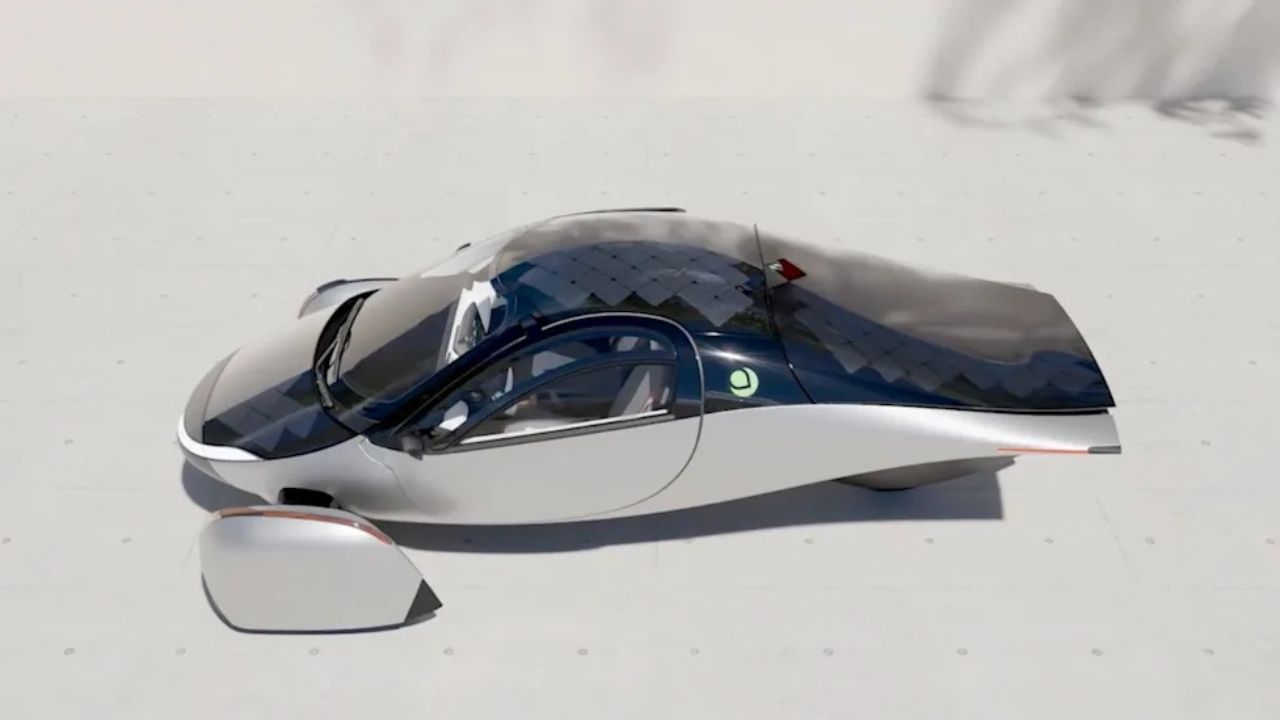
Aptera has built its identity around the idea of a “never charge” electric vehicle, a lightweight, ultra-aerodynamic two-seat trike covered in solar cells. The company has long argued that by combining a low drag coefficient, a small frontal area, and an efficient powertrain, it can turn a relatively modest solar array into a significant share of daily driving energy. Earlier development materials described a target base price of 25,900 dollars and a launch originally planned for 2021, with the promise that the most heavily optioned version could rely on solar for much of its annual mileage, as outlined in early product claims.
The latest twist came when Aptera’s CEO compared the energy output of a prototype vehicle’s solar roof to the rooftop array on his home. According to his account, over a sunny day the car’s panels produced more kilowatt-hours than the stationary system feeding his household. The comparison surprised even some supporters, since residential arrays are typically larger in total panel area than anything that can fit on a compact vehicle. His point was not that the car had more silicon, but that its orientation, shading conditions, and panel efficiency turned it into a more productive generator under those specific conditions, a story that was quickly picked up in coverage of the CEO’s claim.
Aptera’s solar strategy centers on squeezing every watt from limited real estate. The company has cited a peak output of roughly 700 watts across the full spread of bodywork on higher-spec configurations, although the exact production setup is still evolving. Independent testing of one of Aptera’s solar assemblies has highlighted a figure of 363 watts for the roof section alone, a number that helps frame the CEO’s anecdote. In a detailed breakdown of the system, one analysis described how the 363 watt roof worked in conjunction with additional panels on the hood and rear deck to raise the total capacity.
Those figures matter because they show that Aptera is not relying on exotic or speculative technology. The car uses commercially available photovoltaic cells, arranged in curved modules that follow the body. What the company is betting on is that careful integration, minimal shading, and efficient wiring can push real-world yield closer to theoretical limits than typical rooftop systems that may suffer from partial shade or suboptimal orientation. In the CEO’s example, the house array apparently spent part of the day in the shadow of nearby trees, while the vehicle sat in a clear patch of driveway with full sun exposure.
External observers have also pointed out that a mobile platform can, in some cases, chase the sun. A commuter might park the car in an open lot near work, where it sits for eight hours gathering energy. That same person’s house could be hemmed in by neighboring buildings or trees. Under that scenario, the car’s smaller but unobstructed array could indeed outproduce a larger but shaded rooftop system on certain days. The CEO’s comparison, while dramatic, reflects this interplay of siting, shading, and panel quality more than a raw contest of surface area.
Aptera has also positioned the anecdote within a broader narrative about solar efficiency. Commentators who have followed the project note that the vehicle’s design challenges long-held assumptions about how much energy a car can realistically gather from sunlight. One analysis argued that by pairing a slippery body and low mass with high-efficiency cells, the company has effectively upended expectations around on-board solar, at least for certain use cases and climates.
Why it matters
The CEO’s boast about his car outproducing his roof resonates because it taps into a wider conversation about how to decarbonize both transport and electricity. Rooftop solar and electric vehicles are often treated as separate tools in the climate toolbox. Aptera’s pitch is that the car itself can be a small but meaningful generator, reducing reliance on the grid and cutting both charging time and infrastructure needs for drivers with moderate daily mileage.
From a technical perspective, the anecdote highlights the difference between energy generation and energy demand. A typical compact EV might consume around 250 watt-hours per mile. Aptera claims that its efficiency target is far lower, thanks to its three-wheel layout, narrow track, and very low drag coefficient. Early promotional material suggested an energy use figure on the order of 100 watt-hours per mile at highway speeds, although the company has yet to prove that in mass-produced vehicles. If a car can truly travel several miles per 100 watt-hours, then a few kilowatt-hours of solar generation per day become much more significant in practical terms.
In that context, a vehicle that generates, for example, 4 kilowatt-hours over a sunny day could cover dozens of miles of driving without plugging in. For a short commute or local errands, this might be enough to make public chargers or home wall boxes occasional rather than daily necessities. The CEO’s comparison with his home system is meant to illustrate that the car is not just topping up a little, but in favorable conditions can meaningfully offset its own consumption.
The story also exposes the limits of such claims. A residential solar array is designed to power a household that may consume tens of kilowatt-hours per day. Even if a car’s panels occasionally outproduce a shaded rooftop system, they are not going to run an entire home. The more relevant metric is how much of the vehicle’s own energy needs the panels can cover across seasons, locations, and usage patterns. Aptera’s marketing has sometimes leaned on the phrase “never charge,” but the real-world experience will depend heavily on where owners live, how they park, and how far they drive.
Solar resource varies dramatically by latitude and weather. A driver in San Diego who parks outside is likely to see far more benefit than someone in Seattle who keeps the car in a covered garage. Snow, dust, and panel degradation over time will also affect output. The CEO’s sunny-day anecdote does not answer those questions, but it does encourage closer scrutiny of the company’s underlying performance data. Analysts will be looking for long-term logging from test vehicles that track daily solar yield over months, not just isolated days.
The claim also matters for the broader EV industry, where several startups and established automakers have experimented with on-board solar. Projects such as solar-roofed versions of the Hyundai Ioniq 5 or Toyota Prius Prime have offered modest gains, sometimes adding a few miles of range per day under ideal conditions. Aptera’s approach is more aggressive, with a body specifically sculpted to maximize solar area and minimize drag, rather than treating the panels as an optional accessory on a conventional shape.
That design philosophy has implications for cost and consumer acceptance. A three-wheeled, tandem-seat vehicle is a radical departure from the crossovers and sedans that dominate the market. Some potential buyers may be drawn to the efficiency and futuristic styling, while others may see it as too much of a compromise on practicality, safety perception, or cargo space. The CEO’s comparison with his home solar system is part of an effort to reframe those trade-offs as a fair price for near-grid independence.
There is also a policy dimension. If vehicles can generate a nontrivial share of their own energy, that could influence how regulators and utilities think about charging infrastructure, time-of-use pricing, and incentives. A car that arrives home with a full battery from solar harvesting at work or in a parking lot places less strain on evening peak demand. On the other hand, if on-board solar remains a niche feature limited to a small subset of ultra-efficient vehicles, its impact on the grid will be marginal.
Investors and early reservation holders are watching closely because Aptera’s business case relies on convincing a segment of drivers that solar integration is not a gimmick. The CEO’s anecdote is a powerful marketing hook, but it must be backed by transparent data if the company wants to maintain credibility. Independent testing of the 363 watt roof and the full system capacity is a start, yet questions remain about real-world yield across climates and over years of use.
The discussion is not happening in a vacuum. Other startups are exploring similar ideas in different vehicle categories. One example is a new compact pickup concept that integrates solar panels into the bed cover and roof, aiming to extend range for delivery fleets and outdoor users. Reporting on the project has highlighted how these solar trucks might use their panels to support worksite tools or emergency power, a reminder that vehicle-mounted solar can serve multiple roles beyond propulsion.
These parallel efforts show that Aptera is part of a broader experiment in treating vehicles as mobile solar platforms. The CEO’s comparison with his house array is thus less about bragging rights and more about testing a hypothesis: that under certain conditions, a car can be an efficient generator precisely because it is small, efficient, and often parked in open sun.
What to watch next
The next phase for Aptera will determine whether the CEO’s claim becomes a footnote or a turning point. The company needs to move from prototypes and controlled tests to customer vehicles that log real-world data at scale. Analysts will be looking for aggregated statistics on daily solar yield, broken down by region, season, and parking behavior. If a statistically significant share of owners report that their cars regularly outproduce small or shaded home arrays, that would lend weight to the CEO’s anecdote.
One key milestone will be the publication of standardized efficiency figures. Early coverage of Aptera framed the vehicle as a potential “never charge” EV, with a base price of 25,900 dollars and an arrival window that has already slipped from initial expectations. Those early promises of range and pricing will be judged against certified test results and final sticker numbers. If the production car achieves energy consumption close to the company’s targets, then even modest solar output will translate into meaningful driving range.
Another area to watch is how Aptera and others refine their solar hardware. The 363 watt roof figure provides a reference point, but panel efficiency continues to improve incrementally across the industry. Manufacturers are experimenting with higher-efficiency cell chemistries, better encapsulation to handle the curvature of vehicle roofs, and smarter power electronics that can mitigate partial shading. Reporting on the Aptera prototype has already shown how integrated roof modules can push output within the constraints of vehicle design.
More from Fast Lane Only