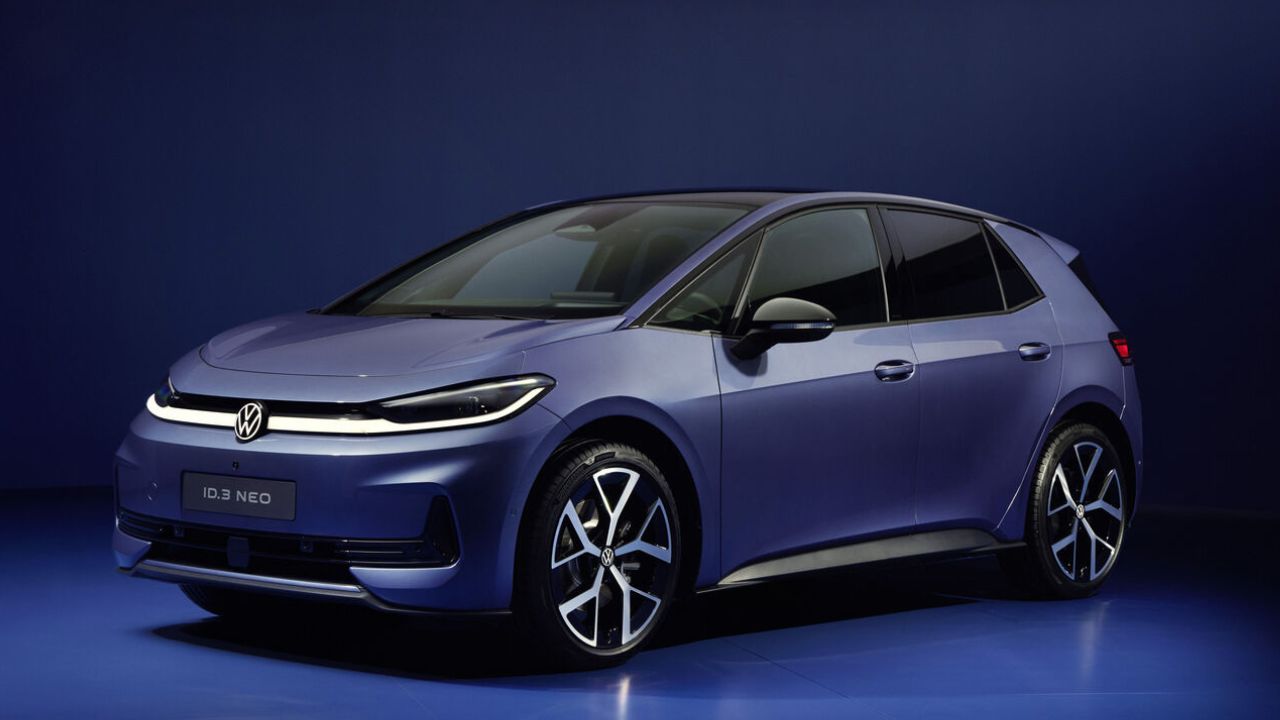
Volkswagen is giving its compact electric hatchback a major reboot, and it is not subtle. The new ID.3 Neo arrives with sharper styling, a heavily reworked cabin and a headline range figure of up to 630 kilometers, or about 391 miles, on the WLTP cycle.
Beyond the numbers, the ID.3 Neo shows how Volkswagen wants its mass-market EVs to feel more premium, more intuitive and more efficient, while staying firmly within reach of mainstream buyers in Europe and other key regions.
What happened
Volkswagen has unveiled the 2026 ID.3 Neo as the next evolution of its compact electric hatch, built on the familiar MEB platform but treated as a significant update rather than a minor facelift. The car introduces a new front fascia with slimmer LED headlights, a smoother bumper design and a reshaped hood that visually lowers the nose for a sportier stance, according to early design previews.
At the rear, the ID.3 Neo keeps its basic hatchback proportions but adopts revised LED taillights and subtle trim changes that align it with Volkswagen’s latest electric family look. Volkswagen positions the Neo as a core model within the ID.3 range rather than a separate nameplate, effectively making it the refreshed version of its compact EV for the 2026 model year, as outlined in official launch details.
The headline figure is the claimed range. With a new, larger battery option, Volkswagen says the ID.3 Neo can travel up to 630 kilometers on the WLTP test cycle, equivalent to about 391 miles. That top figure applies to the most efficient configuration, which pairs the biggest battery with modest wheels and the single-motor rear-drive layout. A smaller battery version sits below that flagship pack and offers a still-competitive range for urban and suburban use, according to early spec disclosures.
Power continues to come from a rear-mounted electric motor, with output tuned to balance brisk acceleration and efficiency rather than chasing performance-car numbers. Volkswagen has focused on improving real-world drivability and refinement, including updates to motor control software and noise isolation. The company also highlights improved charging performance, with the larger battery supporting higher DC fast-charging rates that shorten highway stops, according to technical briefings.
The interior sees some of the most noticeable changes. Volkswagen has responded directly to criticism of earlier ID models by bringing back more physical controls. The ID.3 Neo gains additional hard buttons on the steering wheel and center console, along with illuminated sliders for volume and climate functions that are easier to use at night. A larger central touchscreen, improved graphics and faster processing aim to make the infotainment system feel more responsive, as described in early technology rundowns.
Material quality has also been upgraded. Volkswagen uses more soft-touch surfaces, new seat fabrics and revised door trims to give the compact EV a more upscale feel. Some trims feature recycled and animal-free materials, reflecting the company’s broader sustainability messaging. Cabin storage and packaging remain similar, with a flat floor and generous rear-seat space for a car of this size.
On the driver-assistance front, the ID.3 Neo incorporates the latest versions of Volkswagen’s adaptive cruise and lane-keeping systems, along with automated parking functions and improved traffic sign recognition. Depending on market and trim, the car can also offer head-up display features and advanced navigation that integrates charging stops into route planning, according to feature breakdowns.
Pricing will vary by market, but Volkswagen intends to keep the ID.3 Neo positioned as a mainstream compact alternative to combustion-powered hatchbacks and compact crossovers. Early guidance suggests that the entry model will remain competitive with well-equipped versions of popular compact cars, while higher trims with the long-range battery and advanced tech will push into more premium territory, as indicated in early pricing previews.
Why it matters
The ID.3 has always carried more weight for Volkswagen than its size might suggest. It was pitched as the spiritual electric successor to the Golf, a core product meant to show that battery power could fit seamlessly into everyday European life. The ID.3 Neo is therefore not just a cosmetic refresh, but a test of whether Volkswagen has learned from the first generation’s missteps and customer feedback.
Range is the most obvious competitive lever. With a claimed 630 kilometers on the WLTP cycle, the ID.3 Neo’s top configuration moves into territory that only a handful of compact EVs currently reach. That figure gives Volkswagen a strong marketing hook against rivals that hover closer to 400 or 500 kilometers. For drivers in countries with dense charging networks, the extra buffer can turn a car from city-focused to genuinely road-trip capable, as emphasized in the range announcement.
The more significant story may be the interior rework. Early ID models drew criticism for their heavy reliance on touch-sensitive sliders and capacitive buttons that were hard to use on the move. Volkswagen’s decision to restore more physical controls, especially for core functions like climate and audio, suggests a broader industry shift back toward tactile interfaces after a wave of screen-heavy experimentation. The ID.3 Neo’s added buttons and illuminated controls are a clear response to those complaints, as outlined in interface reports.
Software is another pressure point. Volkswagen has invested heavily in its in-house software efforts, and the ID.3 Neo becomes one of the first mass-market products to benefit from that work in a more mature form. Faster infotainment responses, more reliable voice control and smoother over-the-air update capabilities are not just convenience features. They are now central to how buyers judge modern EVs, especially when comparing them with established electric players that have set expectations for seamless digital experiences.
For Volkswagen’s broader strategy, the ID.3 Neo helps shore up the middle of its electric lineup. The company has larger ID models targeting families and crossovers, as well as more affordable entries in development. A confident, well-rounded compact hatchback strengthens its position in markets where urban density and smaller roads make compact cars the default choice, as described in market positioning analysis.
The Neo also arrives amid intensifying competition from Chinese-built EVs in Europe. Brands such as BYD and MG are pushing aggressively into the same compact and midsize segments with sharp pricing and generous equipment. A more refined and efficient ID.3 gives Volkswagen a stronger answer to those challengers, especially if it can maintain local manufacturing advantages and brand loyalty.
There is also a regulatory dimension. European emissions rules continue to tighten, and mainstream automakers need high-volume EVs that can offset combustion sales. A compelling ID.3 Neo that sells in meaningful numbers helps Volkswagen meet fleet-average targets while keeping customers inside the brand. The long-range version in particular could appeal to drivers who might otherwise wait for future models or consider plug-in hybrids.
From a consumer perspective, the ID.3 Neo illustrates how quickly expectations around electric cars are rising. A few years ago, a compact EV with roughly 300 kilometers of range and a basic touchscreen felt advanced. Now, buyers in this segment can reasonably expect nearly double that range, faster charging, sophisticated driver-assistance systems and an interior that does not feel like a step down from similarly priced combustion models. The Neo’s blend of range, tech and improved ergonomics reflects that new baseline, as covered in early comparisons.
The styling update, while modest compared with a full redesign, also matters. Compact hatchbacks often rely on subtle cues to signal freshness. The ID.3 Neo’s revised front end, lighting signatures and trim details help it stand out in a crowded field of new EVs while staying recognizable to existing owners. That balance of continuity and novelty is key for a model that Volkswagen hopes will build on, rather than reset, the ID.3’s reputation.
Finally, the way Volkswagen prices and packages the ID.3 Neo will influence how quickly electric cars move from early adopters to the mass market. If the company can keep the base model accessible while offering tempting long-range and tech options, it can capture both budget-conscious buyers and those looking to replace a premium compact. Early spec and equipment suggest a broad spread of trims that aim to do exactly that.
What to watch next
The ID.3 Neo’s launch raises several questions that will play out over the next year. One is how closely real-world range will match the WLTP claim. European test cycles tend to be optimistic compared with mixed driving conditions, especially at highway speeds or in cold weather. Independent tests and owner reports will reveal whether the 630 kilometer figure translates into the kind of 500 kilometer-plus highway range that would materially change long-distance usability, as early engineering notes suggest Volkswagen is targeting.
Charging performance will be just as critical. Buyers increasingly look at how quickly a car can go from a low state of charge to a useful level at high-power DC stations. Volkswagen’s claims of faster charging with the larger battery will need to be validated against rivals that already advertise rapid 10 to 80 percent times. The shape of the charging curve, not just peak kilowatt numbers, will influence how the ID.3 Neo fits into long-distance travel patterns.
Another key factor is how much the interior changes resonate with drivers. The return of more physical controls and improved ergonomics has been widely welcomed in early coverage, but the real test will be daily use. If owners find that the new layout reduces distraction and makes common tasks easier, it could encourage other manufacturers to rethink all-touch interfaces. Early impressions in hands-on reports point in that direction, but long-term feedback will carry more weight.
Software reliability and update cadence will also be under close scrutiny. Volkswagen has had a bumpy transition into becoming a software-centric automaker. The ID.3 Neo provides a fresh opportunity to demonstrate that it can deliver smooth over-the-air updates, add meaningful features after purchase and avoid glitches that frustrate owners. The success or failure of that effort will influence perceptions of the wider ID lineup and future models built on updated platforms.
On the market side, analysts will watch how the ID.3 Neo’s sales mix breaks down between battery sizes and trim levels. A strong share for the long-range versions would indicate that buyers are willing to pay extra for maximum range, while robust demand for the entry model would show that price sensitivity still dominates in this segment. Early pricing analysis suggests that Volkswagen expects a healthy mix, but actual orders will reveal where the sweet spot lies.
There is also the question of geographic reach. The ID.3 has been primarily a European product, with limited presence in other regions. Observers will be watching to see whether Volkswagen expands the Neo’s availability to additional markets where compact hatchbacks have a niche but loyal following, or whether it keeps the model focused on Europe while leaning on crossovers elsewhere. That decision will play into how the company allocates production capacity and batteries across its portfolio.
More from Fast Lane Only