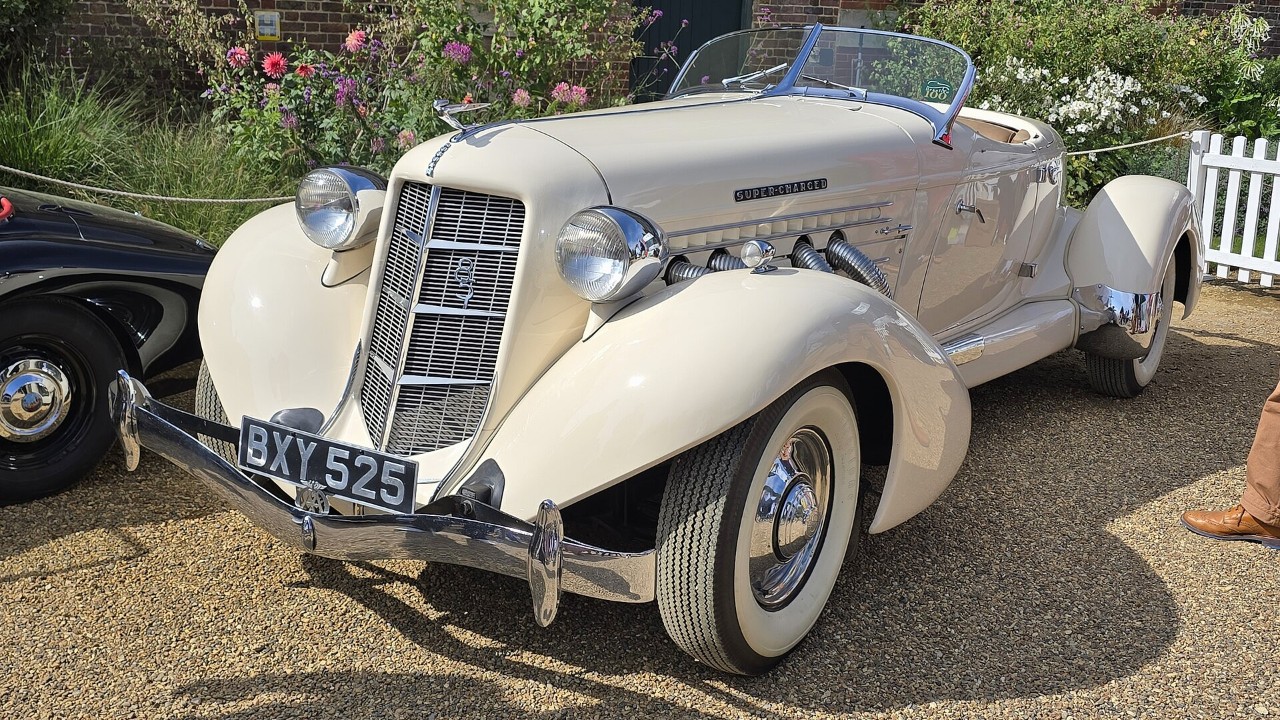
Every supercharged Auburn 851 Speedster left the factory with a small plaque on its dashboard. It carried race driver Ab Jenkins’ etched signature and a promise that the car had topped 100 mph before delivery. At the time, the car cost $2,245 at the factory in Auburn, Old Cars Weekly reports.
The plaque was more than a badge. It summed up what Auburn was selling: speed, style and a supercharger. Behind the car stood E.L. Cord’s company, an engineering firm in Indianapolis and a designer who reworked leftover bodies.
Here is what the plaque said, how the car earned it and where a certified example sits today.
What the dash plaque said
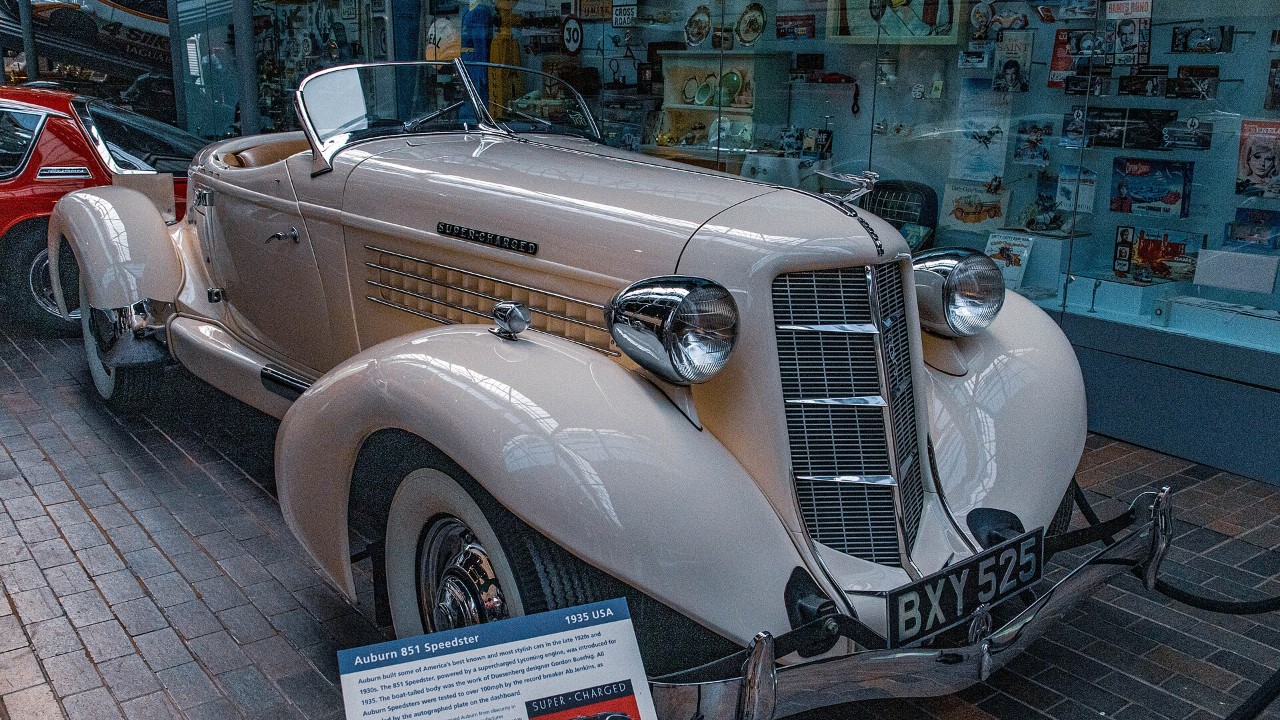
According to Old Cars Weekly, the plaque read: “This Auburn automobile was driven up to 100.6 mph prior to delivery.” Above all, Jenkins’ signature gave the words weight, because he was known for speed records at Bonneville.
However, the wording needs care. Old Cars Weekly notes that the speeds on these plaques varied from car to car. It also says Jenkins had not personally driven each Speedster to the noted speed. Instead, someone else did the driving before delivery, and the plaque carried Jenkins’ name.
The American Heritage Museum describes its own car’s plaque as “certifying this capability” of 100 mph. That car is certified at 101.3 mph. In other words, the number on each dash belonged to that one car.
How the Auburn 851 Speedster made its speed
First, the engine was a long-stroke L-head straight eight of 279.9 cubic inches. Old Cars Weekly credits its development to Herb Snow and George Kublin. It used a 3 1/16-inch bore, a 4 3/4-inch stroke and a Stromberg carburetor. A later Old Cars Weekly story adds that Lycoming built the engine, a company E.L. Cord had bought in 1927.
Without a blower, the eight made 115 hp at 3,600 rpm. With the supercharger, Old Cars Weekly reports, it made 150 hp at 4,000 rpm. That was a one-third gain, and the magazine says it came at low cost.
Schwitzer-Cummins of Indianapolis engineered the supercharger, with help from Augie Duesenberg. Auburn then geared it to spin at six times crankshaft speed. As a result, the blower turned about 24,000 rpm when the engine reached 4,000.
The driveline helped too. Auburn’s Dual-Ratio axle let the driver shift between a 5.1:1 ratio for acceleration and 3.7:1 for cruising. Because of that, the synchronized three-speed gearbox effectively had six gears. Altogether, the Speedster weighed 3,765 pounds, according to Old Cars Weekly.
A body built from leftovers
Auburn did not have money for an all-new car. In 1924, E.L. Cord had stepped in to save the company. By 1935, though, money was tight again.
Gordon Buehrig handled the problem. First, he further streamlined Alan Leamy’s 1934 design for all 1935 Auburns, according to Old Cars Weekly. Then, for the Speedster, finances dictated modifying leftover Speedster bodies from the 1931-1933 generation.
Buehrig gave those bodies a tapered boattail. Old Cars Weekly says he styled it after a Duesenberg SJ Speedster he had also designed. The link made sense, since Cord had bought out the Duesenberg brothers of Indianapolis.
The 1935 cars wore the badge of the Auburn 851 Speedster. For 1936, the Speedster continued as the 852, with the same supercharger standard and the same 150 hp, Old Cars Weekly reports. Even so, production was small. Experts estimate Auburn built about 150 Speedsters, according to the 1935 Old Cars Weekly profile.
Records at Bonneville
The plaque leaned on Jenkins’ reputation, and he had earned it in a Speedster. Old Cars Weekly says Jenkins drove a Speedster to set 70 international and national records at Bonneville.
The American Heritage Museum adds the run that mattered most. A Speedster driven by Jenkins at Bonneville became, in the museum’s words, the first fully equipped American stock car to exceed 100 mph for a twelve-hour period. That record gave the plaque’s 100-mph promise its backing.
The end of Auburn, and where to see one
The speed and the plaque did not save Auburn. According to the 1936 Old Cars Weekly profile, the company stopped building new Auburns at the end of 1936. Meanwhile, E.L. Cord retired to England after his family received threats following the Lindbergh kidnapping, Old Cars Weekly reports.
Later, some Speedsters sold for very little. For example, the 1936 profile notes that Gordon Craft of Riverside, California, found and bought one in 1956 for $900.
Today, however, a certified example sits in a public collection. The American Heritage Museum in Hudson, Massachusetts, shows a 1936 boattail Speedster from the Jacques M. Littlefield Collection. The museum calls the Model 851 Auburn’s crowning achievement. Its car’s dash plaque certifies a top speed of 101.3 mph.
More from Fast Lane Only