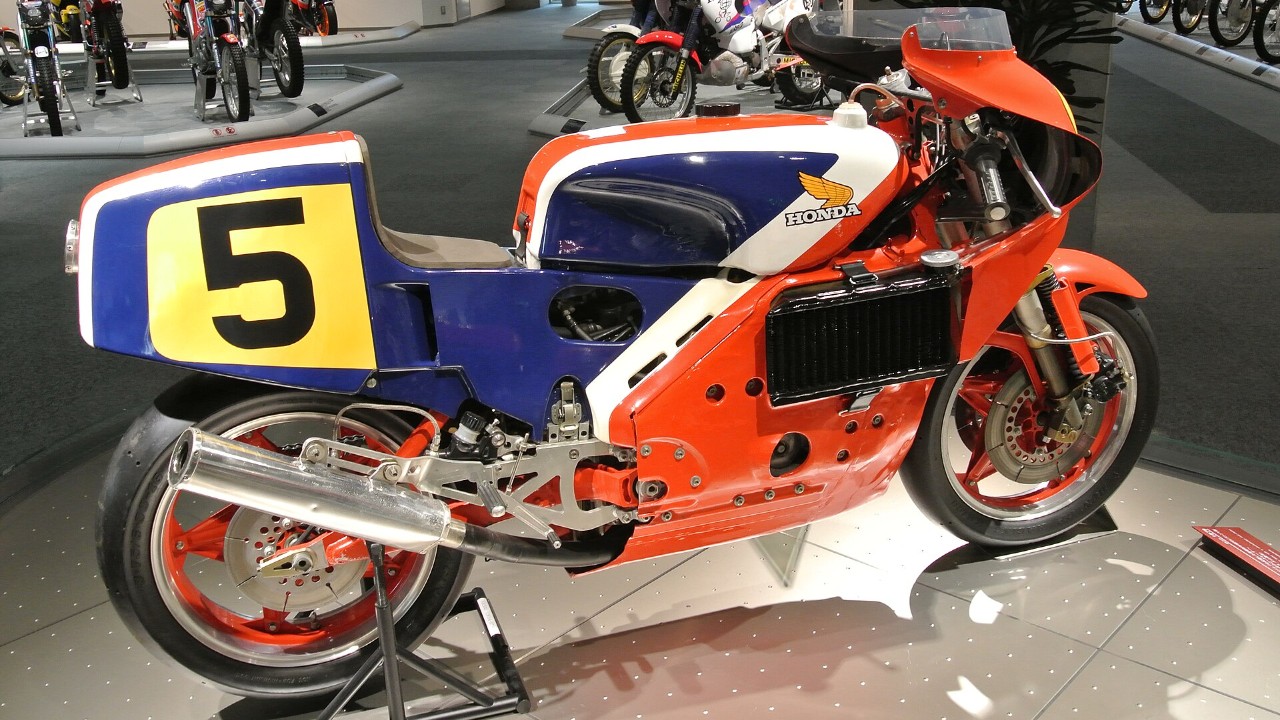
The Honda NR500 was a four-stroke Grand Prix racer built to beat two-strokes at their own game. To do it, Honda gave each cylinder an oval piston, two connecting rods, two spark plugs and eight valves. On paper, the engine could reach 23,000 rpm.
Honda’s engineers took that path because the rules left them little room. A four-cylinder limit meant a 500 cc four-stroke had to spin roughly twice as fast as usual to match the power of the two-strokes.
The bike won only once, and never in a world championship race. Still, Honda kept developing the oval-piston idea for years, and it finally reached the road in 1992.
Why Honda NR500 engineers chose a four-stroke
Honda announced its return to World Grand Prix racing in April 1978, according to Honda’s heritage history of the oval-piston engine. The NR (New Racing) Block formed at the Asaka R&D Center with three young staff members. Honda’s racing pages add that this marked a return after an 11-year absence.
A four-stroke was the obvious choice inside Honda, the heritage history says. The company had won many events with four-stroke engines. Founder Soichiro Honda also looked down on two-strokes, calling them “bamboo tubes.”
The problem was the competition. Rival two-strokes averaged about 120 hp, Honda’s history says. Its racing history adds that the factory Yamaha and Suzuki bikes weighed 130 kg. Meanwhile, Honda expected the NR500 engine to weigh about 10 kg more than the two-stroke engines.
The math behind 23,000 rpm
A two-stroke fires on every turn of the crankshaft, while a four-stroke fires on every second turn. World GP rules capped engines at four cylinders, so Honda could not simply add more of them. Instead, the heritage history explains, the four-stroke had to run at roughly twice its normal rpm.
That called for more valve area. Honda’s NR500 development history says the first NR500 needed four intake and four exhaust valves per cylinder to reach 130 PS at 20,000 rpm with 1970s technology. In fact, a single large valve of 28 mm was beyond the valve springs of the time, so the team settled on small 20 mm valves.
Eight valves would not fit over a round bore, however. Project leader Irimajiri found the answer while waiting at a traffic light outside the Asaka center, according to the racing history. He would stretch the cylinder into an oval.
Oval pistons with two connecting rods
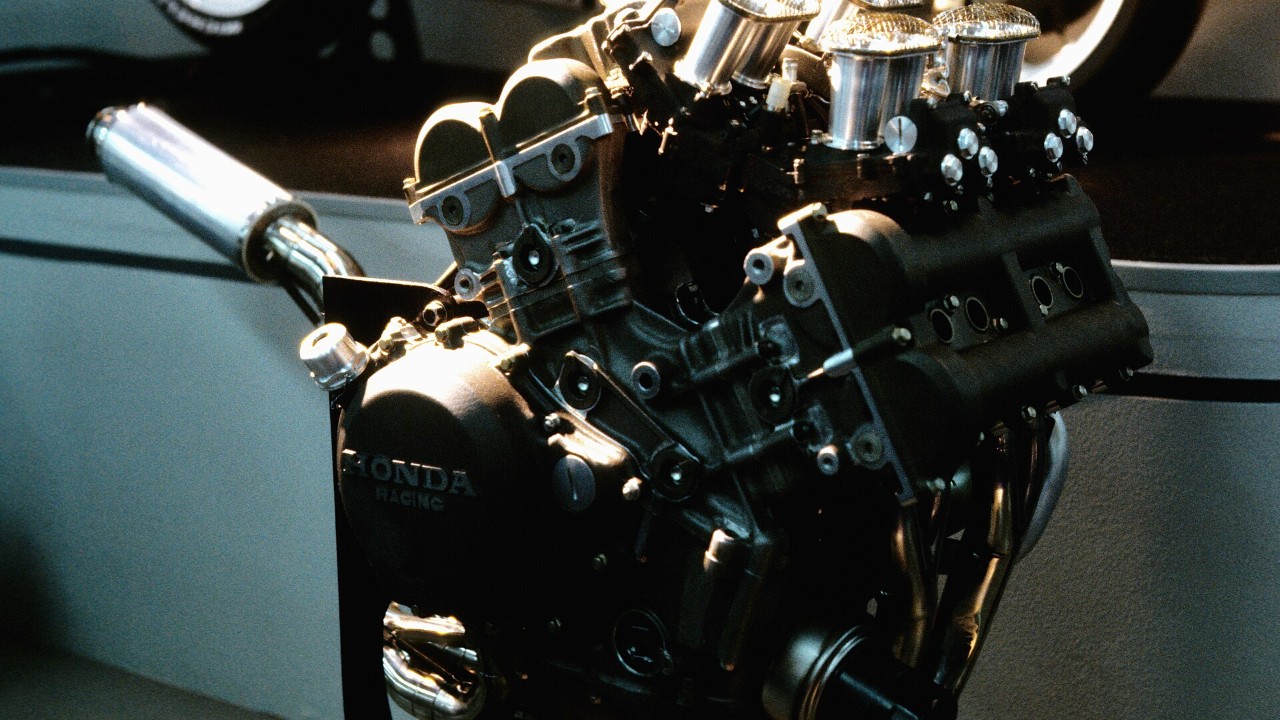
An oval combustion chamber still allowed two camshafts per head, as in a normal DOHC engine. Each oval piston rode on two connecting rods. Because the flame could not spread evenly across a long, narrow chamber, Honda also fitted two spark plugs per cylinder.
The numbers show how odd the shape was. Honda lists the bore at 93.4 mm on its long axis and 41.0 mm on its short axis, with a 36.0 mm stroke. By comparison, a round bore with the same stroke and volume would have measured 66.4 mm. Engineers also capped piston speed at 24 meters per second or less, so friction would stay low enough to pass 20,000 rpm.
Sealing the piston was the hardest job. Where the curved ends met the straight sides, the rings tended to twist. As a result, Honda tested four split-ring designs and found all of them lacking. In the end, it chose one-piece self-tensioning compression rings for the engine.
Honda calls the result the world’s first non-round piston engine in actual use. Put together, the eight-valve oval-piston engine was estimated to reach 23,000 rpm and 130 hp, according to the heritage history.
A hard debut at Silverstone
Bench testing of the first four-cylinder engine, the 0X, began in April 1979. Honda completed two NR500s in July, and the bikes debuted at the British Grand Prix at Silverstone in August 1979. The 1979 bike’s tachometer read to 21,000 rpm, with a rev limit mark at 20,000 rpm, Honda’s racing history notes.
The engine was not ready, though. At the time of the race, it made 100 hp at 16,000 rpm, short of the target. Both bikes barely qualified. Then Mick Grant fell at the first corner, and Takazumi Katayama retired after several laps with engine trouble. Later that season, both riders failed to qualify at the French GP.
One Honda NR500 win, then the NR750
Honda kept developing the engine. The heritage history says that in July 1981, Freddie Spencer led Kenny Roberts at Laguna Seca on the 2X version before retiring with an electrical problem. That same year, Kengo Kiyama won the Suzuka 500 km race on the NR500, its only victory.
By 1982, the 2X engine made 135 hp, according to Honda. Even so, Honda introduced its NS500 two-stroke as a compromise that year. Honda’s heritage history gives the later 3X engine 130 hp at 19,500 rpm in 1983. “Although it couldn’t win a race,” engine designer Toshimitsu Yoshimura said, “the 3X was very close to the complete form of an oval-piston engine.”
The idea did not end with racing. In 1992, Honda released the NR750 road bike, which drew on the ten-year NR project, according to its heritage history.
More from Fast Lane Only