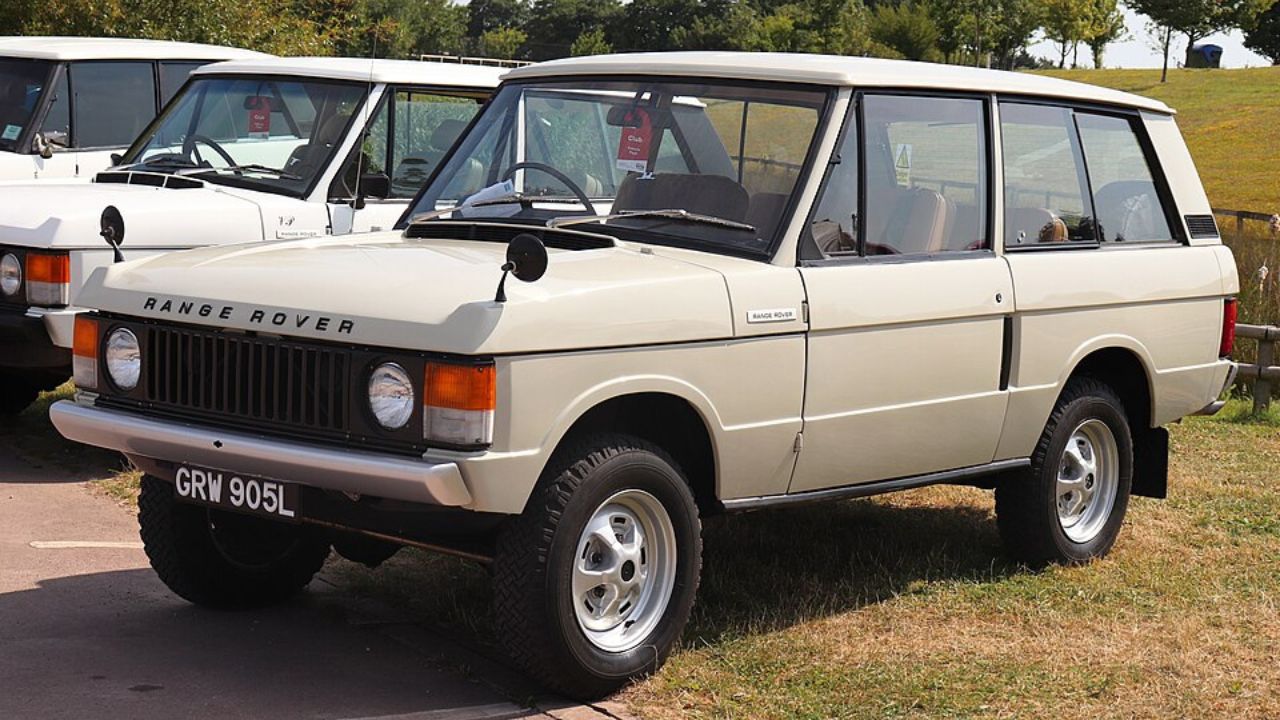
Long before leather-lined crossovers clogged city streets, a boxy British 4×4 quietly rewrote the rules for what an off-road vehicle could be. When the first Range Rover arrived in 1970, it fused serious trail hardware with everyday comfort in a way that felt almost implausible to drivers raised on bare-metal workhorses. The modern luxury SUV traces a direct line back to that moment, when Land Rover decided that mud-plugging ability and social status no longer had to live in separate garages.
The 1970 Range Rover did more than create a new model line. It proved that a vehicle could carry a family across a field, up a mountain track, then pull up outside a restaurant in town without looking out of place, and that single idea still shapes the premium SUV market half a century later.
From farm tracks to family driveways
To understand why the first Range Rover felt so radical, it helps to look at what came before it. Early Land Rover products such as the Series 1 were conceived as agricultural tools, something a farmer might park beside a tractor rather than outside a hotel. In one modern walkaround of a Land Rover Series 1, the presenter describes going “way way way back in time” to a machine that is “genuinely” basic, a reminder of how utilitarian those origins were, with the Land Rover Series presented as a kind of mechanical time capsule.
The project that became the Range Rover set out to bridge that world and everyday family life. One retrospective on the 1970 model notes that it effectively merged an off-roader with a family wagon, and that it could perform both roles better than most single-purpose competitors of the era. Instead of forcing buyers to choose between a crude 4×4 and a comfortable estate car, the new model promised both sets of strengths in one package.
The gamble rested on a simple assumption. There were drivers who wanted to tow a horse trailer, climb a muddy track or cross a field, then drive home at motorway speeds without feeling punished by noise, vibration or cramped space. The 1970 Range Rover was built around that use case, and it quickly found an audience that had been underserved by the traditional split between work trucks and passenger cars.
The 3.5‑liter V8 and a new kind of performance
Under its square bonnet, the original Range Rover carried hardware that set it apart from the tractors-with-seats that had defined 4x4s. A period comparison highlights the 1970 Range Rover Classic with a 3.5L V8 carbureted engine, identified simply as a “3.5L V8 (carbureted)” in the 1970 vs. 2024 breakdown. That engine gave the car relaxed cruising ability and brisker acceleration than most rivals, which were often saddled with slow, noisy diesels or small petrol units.
The drivetrain combined permanent four-wheel drive with a two-speed transfer case, so the Range Rover could crawl over rough ground yet still sit at high road speeds without feeling strained. Contemporary descriptions of the model’s impact on American buyers point to touches like four-wheel disc brakes and the use of aluminum body panels on a steel frame to reduce weight, all wrapped in a body-on-frame design that preserved off-road toughness. This mix of power, braking confidence and structural strength meant the car could be driven hard on tarmac and then pointed at a rutted track with equal assurance.
In an era when most 4x4s were still slow and noisy, the V8 soundtrack and relatively smooth road manners felt almost decadent. The Range Rover did not just go further off road; it did so at higher average speeds on the way there, with less fatigue for the driver and passengers.
Utilitarian roots hiding under clean design
Modern buyers tend to imagine the Range Rover as a pure luxury object, but the first generation was more modest inside. A factory retrospective points out that despite the luxury status of the brand today, the early Range Rovers were designed to be utilitarian vehicles. They had vinyl seats and a simple, wipe-clean interior, a detail that is spelled out in a post that notes that “Despite its luxury status today, the early Range Rovers were designed to be utilitarian vehicles. They had vinyl seats and a si…” in a factory account of those first prototypes.
The cabin was deliberately sparse, with flat surfaces and easily hosed-out materials, because the designers expected owners to treat the vehicle as a working tool. Yet even in that stripped-back form, the seating position, glass area and ride quality felt more car-like than the Series models that came before. The car’s creators were not chasing plushness in 1970 so much as usability and refinement compared with the farm-oriented 4x4s that dominated the segment.
That balance between work-ready practicality and daily comfort became part of the Range Rover’s identity. It allowed owners to use the car as a family wagon during the week and a tow vehicle or shooting brake at the weekend, without feeling that they were sacrificing comfort in either role.
A global debut that reset expectations
The Range Rover’s impact was not confined to Britain. In a 50th anniversary retrospective, one presenter notes that “50 years ago the world was completely changed because it was in June of 1970 that the Range Rover made its global debut,” an anniversary that underlines how quickly the model reshaped expectations of a 4×4. The phrase “June of 1970” and the reference to “50” years are used to frame how the global debut became a turning point for the segment.
From the outset, the car was pitched as equally at home in the countryside and in more glamorous settings. Official material on the classic model describes a European Model Shown that is “Equally at home on Place du Casino, Monaco, as it is in the Sahara Desert,” positioning the Range Rover as a vehicle that could sit outside Place du Casino, Monaco, one day and cross the Sahara Desert the next. That duality, presented on the classic model page, crystallized the idea that serious off-road capability and social cachet could coexist in a single product.
Launched by the British Leyland Motor Corporation, the first production version carried the familiar Land Rover badge into a new space. One retrospective describes how it was Launched in 1970 by the British Leyland Motor Corporation and how the first Range Rover was a game-changer because, Unlike the utilitarian Land Rovers that came before, it targeted a more comfort-oriented buyer. The contrast between the Range Rover and the earlier Land models is spelled out in a modern history that highlights this shift.
Britain’s new 4×4 status symbol
In its home market, the Range Rover quickly became more than a tool. A modern commentator describes it as a “king sitting on his throne since 1970” that ruled alone in Britain’s concrete jungle, a phrase used in a video that opens with the line “on today’s episode we have a king sitting on his throne since 1970 deep in Britain’s concrete jungle the Range Rover ruled alone.” The description of Britain and the Range Rover in that urban-focused clip captures how the car moved from muddy fields to city streets without losing its off-road identity.
Another account of the brand’s evolution calls it “Britain’s best luxury 4×4” and notes that the first Range Rover rolled off the production line in Solihull, tying the model to a specific place in British industrial history. That framing in a heritage feature reinforces how closely the vehicle is associated with Britain’s manufacturing story and with a particular image of rural and urban sophistication.
Over time, the Range Rover name survived multiple ownership changes, moving from British Leyland to BMW and beyond, yet it kept the core heritage established by its original designer. A brand history notes that Range Rover has evolved through multiple ownership transitions, from British Leyland to BMW, while preserving the heritage established by original designer Spen King, a point highlighted in a branding overview. That continuity helped the car remain a status symbol even as the market around it changed.
Luxury and Off‑Road Capability in one package
What made the 1970 Range Rover different was not just that it rode better or looked cleaner than a farm truck. It was that it offered genuine Luxury and Off Road Capability in a single package. A modern enthusiast group describes how Range Rover is renowned for combining luxury with exceptional off-road capability and notes that it was one of the first to do so, a sentiment captured in a post that explicitly pairs “Luxury and Off Road Capability” in a discussion of 6‑wheelers and other variants.
That combination was not marketing spin. The car’s long-travel suspension, robust axles and permanent four-wheel drive meant it could tackle rough terrain that would stop many later crossovers. At the same time, the interior, even in its early vinyl-trimmed form, provided better seating comfort and visibility than most rivals. As later generations added leather, wood and more insulation, the basic template remained the same: a vehicle that could cross a muddy field in the morning and roll up to a red carpet event in the evening.
The manufacturer itself leans into this dual image. Official descriptions of the classic model emphasize that it is as comfortable outside a casino as in a desert, and modern marketing continues to present the Range Rover as a bridge between rugged adventure and discreet luxury. That identity traces directly back to the original 1970 design brief.
Crossing the Atlantic and redefining “luxury” for SUVs
The Range Rover’s influence grew further when it reached American buyers. A detailed account of its arrival in the United States explains that Land Rover used the model to introduce a more luxurious interpretation of the brand to American audiences. The piece highlights hardware such as four-wheel disc brakes, aluminum body panels on a body-on-frame chassis and a focus on comfort that differed from the bare-bones utility vehicles Americans associated with British 4x4s, a narrative laid out in an analysis of how the Range Rover Brought to America.
For American buyers used to domestic trucks with basic interiors, the combination of European design, capable suspension and a relatively refined cabin felt new. The Range Rover showed that a four-wheel-drive wagon could be aspirational, not just practical. It helped set the stage for later waves of luxury SUVs from other European brands, which followed the same formula of combining high seating positions and off-road styling with comfort and status.
In that sense, the 1970 model did not just create a niche product. It helped define what the word “luxury” would come to mean when attached to an SUV, first in Britain, then in the United States and eventually around the world.
More from Fast Lane Only