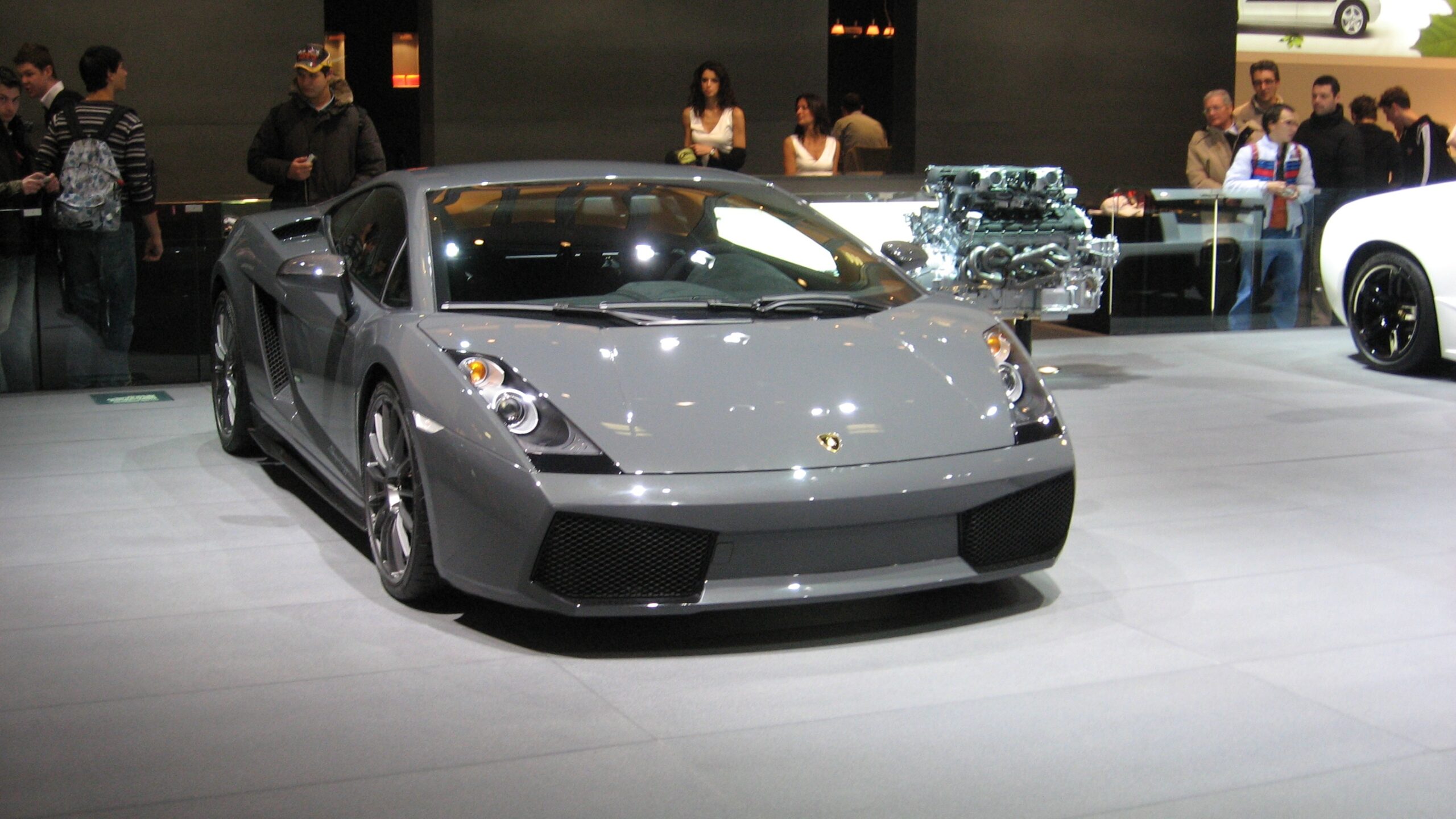
The 2007 Lamborghini Gallardo Superleggera arrived as a focused, stripped-back evolution of the standard Gallardo, shedding around 100 kilograms while keeping its naturally aspirated V10 at center stage. In an era already drifting toward turbocharging and electronic filters, it offered a rawer connection between driver, engine, and road. Nearly two decades later, that combination of light weight and high-rev drama looks less like a special edition and more like a snapshot of a disappearing philosophy.
From Gallardo to Superleggera
By the mid-2000s, the regular Gallardo had established itself as Lamborghini’s entry model, a more usable counterpoint to the Murciélago with a 5.0 liter V10, All Wheel Drive, and a relatively compact footprint. The Superleggera variant sharpened that formula instead of rewriting it. Engineers focused on mass and response, trimming roughly 100 kilograms through extensive use of carbon fiber for the rear diffuser, mirror housings, engine cover, and interior panels, and by swapping the standard seats for lightweight buckets. Even the side glass and polycarbonate rear window contributed to the diet.
The powertrain remained a naturally aspirated V10, but output climbed modestly compared with the early Gallardo, and the engine’s character did most of the talking. Rather than chasing huge power with forced induction, the Superleggera leaned on a freer-breathing intake and exhaust, a slightly higher redline, and recalibrated throttle response. The result was not only a better power-to-weight ratio but also a sharper feel when the driver worked the last third of the rev range.
Transmission choice framed the car’s personality. Many examples used the automated single-clutch e-gear system, which delivered aggressive upshifts at full throttle but felt clunky at low speeds. A smaller number left the factory with a gated six-speed manual, pairing the lighter shell with a direct mechanical link that enthusiasts now prize. In either form, the drivetrain emphasized engagement rather than isolation.
Weight saving as a philosophy
The 100 kilogram reduction in the Superleggera was not an arbitrary statistic. It reflected a clear decision to chase lap time and feel through subtraction instead of simply adding power. The diet touched almost every part of the car. Interior sound deadening was pared back, the rear seats were deleted entirely, and even the floor mats were reconsidered. Options were curated to avoid bloat, so buyers who wanted the lightest configuration had to accept a more Spartan cabin and a louder, more resonant ride.
This approach echoed motorsport practice, where engineers often say that losing weight is like gaining power everywhere. A lighter car accelerates harder, brakes shorter, and changes direction more readily. For the Superleggera, the weight loss also helped offset the compromises of all wheel drive, which added traction but carried a mass penalty compared with rear-drive rivals. The car’s agility in medium-speed corners and under braking owed as much to the diet as to any software tuning.
Visually, the philosophy showed up in detail. Exposed carbon fiber components signaled function as much as style. The fixed rear wing, available on many cars, did more than shout about performance. It added downforce at higher speeds, working in tandem with the deeper front splitter and rear diffuser to keep the lighter chassis stable. The overall effect was a Gallardo that looked leaner and more purposeful without resorting to exaggerated aero add-ons.
The sound and feel of natural aspiration
What set the 2007 Superleggera apart from many later performance cars was not only its mass but also the way its engine delivered power. The 5.0 liter V10 used direct breathing rather than turbocharging, so torque built progressively, and the final 2,000 rpm delivered a surge that encouraged drivers to chase the redline. There was no artificial torque plateau, no sudden wall of boost. Instead, the engine rewarded precise throttle inputs and careful gear selection, especially on track.
The soundtrack played a large role in the experience. With less insulation and a freer-flowing exhaust, the Superleggera filled its cabin with induction roar and high-pitched mechanical noise. At low revs, the car sounded busy and slightly coarse, which some owners found tiring on long journeys. At full load, however, the V10 produced a layered note that climbed from a bass-heavy growl to a metallic shriek. That soundscape became part of the car’s identity and helped cement its status among collectors who value sensory drama over outright speed.
Steering and chassis tuning complemented the powertrain. The Superleggera rode on stiffer springs and dampers than the standard Gallardo, with a lower ride height that reduced roll and sharpened turn-in. The steering rack remained hydraulically assisted, which gave a more textured sense of grip than many later electric systems. Combined with the lighter curb weight, the result was a car that felt more eager to rotate into a corner and more communicative at the limit.
Context: before turbo dominance
When the Superleggera arrived, turbocharging had already taken hold in mainstream performance cars, but naturally aspirated engines still defined many supercars. Over the following decade, emissions and efficiency targets pushed even exotic brands toward smaller, boosted units. By the mid-2010s, turbocharged V8s and V6s were common in cars that once would have relied on large, high-revving engines. That shift cast the Superleggera in a different light. Its relatively simple, unboosted V10 became a reference point for drivers who preferred linear response and unfiltered sound over the flexibility of turbo torque.
The Gallardo’s successor, the Huracán, initially kept the naturally aspirated formula, again with a V10 and All Wheel Drive. Yet even around that car, the market was changing. Rivals adopted twin-turbo layouts, hybrid assistance, or both. The Superleggera’s focus on weight reduction and mechanical character began to look like an early statement of resistance to trends that would soon dominate the segment.
At the same time, electronics grew more sophisticated. Stability control, variable drive modes, and adaptive dampers became standard in many high-end performance cars. The 2007 Superleggera offered only a basic selection of modes and relatively simple traction systems compared with later models. For some drivers, that simplicity was part of the appeal. It required more judgment and rewarded skill, especially with systems relaxed or disabled on track.
From Gallardo Superleggera to Huracán specials
The Superleggera badge did not end with the Gallardo. As development of the Huracán progressed, attention turned to a lighter, more track-focused version that would echo the earlier car’s philosophy. Prototypes of a Huracán Superleggera were seen testing with revised aero, a more aggressive exhaust, and subtle tweaks that suggested a renewed push for weight reduction. One development car wore a large fixed rear wing and reworked bumpers that pointed to a more serious track intent.
Spy photographers captured Huracán test mules lapping circuits with masked bodywork and new intakes, hinting at a package that would again prioritize downforce and reduced mass over a radical power increase. Reports on the Huracán Superleggera suggested that engineers were pursuing the same basic recipe as the 2007 car: cut weight where possible, refine aero, and leave the naturally aspirated V10 largely intact.
Further sightings showed development continuing at pace, with camouflaged Huracán prototypes testing revised exhaust layouts and more aggressive rear diffusers. Observers noted that these cars appeared to sit lower and to run wider rubber than the standard model, again echoing the Gallardo Superleggera’s stance. Coverage of ongoing development highlighted how the brand was leaning on lessons from its earlier lightweight special while adapting them to modern expectations for grip and stability.
Why the 100 kg diet still matters
The significance of the 2007 Superleggera’s weight loss becomes clearer when viewed against the steady growth in curb weights across the industry. Safety regulations, comfort features, and complex drivetrains have pushed many modern performance cars well beyond the mass of their predecessors. A 100 kilogram cut in that context is not just a number. It represents a rare move in the opposite direction.
On track, the benefits are measurable. A lighter car typically stops in a shorter distance from a given speed and puts less strain on brakes and tires. That can translate into more consistent performance over a long session, with reduced fade and slower heat buildup. For owners who track their cars, the Superleggera’s diet offered a tangible edge over the standard Gallardo, even if the official power figures were not dramatically different.
On the road, the effect is more subtle but still present. The lighter body responds more quickly to steering inputs, and the suspension can be tuned with slightly softer rates for the same level of control, which helps ride quality. The car feels less inert, more willing to change direction, and more transparent about grip levels. These qualities are hard to replicate simply by adding power or electronic trickery.
The Superleggera also showed that a manufacturer could create a more focused variant without resorting to extreme measures that compromised everyday use. The car retained air conditioning, basic infotainment, and a usable driving position. It was not a stripped race car with license plates. That balance broadened its appeal and influenced how later special editions from various brands approached the problem of adding intensity without alienating buyers who still wanted to drive to dinner.
Collector appeal and long-term legacy
As turbocharged and hybrid supercars have become more common, interest in older, naturally aspirated specials has grown. The 2007 Gallardo Superleggera sits near the center of that trend. It combines an early-generation Lamborghini V10 with a relatively short production run and a clear engineering story built around weight and response. Collectors value that clarity, especially when it comes with a manual gearbox option.
Values for well-kept examples have reflected this shift, with manual cars in particular attracting attention from enthusiasts who see them as the last opportunity to pair a high-revving V10 with a traditional shifter in a compact package. The car’s visual details, from its carbon fiber accents to its distinctive graphics, mark it as a late-2000s period piece, yet its core ingredients align with current enthusiasm for analog driving experiences.
The Superleggera’s influence extends beyond the used market. Its formula of modest power gains, significant weight loss, and sharpened dynamics has become a template for many brands when they create track-leaning versions of their standard models. Whether labeled as Clubsport, RS, or something else, the underlying idea often looks similar to what Lamborghini put into practice with the Gallardo in 2007.
What to watch next in lightweight supercars
The broader question raised by the 2007 Superleggera is how far modern supercars can continue to prioritize light weight and natural aspiration in a regulatory environment that favors efficiency and lower emissions. The Huracán and its anticipated track specials represent one path, keeping the V10 while relying on aero and chassis tuning to deliver gains. Future models may have to blend hybrid assistance with downsized engines, which could change the character of these cars even if outright performance improves.
Enthusiasts watching the evolution from Gallardo to Huracán and beyond are paying attention to how brands handle sound, response, and mass. Electric assistance can fill torque gaps and enable clever torque vectoring, but it also adds weight and often mutes engine character. The challenge is to retain some of the immediacy that defined the Superleggera while meeting modern standards.
More from Fast Lane Only
- Unboxing the WWII Jeep in a Crate
- 15 rare Chevys collectors are quietly buying
- 10 underrated V8s still worth hunting down
- Police notice this before you even roll window down
*Research for this article included AI assistance, with all final content reviewed by human editors.