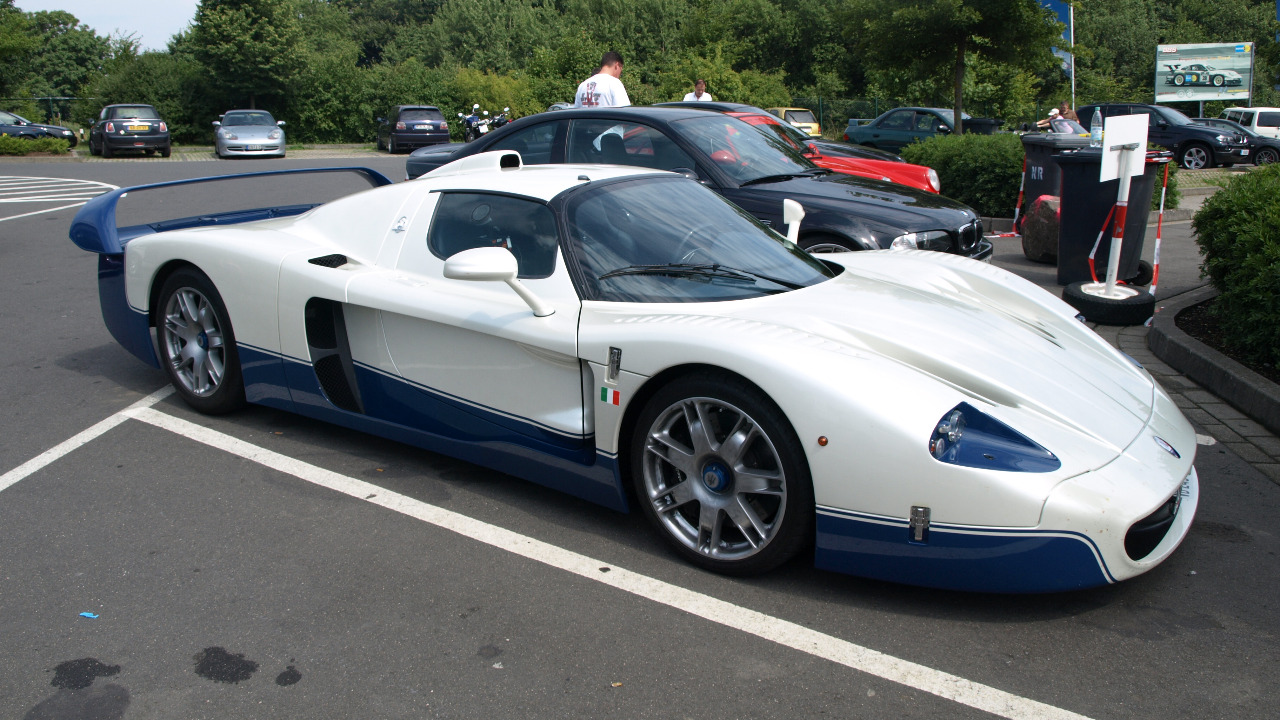
The Maserati MC12 arrived in 2003 as a barely tamed race car, built first to win on track and only second to satisfy road regulations. With a screaming V12, a vast carbon shell and a production run that stayed in double digits, it embodied a brief era when homologation really meant turning a competition machine into something that wore number plates. Two decades on, it still feels closer to a GT racer than a conventional supercar.
What began as a tool for FIA GT success has become one of the most coveted Maseratis ever built, with collectors now chasing the few surviving examples that remain in original condition. The car that once terrorized circuits has become a blue-chip artifact of analog performance, and its story shows how Maserati tried to reassert itself at the top of the performance hierarchy.
From GT racing project to road-legal weapon
The MC12 started life as a racing program, created so Maserati could compete in FIA GT competition with a car that shared its core with the Ferrari Enzo but wore its own body and badge. Regulations required a small batch of road cars, so Maserati built a limited series of street-legal “Stradale” versions that stayed very close in specification to the GT racer. The chassis used a carbon fiber and aluminum structure, and the bodywork was shaped around aerodynamic efficiency rather than curbside glamour.
Compared with the Enzo, the MC12 was longer, wider and more focused on downforce, with an integral rear wing and a dramatic tail that stretched well beyond the rear axle. The cabin sat far forward, the nose was low and pointed, and the rear deck was essentially a sculpted airflow management surface. Maserati did not chase all-round usability; it chased lap times and stability at very high speed, then adapted that package just enough for public roads.
Engine, gearbox and raw performance
At the heart of the MC12 sat a naturally aspirated V12 that shared its basic architecture with Ferrari’s F140 unit but was tuned specifically for Maserati’s needs. Displacement, cylinder count and layout matched contemporary Ferrari flagships, yet Maserati calibrated the engine for a different balance of torque and top-end power, and paired it with its own exhaust and intake systems. The result was a power figure that comfortably cleared 600 horsepower and a rev range that rewarded drivers who stayed near the limiter.
Power went to the rear wheels through an automated manual gearbox that used paddle shifters behind the steering wheel. Shifts were abrupt by modern standards, with a clear mechanical jolt through the drivetrain at each upchange, but that directness suited the car’s character. The MC12 would sprint from rest to highway speeds in a handful of seconds and run on to a top speed well beyond 200 miles per hour, performance that placed it among the fastest production cars of its time.
The suspension used double wishbones with pushrod-actuated springs and dampers, a layout taken directly from racing practice. Ride quality on imperfect roads could be harsh, yet the payoff came in body control and turn-in precision. Braking hardware relied on large carbon-ceramic discs that resisted fade during repeated high-speed stops and helped keep unsprung mass in check.
Aero, grip and the feel of a GT1 car
What truly separated the MC12 from many of its contemporaries was the way it generated grip. The long tail, fixed rear wing, deep front splitter and carefully sculpted underbody created significant downforce at speed, which in turn allowed the suspension to be tuned for stability rather than softness. On a circuit, the car felt planted in fast corners and encouraged drivers to carry more speed than they might expect from a road-legal machine.
The steering, unfiltered by modern electronic aids, transmitted road texture and load changes directly through the wheel. Combined with the rigid carbon structure, it gave the MC12 a sense of connection that many later hypercars, softened by layers of software, never quite matched. Drivers who sampled both the MC12 and its Ferrari cousin often described the Maserati as the more serious, less forgiving car, one that demanded respect but rewarded commitment with extraordinary pace.
Limited production and collector appeal
Maserati kept production of the MC12 extremely low, with total road-going output measured in dozens rather than hundreds. Each car left the factory with a distinctive blue and white livery that referenced historic Maserati racing colors, and the company offered minimal scope for customization. That scarcity, combined with the car’s racing pedigree, has turned the MC12 into one of the most desirable Maseratis on the market.
Collector demand has grown as the broader market for analog hypercars has surged. A recent auction listing for a Maserati MC12 Stradale highlighted how prized original examples have become, with a low-mileage car positioned as the lead lot at a high-profile Monterey sale. The listing emphasized that the MC12 Stradale is a “supercar” built around a carbon fiber monocoque and finished in the model’s signature Bianco Fuji and Blu Victory color scheme, a combination that underlines its link to Maserati’s competition history and helps explain its rising valuation at events such as the Monterey Jet Center auction.
Prices for top-condition cars now sit firmly in the hypercar tier, reflecting not only rarity but also the perception that the MC12 represents a high point for Maserati’s engineering ambition. Collectors view it as a bridge between the analog race-bred machines of the 1990s and the hybrid, software-heavy hypercars that followed.
Inside the cabin: compromise in the name of speed
The MC12’s interior made few concessions to luxury. While the cabin featured leather and carbon fiber trim, the driving position, visibility and ergonomics were dictated by the car’s structural and aerodynamic layout rather than comfort priorities. The thick central tub, wide sills and low roofline made entry and exit awkward. Once seated, the driver faced a simple instrument cluster, paddle shifters and a steering wheel that prioritized function over ornament.
Noise levels were high, with the V12’s intake and exhaust note dominating the experience even at moderate speeds. Rear visibility was limited by the long tail and fixed wing, which meant parking and low-speed maneuvers required caution. Air conditioning and basic audio were present, but the overall impression was of a car that tolerated road use rather than embraced it. For many owners, that was exactly the point: the MC12 felt like a racing car that happened to carry a registration plate.
Racing success and brand revival
On track, the MC12 delivered the results Maserati needed. The GT1 race versions competed in international GT series and collected multiple wins and championships, reestablishing Maserati as a force in high-level sports car racing after a long absence. That success fed back into the road car’s image. Buyers were not simply purchasing an exotic V12 coupe; they were buying a car whose silhouette and core engineering matched the machines they could watch fighting for podiums in endurance events.
For Maserati as a brand, the MC12 signaled a renewed commitment to performance at the highest level. It arrived during a period when the company was rebuilding its lineup and reputation, and it gave the marque a clear halo product that sat above the more conventional GT models. The car’s presence in showrooms, even in tiny numbers, helped draw attention to the rest of the range and reminded enthusiasts of Maserati’s racing heritage.
How it stacked up against rivals
The MC12 did not exist in a vacuum. It shared its era with cars such as the Ferrari Enzo, Porsche Carrera GT and Mercedes-Benz SLR McLaren, each of which approached the supercar brief differently. Where the Enzo balanced road and track use, the MC12 leaned further toward circuit performance, sacrificing practicality and subtlety. The Carrera GT offered a manual gearbox and a more compact footprint, while the SLR McLaren combined grand touring comfort with supercharged power.
In that company, the Maserati stood out for its size, its focus on aerodynamics and its direct link to an active factory racing program. It was less suited to city use or daily driving than some rivals, but it offered an experience that felt closer to piloting a GT1 car on slicks. For buyers who valued that sense of purpose, the compromises in visibility, noise and ride comfort were acceptable trade-offs.
Legacy in a turbo and hybrid age
Looking back from a market filled with turbocharged and hybrid-assisted hypercars, the MC12 represents a different philosophy. Its naturally aspirated V12, relatively low reliance on electronic driver aids and racing-derived chassis emphasized driver skill and mechanical grip. There were no hybrid batteries to fill torque gaps, no advanced stability systems to mask mistakes and no configurable driving modes to soften its edges.
That character has become more attractive to collectors and track-focused drivers as modern performance cars grow heavier and more complex. The MC12 demands commitment and attention, yet it also offers clarity. Inputs produce immediate, predictable responses, and the car’s limits, while extremely high, can be approached progressively by an experienced driver. In an era dominated by turbocharged torque curves and software-managed traction, that analog quality adds to its appeal.
What enthusiasts and buyers should watch
For enthusiasts, the MC12’s trajectory in the collector market will remain a key storyline. Auction results for low-mileage, well-documented cars will continue to set benchmarks for Maserati’s top-tier models and influence how the brand’s more recent performance cars are valued. Any appearance of an MC12 at a major sale or concours event tends to draw attention, both because of the car’s rarity and because each example often carries a detailed history of ownership and use.
Potential buyers need to consider the practical realities that come with ownership. Parts specific to the MC12 are scarce, and servicing requires specialists familiar with both Maserati’s systems and the shared Ferrari-based components. Track use, while tempting, can accelerate wear on expensive items such as carbon-ceramic brakes and suspension components. For many owners, the solution has been to treat the MC12 as a carefully exercised collection piece, driven occasionally on road or track but maintained with long-term preservation in mind.
For Maserati itself, the MC12 sets a high bar for any future halo model that aims to recapture the same blend of racing credibility and road-legal drama. As the industry moves deeper into electrification, any successor will likely need to combine electric assistance with lightweight construction and advanced aerodynamics. The original MC12 shows that when Maserati commits to a clear performance target, it can build a machine that stands comparison with the best from its rivals and that holds its appeal long after its racing career ends.
The 2003 MC12 may have started as a homologation requirement, but it evolved into something more significant. It crystallized Maserati’s racing ambitions into a physical object, one that delivered uncompromising track-focused performance on the road and left a lasting imprint on how enthusiasts think about the brand. In a market where many supercars chase versatility, the MC12’s singular focus remains its greatest strength.
More from Fast Lane Only
- Unboxing the WWII Jeep in a Crate
- 15 rare Chevys collectors are quietly buying
- 10 underrated V8s still worth hunting down
- Police notice this before you even roll window down
*Research for this article included AI assistance, with all final content reviewed by human editors.