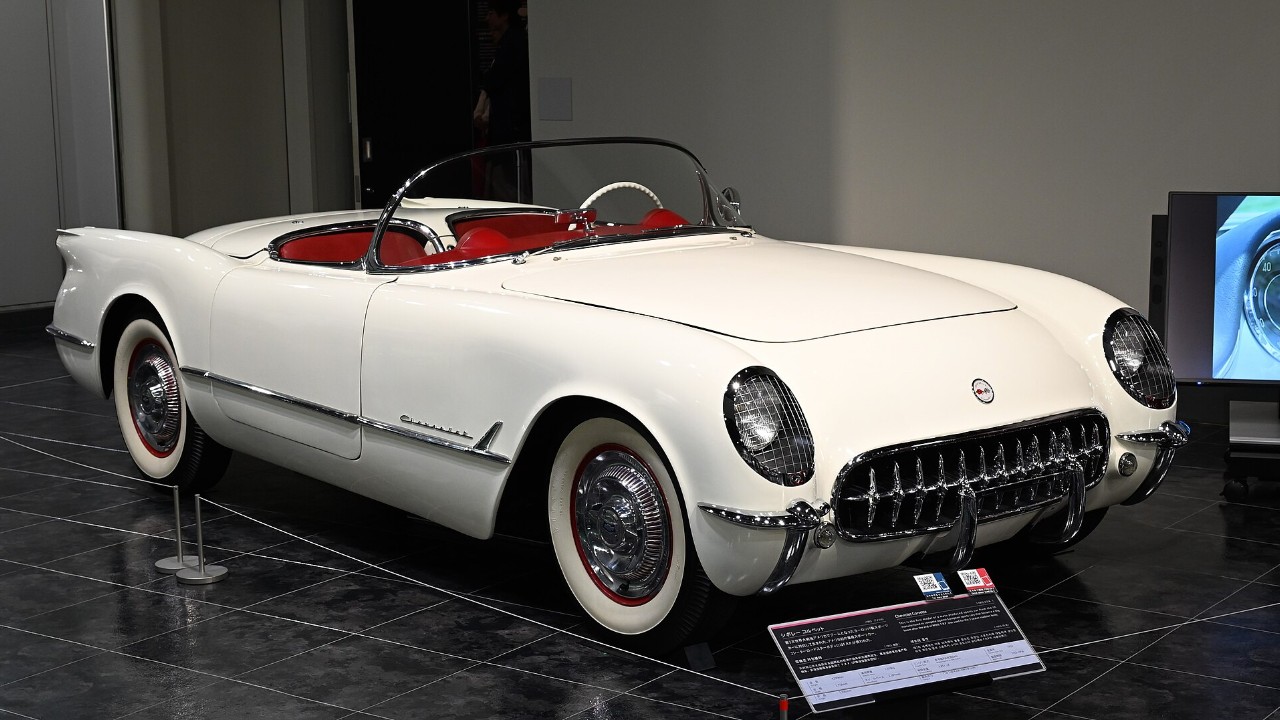
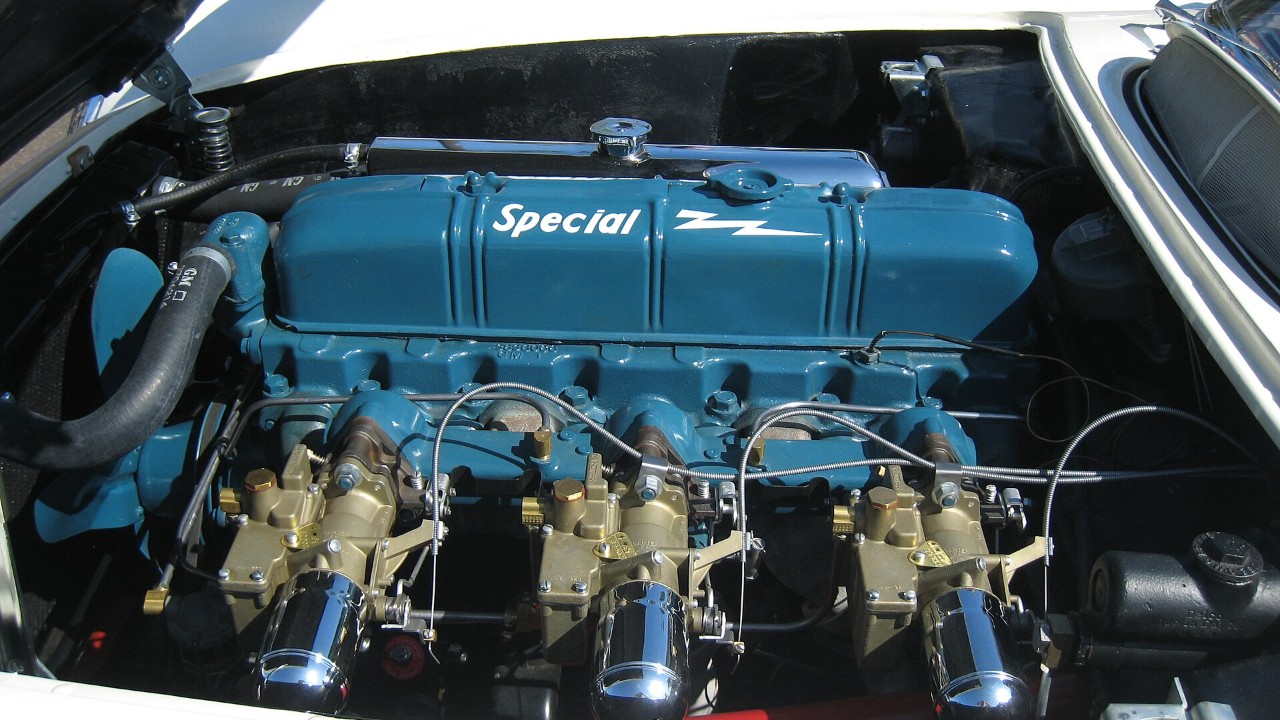
Chevrolet gave the 1953 Corvette exactly one engine, and it wasn’t a V8. Under the hood sat the Blue Flame six, a 235-cubic-inch inline six rated at 150 horsepower. Chevy got there without a new engine design. Instead, it borrowed a camshaft from its trucks and bolted on three Carter carburetors.
That number matters because the regular 235 was a much milder engine. According to Jalopnik, the version already used across much of Chevrolet’s range made just 115 horsepower. So the Corvette engine gained about 30 percent more power from parts and tuning alone.
For two model years, it was the only way to get a Corvette. The small-block V8 didn’t arrive until 1955, and even then the six stayed on the order sheet. Here is how Chevrolet turned a dependable family-car six into a sports-car engine.
Where the Blue Flame six came from
The engine’s roots go back well before the Corvette. Chevrolet adopted the six-cylinder that came to be called the Blue Flame in 1937, according to EngineLabs’ history of the Chevrolet six. At first it displaced 216.5 cubic inches, ran 6.5:1 compression and made 85 horsepower.
Then the engine grew. In 1941, a heavy-truck version reached 235 cubic inches and 123 horsepower, EngineLabs reports, in a Thrift-King version with solid lifters. By the early 1950s, that 235 was in use across much of Chevrolet’s range, Jalopnik says. As a result, it was the natural starting point for a new two-seater.
The truck camshaft
The first trick was in the valvetrain. EngineLabs says the Corvette engine was a 235 fitted with the camshaft from Chevrolet’s 261-cubic-inch truck engine. In other words, the sports car’s cam came from a working truck, not from a race shop.
A camshaft controls when the valves open and how long they stay open. A different cam profile changes how much air and fuel the engine can pull in at higher speeds. The goal of a swap like this is simple: help the engine breathe at higher rpm, where a sports car spends more of its time.
Three Carters and an aluminum intake
The second trick was easier to spot with the hood up. Induction came from three single-throat sidedraft Carter carburetors, according to EngineLabs. The CorvSport 1953 Corvette specifications page lists two designs of that carburetor, the Carter 2066S and the later 2066SA.
The carbs also needed a new home. Jalopnik reports that they sat on an aluminum intake, topped by bullet-shaped air cleaners. A mechanical double-action pump fed them fuel. Meanwhile, the spent gases left through factory dual exhausts, Silodrome notes.
What else Chevrolet changed
The cam and carburetors weren’t the whole story. Jalopnik lists aluminum pistons, a higher 8.0:1 compression ratio and a new camshaft among the changes from the stock 235. CorvSport also gives the Corvette engine’s compression as 8.00:1.
By comparison, the 1937 original ran 6.5:1, EngineLabs says. Higher compression squeezes the fuel mixture harder before it fires. That’s why it pairs naturally with better breathing when the goal is more power from the same displacement.
The Blue Flame six by the numbers
CorvSport lists the Corvette six at 235.5 cubic inches, with a 3.56-inch bore and a 3.95-inch stroke. It lists the engine at 150 horsepower at 4,200 rpm and 223 lb-ft of torque at 2,400 rpm. Power went through a two-speed Powerglide automatic to a 3.55:1 rear axle.
On the road, CorvSport gives the car a 0–60 mph time of 11.2 seconds and a top speed of 108 mph. Even so, EngineLabs calls the 150 horsepower “pretty tame.” CorvSport adds that early Corvettes were often ridiculed as underpowered next to European sports cars.
Weight played a part, too. CorvSport lists the 1953 car’s curb weight at 2,851 pounds. That means each of the six’s 150 horsepower had about 19 pounds to move. By comparison, a Powerglide automatic was the only transmission listed for 1953.
From show car to the street
The engine first went public in a show car. Silodrome reports that Chevrolet introduced the EX-122 Corvette show car at the 1953 GM Motorama, held at the Waldorf-Astoria hotel in New York. Production followed later that year, and the Blue Flame six went with it.
The Corvette’s six also looked the part. Jalopnik says the three Carters were mounted horizontally and wore bullet-shaped air cleaners. That triple-carb look defined the Corvette’s engine bay for two model years, because the six was its only engine in 1953 and 1954.
Original cars now command serious money. Silodrome notes that the 1953 survivors are hugely collectible. For example, Mecum estimated one Powerglide car it offered at $200,000 to $235,000, according to the same report.
What came after
The Blue Flame carried the Corvette alone in 1953 and 1954, EngineLabs says. For 1955, Chevrolet offered both the six and the new small-block V8. However, only the V8 could be ordered with a manual gearbox, according to EngineLabs.
The 1953 cars were the first Blue Flame Corvettes. Silodrome reports that Chevrolet built just 300 that year. CorvSport records their serial numbers as running from E53F001001 through E53F001300.
More from Fast Lane Only