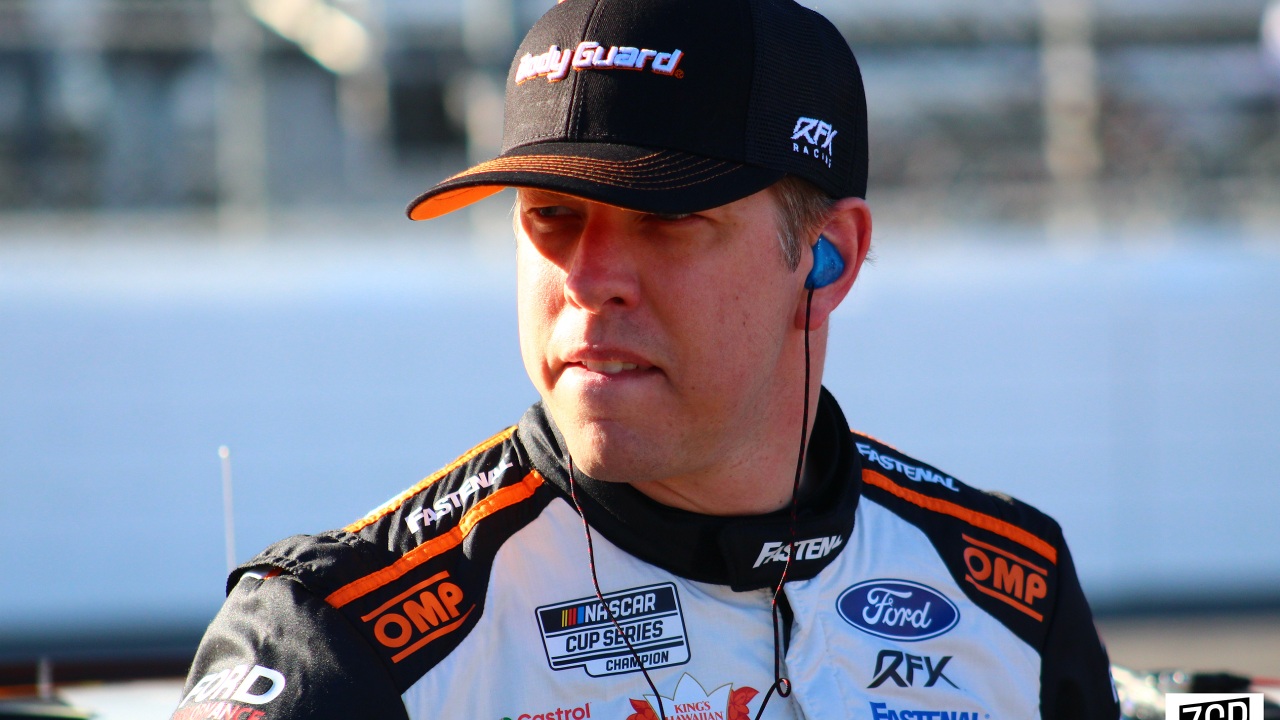
Brad Keselowski has never been shy about long‑range planning, and a devastating leg injury has only sharpened his sense of how his NASCAR career should end. In the weeks since breaking his right femur on a family ski trip, the veteran Cup Series champion has begun to describe, in unusually specific terms, how and when he intends to step away from full‑time driving. The result is a rare glimpse at an exit strategy that balances unfinished business behind the wheel with an expanding portfolio as an owner and future team builder.
Rather than nudging him toward an early retirement, the injury has prompted Keselowski to set a concrete benchmark for his final chapter in the Cup Series and to clarify what will keep him in the car, and what might eventually pull him out. His comments outline a path that runs through a targeted number of starts, a renewed competitive fire, and a growing ambition to shape the sport from the pit box and the boardroom as much as from the driver’s seat.
A freak accident that forced big questions
The turning point for Brad Keselowski came far from any racetrack, on a ski slope where he had just dropped his daughter off for lessons. After parking his car, he slipped and fell, landing in a way that fractured his right femur and immediately raised doubts about how quickly, and how fully, he could return to NASCAR competition. He later described how he “just fell perfectly” on the leg, a reminder that even a routine family outing can carry career‑altering consequences for an elite driver whose livelihood depends on physical precision inside a stock car.
The injury was severe enough to require surgery to reconnect bone and surrounding structures, and the early aftermath was alarming. His foot, ankle, and calf remained responsive, but his quadriceps went numb, leaving him uncertain how his leg would respond to the sustained load of a Cup Series race. Medical updates have since been more encouraging, with the nerves in that area beginning to reawaken and movement gradually returning, yet the episode forced Keselowski to confront the fragility of a career that had long seemed durable and linear.
Missing the Clash, targeting Daytona, and rejecting a rushed return
The broken femur immediately reshaped Keselowski’s early‑season calendar. He ruled himself out of the preseason Busch Light Clash, a high‑profile exhibition that typically serves as a tone‑setter for the year, and endorsed Corey LaJoie as a substitute while he focused on rehabilitation. In a public statement, he said he was “happy for Corey to get this opportunity” and emphasized that his own attention was fixed on being ready for the Daytona 500, a sign that he was unwilling to compromise long‑term health for a short‑term appearance.
That stance reflected a broader philosophy that emerged as he processed the accident. Keselowski acknowledged that trying to rush back into the car for the Clash would have been, in his words, “super foolish,” given the extent of the injury and the demands of a Cup Series cockpit. Instead, he framed Daytona as the first realistic checkpoint, not a guarantee, and made clear that he would only return once he was medically cleared and confident that his leg could withstand hours of braking, throttle modulation, and lateral force. The decision to prioritize a measured comeback over bravado hinted at a driver thinking not just about the next race, but about the remaining arc of his career.
Setting a retirement target at 900 Cup Series starts
Out of that period of uncertainty came one of the most concrete declarations of Keselowski’s future plans. He has said he wants to reach 900 Cup Series starts before stepping away from full‑time driving, effectively turning a round number into a personal finish line. For a driver already deep into his second decade at NASCAR’s top level, that target represents several more seasons of competition and signals that he does not view the broken leg as a cue to scale back his ambitions.
The specificity of the 900‑start goal stands out in a sport where many veterans speak in vague terms about “taking it year by year.” Keselowski has also indicated that he hopes to continue racing into his late 40s, reinforcing the idea that his exit plan is measured in both starts and seasons rather than in a single contract or sponsor cycle. By tying his eventual retirement to a clear statistical milestone, he has given RFK Racing, partners, and fans a framework for what the final stretch of his driving career might look like, even as he leaves room to adjust if health or performance demands it.
New motivation, RFK responsibilities, and a broader vision
If the injury forced Keselowski to think about an end point, it also appears to have reignited his motivation for the present. As a co‑owner of RFK Racing and a veteran Cup Series driver, he has spoken about finding fresh purpose in leading the organization through adversity while he recovers. Rather than dwelling on the accident, he has framed the setback as a challenge to return stronger and to help RFK build on its recent gains, describing himself as “laser focused” on being ready to compete as soon as he is cleared.
That dual role as driver and co‑owner shapes how he talks about the future. Keselowski has made it clear that he is not looking to step away from the Cup Series in the near term, even as he contemplates life after full‑time driving. His responsibilities at RFK Racing give him a stake in the sport that extends beyond his own results, and his recovery has underscored how much he values being present for the team’s evolution. The exit plan he is sketching is less a retreat than a gradual shift in emphasis, from being the one strapped into the car to being the architect of the cars and programs that carry RFK forward.
Life after full‑time driving: IMSA ambitions and long‑term influence
Keselowski’s thinking about the end of his NASCAR driving career is also informed by a growing interest in other forms of motorsport. He has expressed a strong desire to own an IMSA WeatherTech SportsCar Championship team, specifically to run Ford’s planned Hypercar in the GTP class, but only if that program competes in the United States. He has said that “if it competes in the United States, I’d like to own that team,” a statement that links his long‑term future to Ford’s broader racing strategy and hints at a post‑Cup role that keeps him deeply embedded in top‑tier competition.
That ambition dovetails with RFK Racing’s heritage, since Jack Roush built a formidable sports car operation before focusing on NASCAR, and it suggests that Keselowski sees his eventual transition out of the driver’s seat as an expansion rather than a contraction of his racing footprint. He has stressed that he has no plans to step away from Cup driving yet, but the outlines of his exit plan are increasingly clear. First, return from the broken femur on his own terms. Second, push toward the 900‑start benchmark while leading RFK on track. Finally, when the time is right, pivot fully into ownership and new ventures such as an IMSA program, carrying his influence from the cockpit to the command stand and beyond.
More from Fast Lane Only