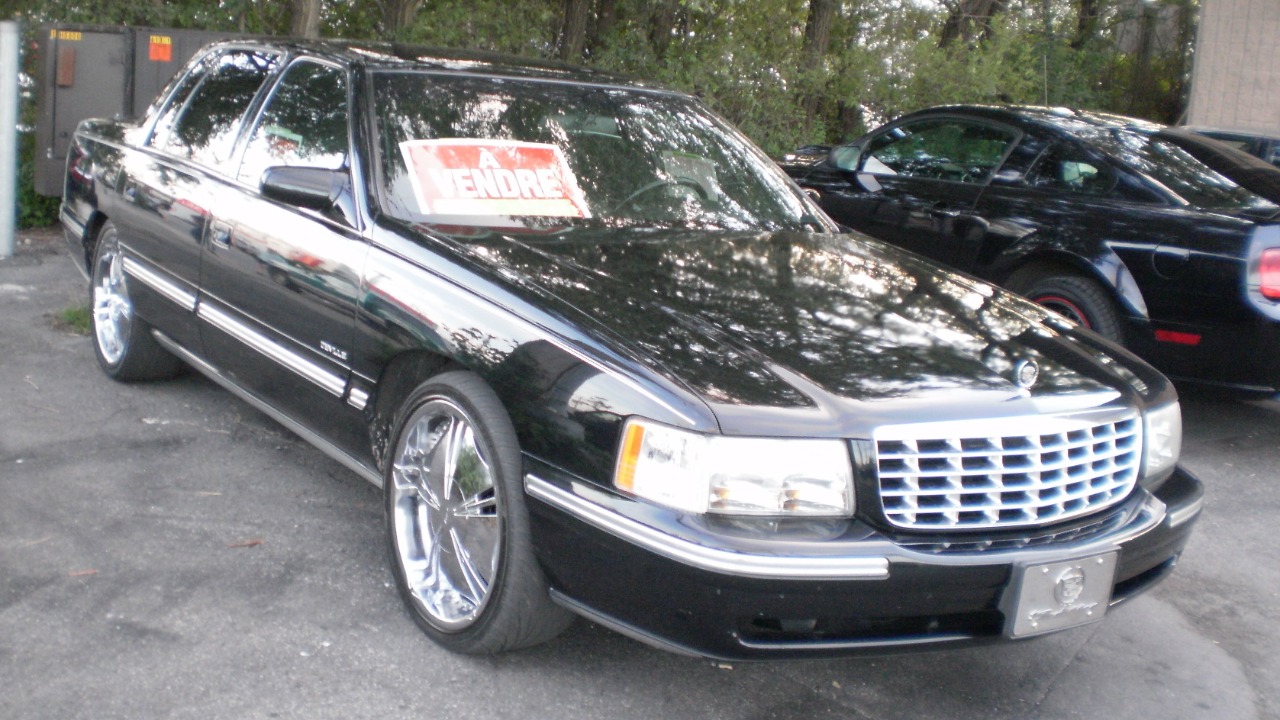
Bring a Trailer built its reputation on obsessive detail and honest photography, so when an obviously AI-touched Cadillac slipped onto the site, the clash between old-school car culture and new digital tricks could not have been sharper. A 1999 Cadillac sedan, dressed up with synthetic “enhancements,” briefly attracted real bids before users spotted surreal glitches and forced the listing offline. The episode turned a single auction into a case study in how quickly artificial images can undermine trust in enthusiast marketplaces.
The Cadillac that did not quite exist
The car at the center of the storm was a late‑1990s Cadillac sedan that, on paper, fit neatly into Bring a Trailer’s usual mix of aging luxury and enthusiast curiosities. The problem was not the model year or the mileage, it was the images that made the car look just a little too clean, a little too glossy, and eventually, flat‑out impossible. Popular auction site Popular Bring a Trailer relies on seller‑supplied photos, and in this case those photos had been run through generative tools that smoothed, sharpened, and quietly invented details that never rolled out of Detroit.
Once the listing went live, the car community did what it does best and zoomed in on every pixel. Commenters quickly noticed that the supposedly real car wore visual artifacts that only an algorithm could love, from oddly rendered surfaces to background elements that bent the rules of physics. Coverage of the incident highlighted how the Trailer Accidentally Lists altered Cadillac For auction with images that looked more like a video game than a driveway. For a platform that trades on authenticity, the idea that a buyer might be bidding on a car that only existed in a neural network’s imagination cut straight to the core of its brand.
The AI glitches that gave the game away
What turned this from a slightly over‑edited listing into a viral moment were the specific, almost cartoonish glitches baked into the pictures. In one widely shared shot, the digitally “enhanced” Cadillac sedan appeared with interior details that no factory engineer would sign off on, including twin column gear shifters sprouting from the steering column. Other images showed cobblestone‑like floor mats and a missing slab of concrete under the car, visual tells that something synthetic had been stitched into the scene. These were not the subtle touch‑ups of a careful photographer, they were the kind of surreal flourishes that generative systems often hallucinate when they lose track of real‑world geometry.
As more eyes landed on the auction, the list of anomalies grew. Reporting on the Photos noted that the environment around the car shifted from frame to frame in ways that made no sense, with textures and shadows morphing as if the sedan had been teleported between slightly different universes. One analysis by Chris Chilton pointed out how the cobblestone mats and missing slab under the Cadillac were classic signs of an AI system improvising scenery rather than capturing it.
How the listing unraveled in real time
Once the oddities were spotted, the reaction unfolded in real time in the comments and on social media. An EDIT from one enthusiast account captured the turning point: “as of 2:37 pm, Eastern Standard Time, the listing has been taken off of BaT after being bid to $800.” That short note, citing Eastern Standard Time, underlined how quickly the community’s skepticism translated into platform action. Bidding had been real, money was on the table, and yet the underlying visual evidence for the car’s condition was, at best, synthetic.
From my perspective, what stands out is how the crowd effectively became the first line of AI moderation. Commenters flagged the impossible details, others amplified the screenshots, and within hours the auction was gone. A detailed breakdown of the Eastern Standard Time edit shows how the bid history and the removal timestamp lined up with the wave of posts pointing out the flaws. In a space where staff cannot manually vet every pixel, the community’s ability to spot a fake Cadillac faster than any automated filter is both reassuring and a reminder of how fragile that vigilance can be if fatigue sets in.
Bring a Trailer’s apology and the seller’s “mistake”
Once the dust settled, Bring a Trailer did not try to pretend nothing had happened. The Auction House’s Reaction Bring Trailer was to acknowledge the error, explain that the images had slipped through its review process, and apologize to users who had expected unaltered photos. Initially, representatives said they were still learning how to handle AI‑touched submissions, but they also stressed that they “own it,” a phrase that resonated with regulars who expect accountability when something undermines the site’s credibility. Separate reporting on the Bring Trailer incident emphasized that the platform apologized directly for letting AI‑altered photos reach the bidding stage.
The seller, for their part, was not portrayed as a cartoon villain trying to pass off a fake car. One detailed analysis argued that “we do not think the seller was intending to purposely mislead anyone but was simply mistaken in their efforts to make the car look better,” a line that came with a clear Jan apology from the platform. That framing matters. It suggests a gray zone where owners reach for easy AI tools to clean up a listing without fully understanding that these systems do not just polish, they invent. For a site that depends on trust between strangers, the difference between naive enhancement and deliberate fraud is important, but the outcome for buyers squinting at impossible gear shifters is the same.
A warning sign for enthusiast marketplaces
For me, the most unsettling part of this saga is not that one Cadillac listing went sideways, it is how easily it could happen again. A thoughtful piece on these AI‑generated images framed them as a sign of “terrible things to come,” and I think that is only slightly hyperbolic. Generative tools are now built into phones and editing apps, which means any seller can conjure cleaner paint, straighter panels, or even a different driveway with a few taps. When a platform like Bring Trailer Accidentally Lists An AI altered Cadillac For sale, it is a preview of the moderation challenge facing every classifieds site, from high‑end auctions to local marketplaces.
There is also a cultural cost. Enthusiast communities pride themselves on spotting the tiny details that separate a survivor car from a respray, or a well‑loved driver from a quick flip. When AI starts to blur those tells, the shared language of patina and panel gaps becomes harder to trust. One report on how Iryna Pashchenko described the community pointing out these absurd details noted that around 150 comments piled up as users dissected the images. That level of scrutiny saved the day this time, but it is hard to imagine every future buyer having the time, or the expertise, to reverse‑engineer whether a driveway shadow is real.
Looking ahead, I suspect platforms like Trailer will have to move beyond trust and apologies into concrete rules about AI use, perhaps requiring disclosure when images are generated or heavily edited. The Auction House’s Initially candid response is a start, but policies, tools, and maybe even AI detectors will need to back up that tone. Otherwise, the next time a glossy Cadillac appears with cobblestone mats and twin shifters, the joke may not land as lightly, especially if someone has already wired the money.
More from Fast Lane Only