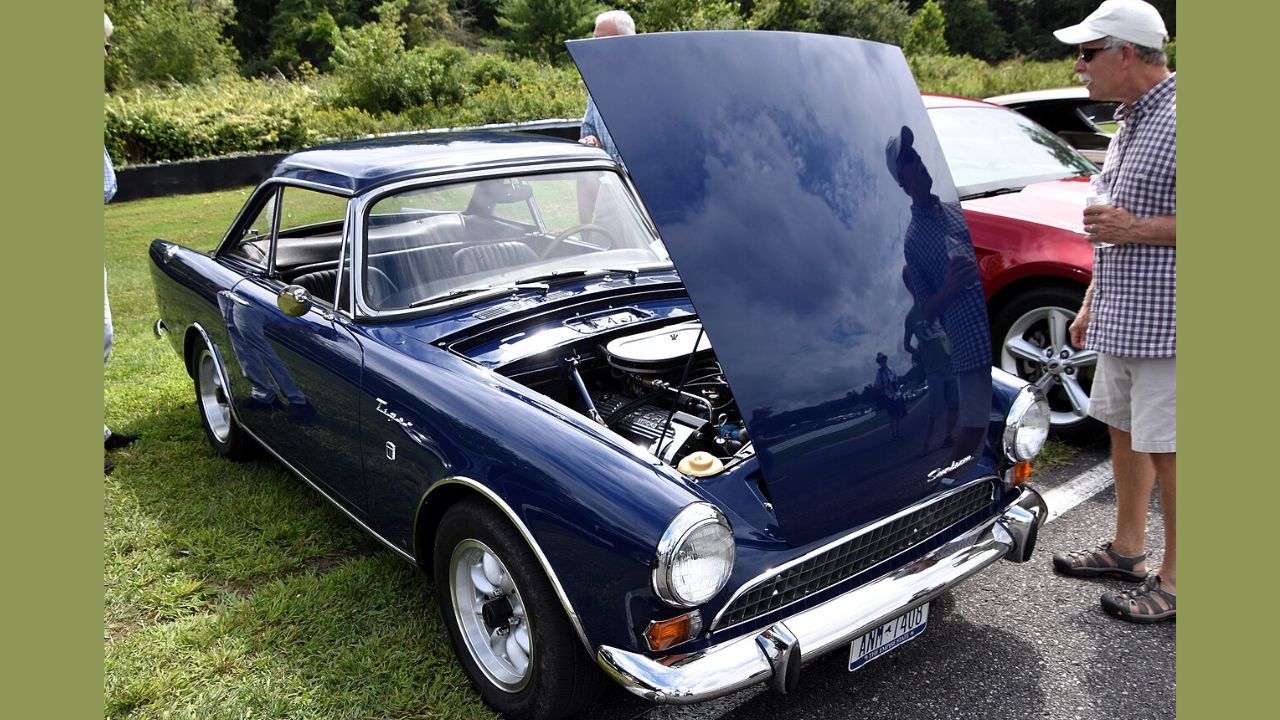
The 1967 Sunbeam Tiger did something that sounded almost reckless on paper. It took a compact British roadster and stuffed a Detroit V8 under the bonnet, yet somehow kept the car’s poise and charm intact. The result was a short-lived Anglo American hybrid that drove like a budget AC Cobra and proved that British finesse and V8 torque could share the same small chassis without tearing it apart.
That balance was no accident. It grew out of a specific corporate problem, a clever engineering workaround, and a brief window before changing ownership and engine politics shut the project down. The final-year Tiger captured that moment perfectly, with the British bodywork and American powertrain working in rare harmony.
From polite Alpine to impatient Tiger
The story starts with Rootes and its pretty but underpowered Alpine. As sports car competition intensified in the 1960s, Rootes realised that if it was to survive in export markets, yet the company did not have a suitable engine or the budget to develop one. The Alpine’s compact engine bay made the challenge even harder.
Internal development was tried first. Engineers at Rootes set out to find a more powerful yet lightweight engine that would fit into the Alpine’s tight nose, and internal development was by labor issues and high costs. The company needed a shortcut.
That shortcut was the Anglo American formula. By the mid 1960s, the idea of pairing a light British chassis with a compact American V8 had already been proven, and Anglo American sports, made famous by Shelby with the Cobra, was already well established. Rootes decided to borrow that blueprint for its own compact roadster.
Carroll Shelby and the Anglo American fix
To turn the polite Alpine into something fiercer, Rootes turned to Carroll Shelby. He and his team knew how to shoehorn a V8 into a small British body, and Carroll Shelby and were instrumental in making this happen. They overcame the challenge of the small engine bay by choosing a compact American V8 and pushing it as far back as possible in the chassis.
The result was The Sunbeam Tiger, a two seat sports car that used the Alpine shell but hid a Ford V8 under the bonnet. According to one period overview, The Sunbeam Tiger emerged as an often overlooked alternative to the Shelby Cobra in the 1960s, offering a similar basic recipe at a lower price and with more civility.
The first production Tigers used a small block Ford unit. The earliest Tigers were equipped cubic inch Ford V8 engine mated to a four speed Top Loader transmission, producing 164 brake horsepower. Another detailed breakdown of the model years notes that the MkI, produced from 1964 to 1967, used a 260 cubic inch (4.2L) V8 and again quotes output at around 164 horsepower. For a car that still looked like a modest British tourer, those numbers were transformative.
British charm, American brawn
Visually, the Tiger stayed close to its Alpine roots. The 1966 Sunbeam Tiger MkI Roadster is described as a British sports carican V8 engine, specifically a 4.2 liter Ford unit. Chrome bumpers, wire wheels and a tidy, upright windscreen kept the car firmly in the British idiom.
Under the surface, the character changed. The car still rode on relatively narrow tires that one test later described as 4.9 inches wide, and Shelby’s rearward positioning produced good weight distribution. That layout meant the Tiger handled remarkably well despite those 4.9 section tires, which one account described as puny.
Period road tests praised the balance. Instead of feeling like a crude engine swap, the Tiger drove like a cohesive car. Steering remained light, the ride stayed supple by sports car standards, and the compact wheelbase gave it a lively turn in. The British chassis did not just tolerate the American torque, it seemed to enjoy it.
The MkII and the 1967 sweet spot
The final evolution of the concept arrived in 1967 with the Sunbeam Tiger Mk II. Power went up again. One detailed development history notes that January the Sunbeam. II model was introduced with the engine size increased to the 200 horsepower 289 cubic inch Ford V8 engine. That figure represented a substantial jump over the 164 horsepower quoted for the 260.
Performance estimates for 1967 cars with the 289 are consistent with that upgrade. A period style specification sheet for a 1967 Sunbeam Tiger with Ford 289 V8 lists a Top Speed ofph (193 km/h) and a 0 to 60 m ph time of about 7 seconds with the 289 engine. Contemporary summaries of British V8 performance in the decade echo those figures, noting that Contemporary tests recordedph acceleration in the mid 7 second range and a top speed of around 122 m ph for the Tiger.
Braking and chassis hardware were upgraded to cope. The same 1967 specification list highlights Brakes with Front disc brakes and rear drums, a serious setup for a compact British roadster of the period. The combination of a 200 horsepower 289, disc brakes and the Alpine derived chassis made the 1967 Mk II feel like the concept finally reached its intended maturity.
How it stacked up against the Cobra
Any Anglo American V8 sports car from this era inevitably gets compared with the Shelby Cobra. The Tiger invited that comparison more directly than most. One retrospective notes that The Sunbeam Tiger emerged as a strong alternative to the Shelby Cobra in the 1960s as a V8 powered two seater.
On raw numbers, the Cobra sat in another league, especially in its larger displacement forms. The Tiger, with 164 horsepower in early 260 form and 200 horsepower in 289 Mk II trim, could not match the most powerful Cobras. Yet the Tiger offered a different balance. It kept more of its British Roadster civility, with a proper boot, weather equipment and a more finished interior. It was also significantly cheaper when new, with one buyer’s guide citing an MSRP of $2898 for early Tigers.
For drivers who wanted British charm with serious straight line performance, the Tiger hit a sweet spot. The Anglo American formula that Shelby and the had already popularized found a more understated expression in the Sunbeam. It was less theatrical, more usable, and for many owners, more approachable.
Why production stopped just as it hit its stride
For all its qualities, the Tiger had a built in expiration date. Corporate changes and engine politics ended the project just as the Mk II was finding its rhythm. A detailed production summary explains that Tiger production ended on June 27, 1967, after the stock of Ford engines was emptied. Chrysler had taken control of Rootes, yet Chrysler’s own V8 engines were too big for the Alpine body.
Another account aimed at enthusiasts reinforces the same basic timeline from a different angle. It notes that Production ended in soon after the Rootes Group was taken over by Chrysler, which did not have a suitable engine to replace the Ford V8. With no compact V8 of its own and little interest in continuing to buy engines from a rival, Chrysler effectively shut the door on the Tiger.
The decision was not about the car’s performance or reputation. Period road tests were positive, and the combination of British chassis and American engine had clear appeal. The problem was simply that the formula depended on a Ford V8, and once Chrysler owned the project, that arrangement became politically and practically impossible.
Driving character: more than a straight line hot rod
On the road, the Tiger felt different from both its British contemporaries and its American cousins. The Alpine derived chassis kept the car compact and communicative. The V8 added a wide, accessible torque band that made the car feel urgent in any gear. Enthusiast accounts point out that Tiger handling received, particularly because the rearward engine placement preserved balance even as power climbed.
In Mk II form, the 200 horsepower 289 cubic inch engine made the 1967 car feel genuinely fast. With a quoted 0 to 60 m ph in the mid 7 second range and a top speed near 120 m ph, the Tiger could run with serious sports cars of its day. Yet the cabin still had wood trim, proper seats and a British driving position. The car did not lose its manners when the road turned rough, which is part of why owners still speak of it with such affection.
Collector status and lasting appeal
The Tiger’s short production run and corporate backstory have turned it into a cult favorite. Enthusiast guides emphasize that the earliest Tigers used a Ford T 10 sideloader four speed transmission and that early cars carried an MSRP just under three thousand dollars, which helped them undercut many rivals. The Mk II, with its limited production and 289 engine, is even more coveted. One auction listing stresses that only 536 Mk II examples were produced and highlights the 289 cubic inch V8 as a key part of their appeal.
Beyond rarity, the car’s character keeps it relevant. The 1966 Sunbeam Tiger MkI Roadster is still described in enthusiast circles as a Sunbeam Tiger Roadster elegance and an English body wrapped around an Amer V8. That blend still feels distinctive in a market full of either pure British classics or pure American muscle.
The Tiger also serves as a reminder of how quickly corporate decisions can end a promising idea. Rootes, Alpine, Chrysler and Ford all intersected in the project’s brief life. The car existed only as long as that intersection remained viable. Once Chrysler took control and the Ford engine supply dried up, the project ended even though demand and critical reception suggested there was more life left in the concept.
Why the 1967 Tiger still matters
Looking back, the 1967 Sunbeam Tiger stands out not just as the fastest and most developed version, but as proof that the original idea worked. The 200 horsepower 289 cubic inch engine, the ~120 m ph top speed, the disc front brakes and the refined British body all came together without obvious compromise. The car delivered real V8 performance while keeping the compact dimensions and visual charm of the Alpine.
In a decade full of experiments that paired European chassis with American engines, the Tiger earned its place by being more than a crude transplant. Thanks to Carroll Shelby, Ken Miles and the engineers at Rootes, the British charm and V8 power did not fight each other. In the 1967 Tiger, they met in the middle and, for a brief moment before corporate logic intervened, they worked beautifully.
More from Fast Lane Only