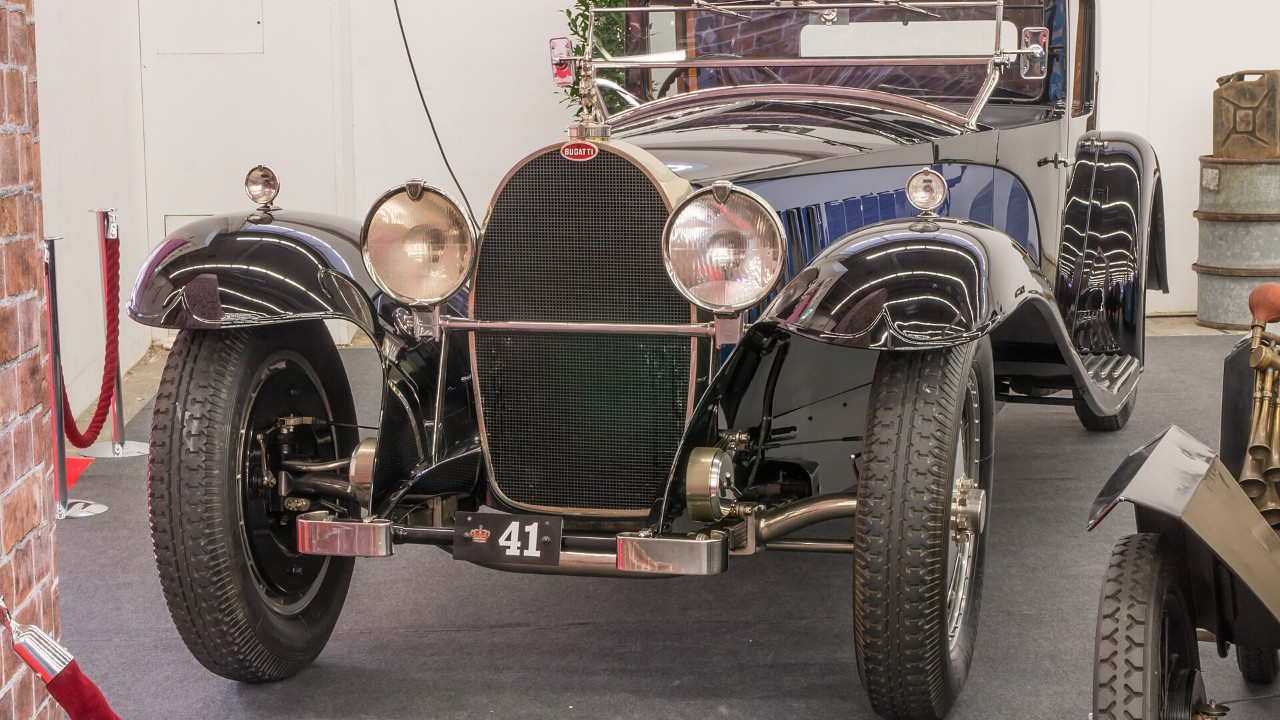
Ettore Bugatti planned about 25 examples of his Bugatti Type 41 Royale and meant to sell them to royal families and heads of state. In the end he built six. And for all the royal intent behind the name, no royal ever bought one.
Instead, the buyers were a Paris clothing maker, a German doctor and a British captain. Bugatti kept the rest. Each car carried a 12.7-liter straight-eight that made about 300 PS, and each had its own coachwork.
Here is what made the Royale so big, who ended up owning one, and where the six live today.
A Bugatti Type 41 Royale was built for kings
Bugatti had long wanted to build the most powerful and luxurious series-production car in the world. However, poor economic conditions in Europe and America killed the plan for about 25 cars, and only six were built, says Bugatti’s 2013 Goodwood release. Its later “Bugatti Legends” history adds that four were sold by 1933.
The price matched the ambition. The Royale cost at least 100,000 Reichsmarks, according to the Bugatti Legends release. That was about three times the price of similar limousines and about 10 times other Bugatti models.
The Henry Ford museum frames it another way. In its words, the Royale was longer than a Duesenberg, had twice the horsepower of a Rolls-Royce and cost more than both combined. For scale, the museum counts 481 Model J Duesenbergs and 1,767 Phantom II Rolls-Royces against six Royales.
The 12.7-liter straight-eight
The first prototype ran an inline eight of almost 15 liters with an overhead camshaft. Production cars then used 12.7 liters with three valves per cylinder, typical of Bugatti at the time. Output was about 300 PS at under 2,000 rpm, according to Bugatti’s 2013 release.
Bill Vance, writing in the Times Colonist, gives the bore and stroke as 125 by 130 mm. That works out to 779 cubic inches. He also notes a 100 kg crankshaft running in nine main bearings.
Even so, the gearbox had only three speeds. At 70 mph in top gear, the engine turned about 1,000 rpm, Vance writes. Bugatti’s Legends history lists slightly different figures, 12.8 liters and 1,800 rpm, so the exact numbers depend on the source.
Built on a 4.3-meter wheelbase
The production Royale rode on a 4.3-meter wheelbase, about 170 inches. The car stretched almost 6.5 meters long and weighed about three tonnes. For comparison, Bugatti says the 1926 prototype used an even longer wheelbase.
Every Royale also wore the same mascot. A dancing elephant by Rembrandt Bugatti, Ettore’s brother, sits on the radiator cap. It became a symbol of the Royale and of the brand.
Who bought them instead
The first customer was Armand Esders, a Paris clothing manufacturer. In 1932 he paid 700,000 francs for chassis 41111, a two-seat roadster designed by Jean Bugatti, Ettore’s son. Then, in 1938, a new owner had it rebodied by Binder of Paris as a Coupé de Ville.
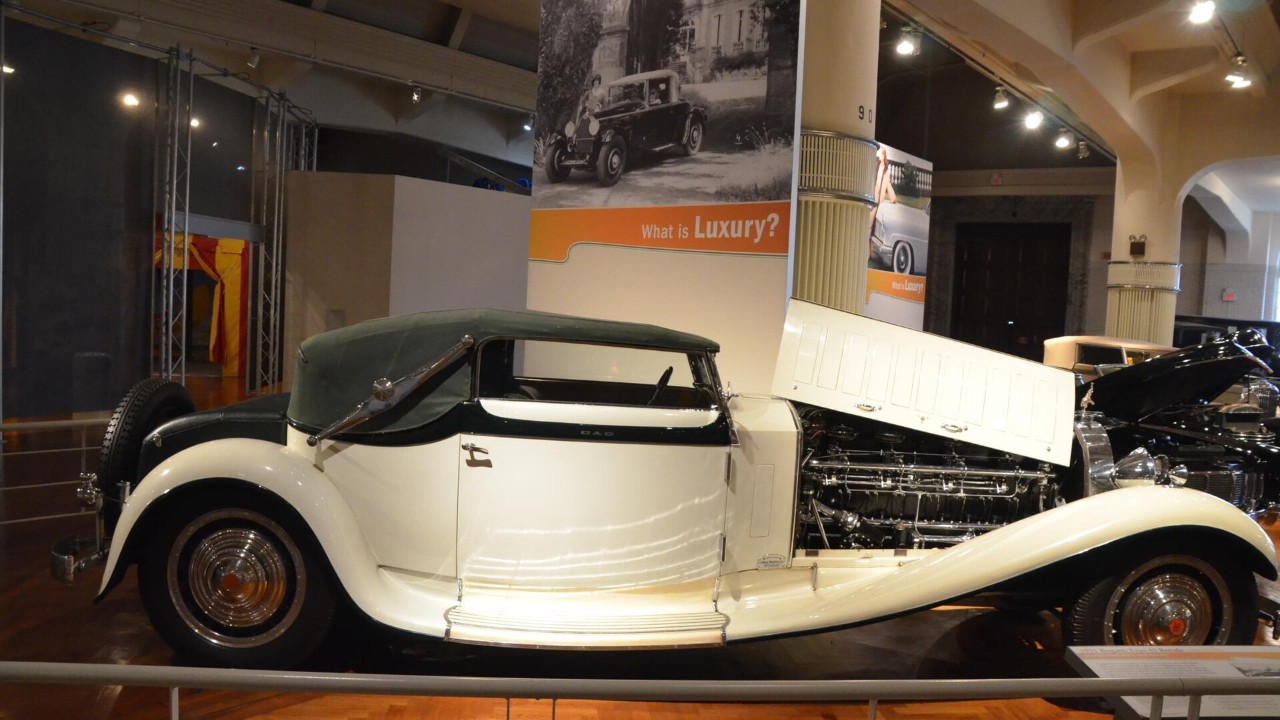
The second buyer was Dr. Joseph Fuchs, a German physician. Ludwig Weinberger of Munich built the body for his 1931 car. Later, Fuchs left Germany for China in 1933 and then went to Canada and New York, taking the car with him, says The Henry Ford.
A cold winter cracked its engine block in 1938. Buick chief engineer Charles Chayne bought it in 1943 and restored it. Finally, in 1958, he donated it to the Henry Ford Museum.
The third buyer, Captain Cuthbert Foster of England, took a Park Ward limousine in 1933, according to Secret Classics. Meanwhile, the Bugatti family kept and used the other cars.
Spare engines went to the railways
Bugatti also had spare Royale engines. So it adapted them for French express railcars. From 1935 to 1958, the engines powered rail units for the ETAT state railway, now SNCF, with two to four engines of 200 hp each, Bugatti says.
The railway ordered 79 of these vehicles. Vance writes that they reached up to 190 km/h, about 118 mph.
Where the six Royales are now
All six still exist. Two belong to the Schlumpf Collection at the Cité de l’Automobile in Mulhouse, France. Another sits at Bugatti’s headquarters in Molsheim, according to the Legends release.
The Fuchs car remains at The Henry Ford in Dearborn, Michigan. In 1985, all six Royales appeared together for the first time at the Pebble Beach Concours d’Elegance, the museum says.
More from Fast Lane Only