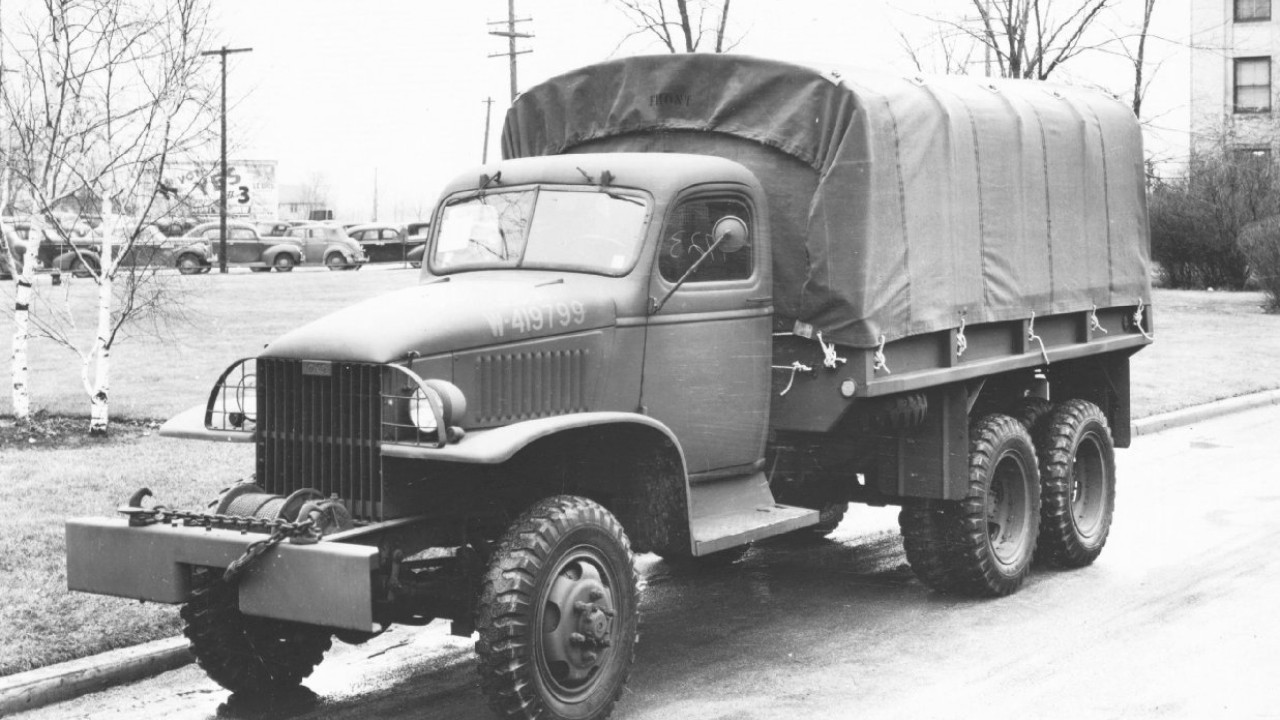
Six-wheel-drive cargo haulers, a truck that could swim and a tractor that pulled radio vans all count among the WWII trucks that carried the Allied war effort. Factories built these six in the tens or hundreds of thousands, and several stayed at work for years after the shooting stopped.
Each one below comes with its production figure or engine from a museum, a historian or an auction record. Together they show how much of the war moved on American tires.
1. 1941–1945 GMC CCKW, the most numerous of these WWII trucks
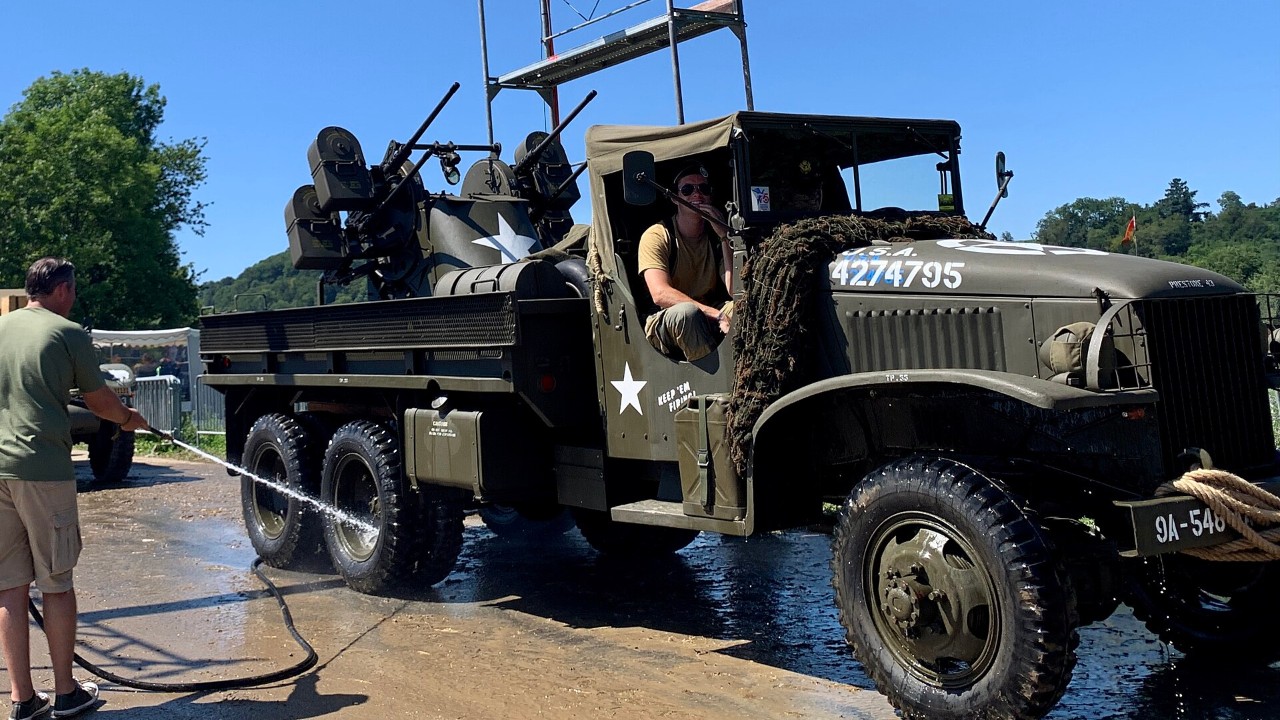
The CCKW was the Army’s standard two-and-a-half-ton 6×6. Even its name was a code. According to WarHistory.org, the letters meant a 1941 design, a conventional cab, all-wheel drive and tandem rear axles. Soldiers simply called it the “Deuce-and-a-half” or the “Jimmy.”
The National WWII Museum counts about 562,750 built, each with a GMC 270 six and a top speed of 45 mph. Its best-known job was the Red Ball Express after D-Day. More than 5,000 vehicles took part, and most of the drivers were African American soldiers in a segregated Army.
2. 1942–1945 GMC DUKW
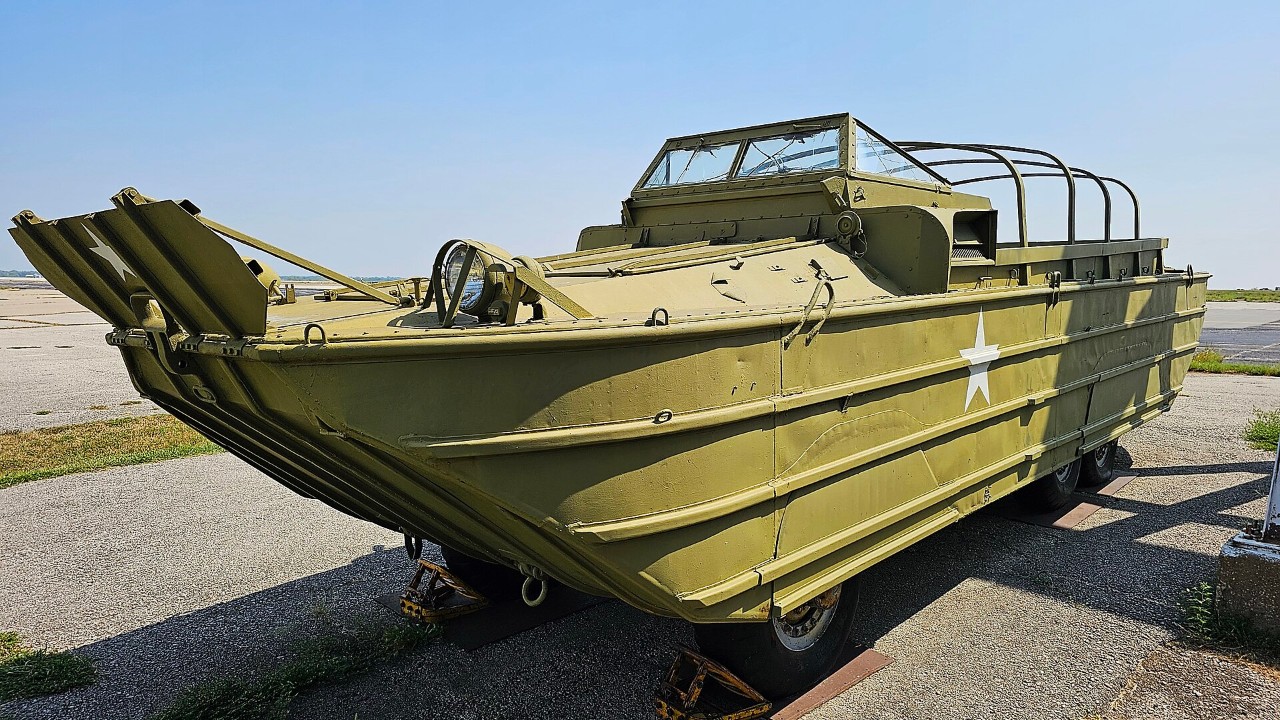
The DUKW, or “Duck,” was an amphibious truck built on the CCKW design. A history of GMC’s wartime output lists 21,147 Army acceptances. GMC built 14,399 of them at Pontiac, Michigan, while Chevrolet built 6,748 in St. Louis.
The same source gives it a 91-hp GMC 270 six and an onboard air compressor, so the crew could change tire pressure. Its first combat came in Sicily in July 1943. Later, Dwight Eisenhower called the DUKW “one of the most valuable pieces of equipment produced by the United States during the war.”
3. 1941–1945 Studebaker US6
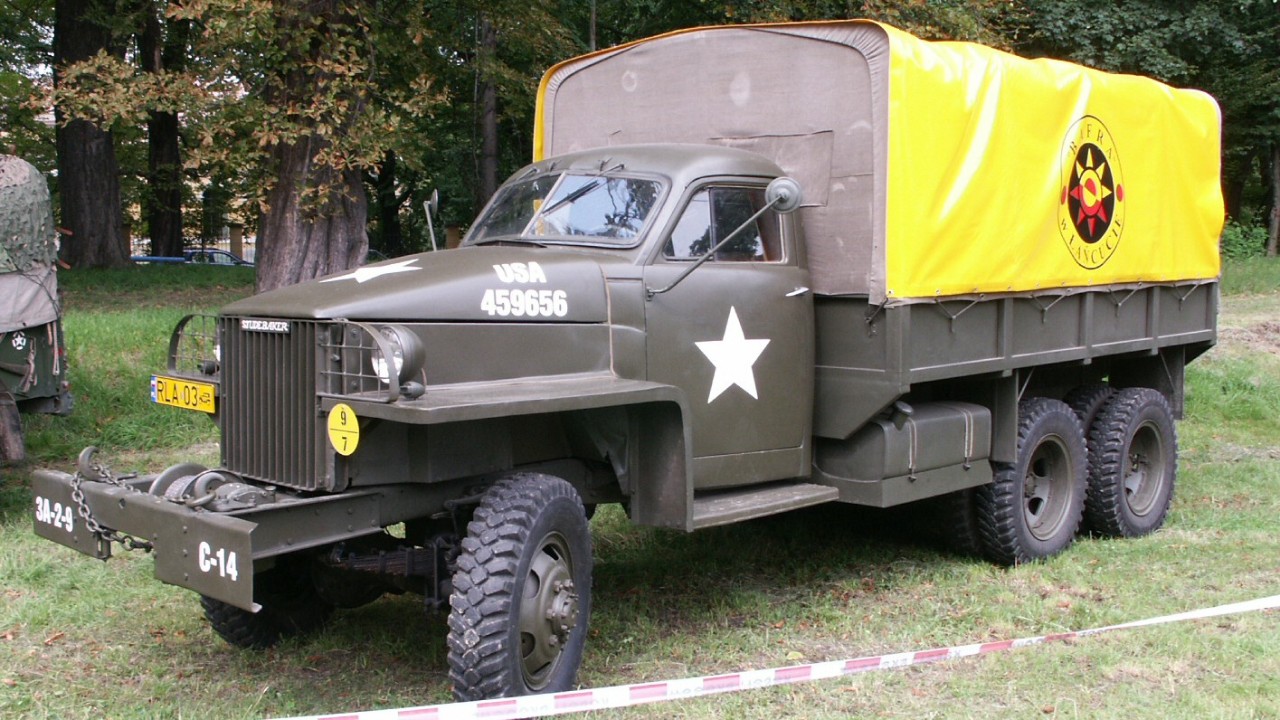
Studebaker’s 6×6 did most of its fighting far from the U.S. Army. According to Military Trader, Studebaker built 197,678 of them in South Bend, Indiana, from June 1941 through August 1945. In addition, Reo built 22,204 more in Lansing, Michigan, identical except for the data plates.
Under the hood, power came from a Hercules JXD six. WarHistory.org says more than half of Studebaker’s output went to the Soviet Union under Lend-Lease. Many traveled through the Persian Corridor, and Soviet troops nicknamed the truck the “Studer.” After the war, the Soviets reverse-engineered it into the ZIS-151, Military Trader adds.
4. 1941 Diamond T 968
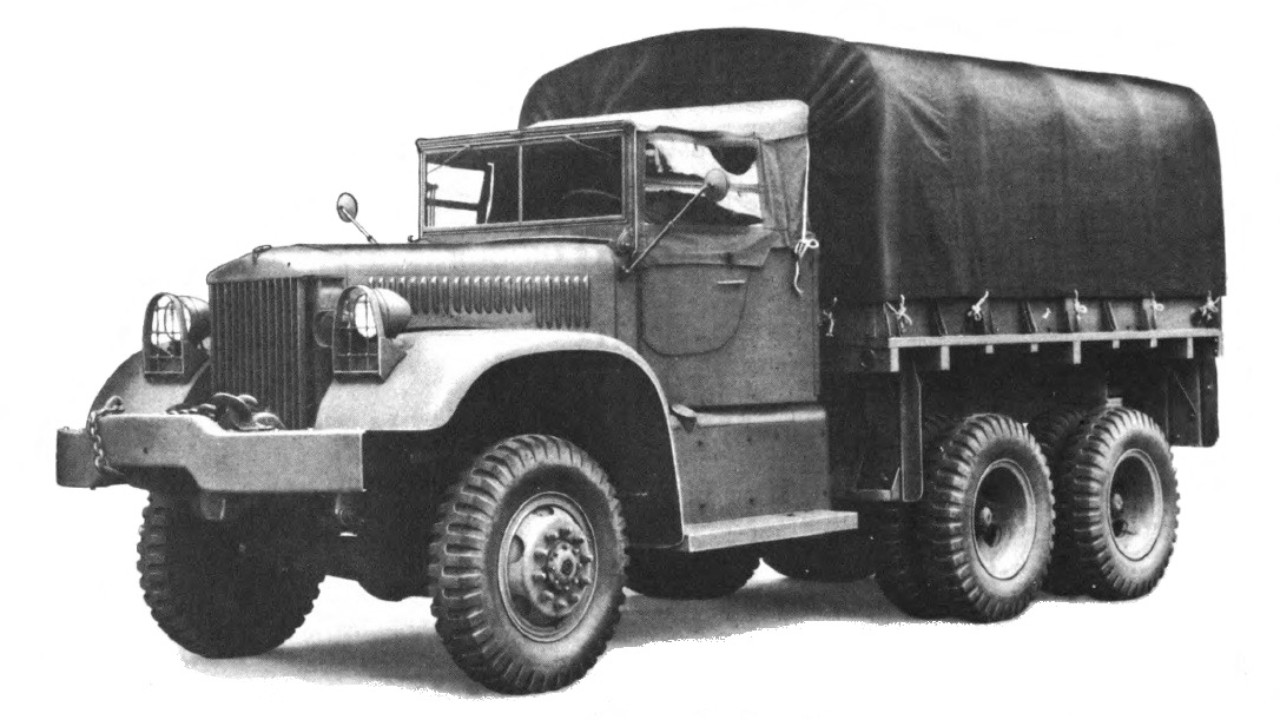
When the Army needed something heavier than a deuce-and-a-half, the Diamond T four-ton was one answer. Military Trader’s guide to the G-509 trucks says the 968 arrived later in 1941, and the 968A followed that November. It used a 529-cubic-inch Hercules RXC six rated at 106 hp at 2,300 rpm, with a five-speed gearbox and two-speed transfer case.
Its jobs included hauling troops and cargo and towing 155mm howitzers. Meanwhile, WarHistory.org counts 10,551 built, plus 2,197 cab-and-chassis units for special bodies. The site adds that it stayed one of the Army’s cargo trucks until the war ended, and many other countries received them during and after the war.
5. 1942 FWD HAR-1

Four Wheel Drive Auto Company of Wisconsin built this four-ton 4×4 for Allied armies. WarHistory.org says it served American, British and Canadian forces and ran a Waukesha GB2 six. As a result, many hauled supplies along the route from Persia to the USSR. The Royal Air Force also used it as a mobile power unit and as a snowplow.
Still, some kept working long after 1945. Military Trader profiled a 1942 HAR-01 that towed radar trailers in a convoy before a family timber business in Wiltshire put it to work in 1947. Spares for its Waukesha engine were scarce, so the owners made or adapted parts. Today, the article says just one other HAR-01 is believed to survive in the U.K.
6. 1944 Autocar U7144T
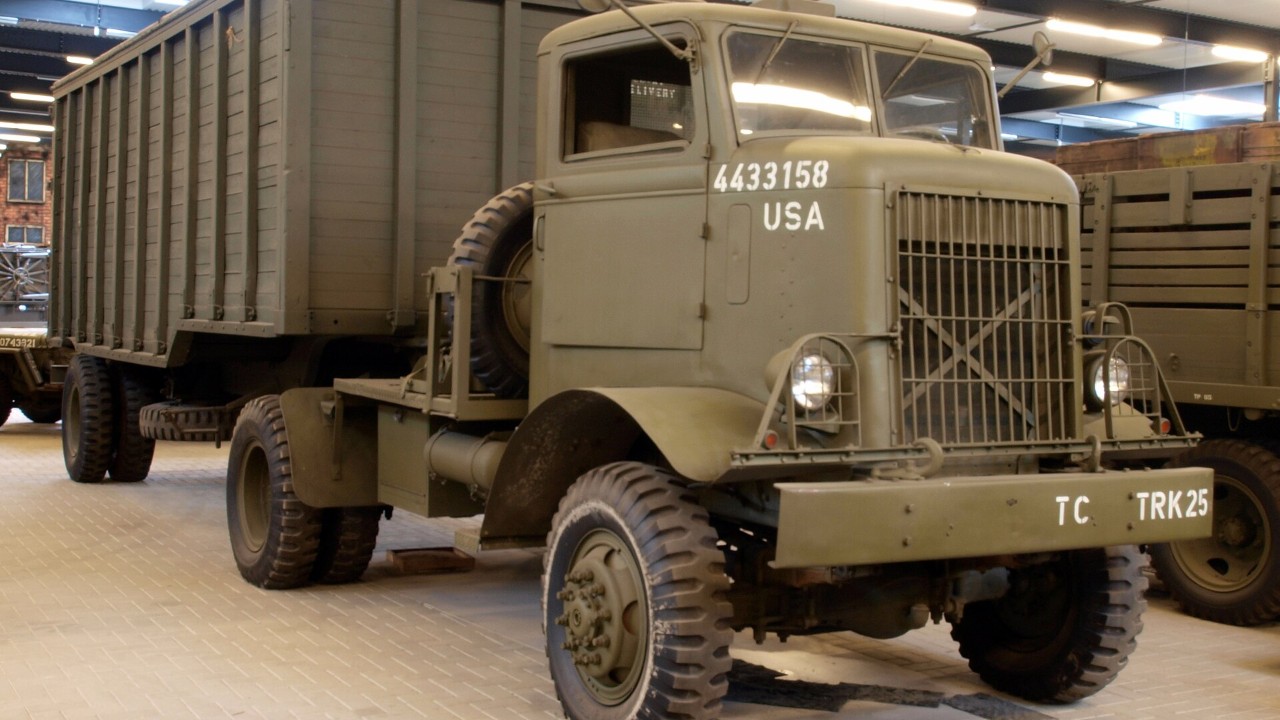
Not every war truck carried a cargo bed. The Autocar U7144T was a cab-over 4×4 tractor built to pull semi-trailers. In fact, WarHistory.org calls it one of the two most popular tractors of the war. It also says artillery units used it to tow radio-equipped vans, mostly for antiaircraft batteries.
A 1944 example from the National Military History Center collection crossed the block at RM Sotheby’s. Autocar built it in Ardmore, Pennsylvania, with a 112-hp Hercules RXC six. The lot notes say these tractors towed refrigerated food trailers and 2,000-gallon fuel tankers. Finally, that 1944 Autocar sold for $6,500.
More from Fast Lane Only