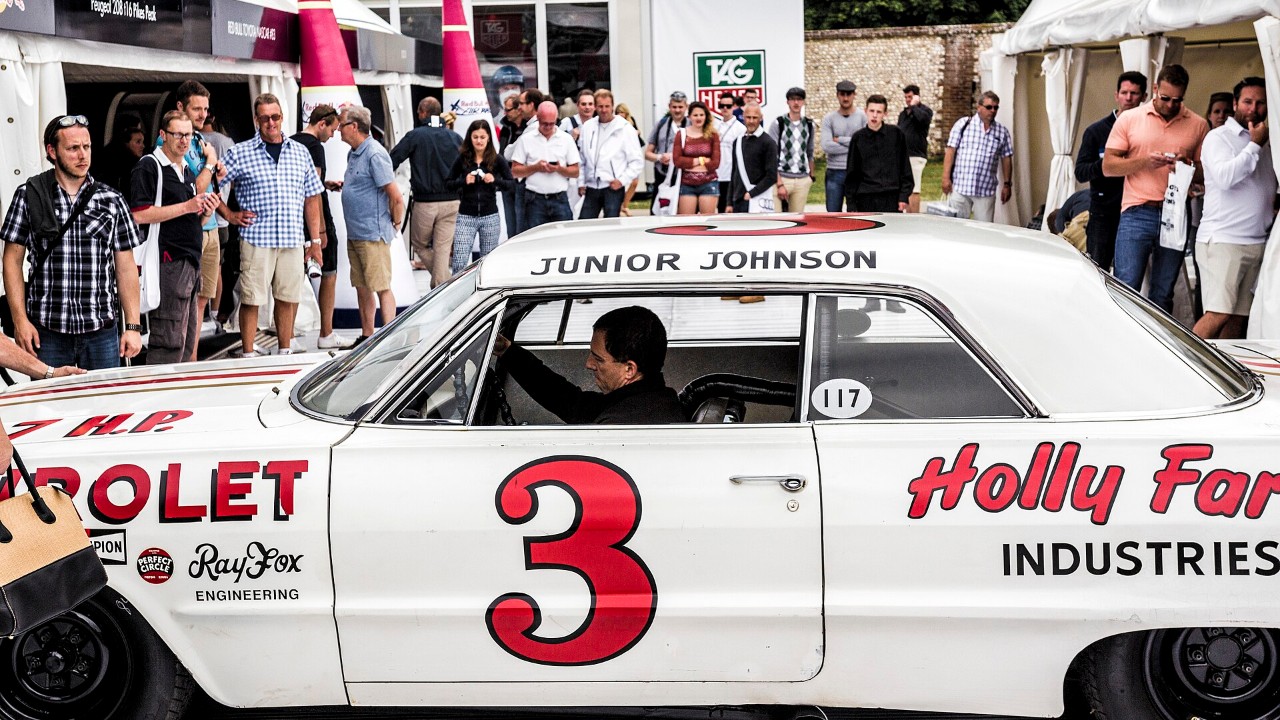
In 1963, Junior Johnson won a Daytona qualifying race with an engine fans came to call the Mystery Motor. The Chevrolet Mystery Motor was a 427-cubic-inch V8 built for NASCAR, with valves set at odd angles inside new heads. By the time it raced, General Motors had already ordered its divisions out of racing.
That timing shaped everything that followed. The engine was fast enough to win, yet it had no factory behind it once the season began.
Here is what the engine was, what happened at Daytona, and how its design reached showroom Chevrolets two years later.
What the Chevrolet Mystery Motor was
Inside Chevrolet, the engine had a plainer name. According to Chevy Hardcore, the company called it the “Mark II” big-block V8, and it was designed and engineered to race. It displaced 427 cubic inches.
Work began in July 1962. A team led by engineer Dick Keinath set out to design an all-new engine, according to Corvette magazine. Chevy chief engineer Harry Barr oversaw the project after Bunkie Knudsen approved it.
The heads were the big idea. They used canted valves, which earned them the “porcupine” nickname, Corvette magazine says. Chevy Hardcore explains that each valve favored the port feeding it, which helped the engine breathe. It also weighed about 50 pounds less than the Z11 427, according to the same report.
GM leaves racing before Daytona
Meanwhile, the politics changed. Days before the 1963 Daytona 500, GM chairman Frederic Donner ruled that no GM division could actively support any form of racing, according to Chevy Hardcore. That move recommitted GM to the 1957 Automobile Manufacturers Association agreement against factory race teams.
Accounts of the exact timing vary. One Chevy Hardcore story says GM backed out before the season began. By contrast, a Corvette Blogger report on Hot Rod’s dyno test says GM pulled support the day before qualifying at Daytona. Either way, the ban came before the 500 itself.
As a result, Chevrolet teams lost their factory parts support. They then had to pick which of the remaining Grand National races to run, Chevy Hardcore says.
Junior Johnson wins his Daytona qualifier
Johnson and Ray Fox ran a new 1963 Chevrolet Impala, according to Chevy Hardcore. In the first 100-mile qualifying race, he won at a record average of 164.083 mph, according to Corvette magazine. Chevy Hardcore gives the same speed for that race.
Then Chevrolet made it two for two. Johnny Rutherford won the second qualifier at 162.969 mph, according to Corvette magazine. He drove Smokey Yunick’s car, which also carried a Mark II engine, Chevy Hardcore says.
In fact, the Mark II Impalas were the fastest cars in the field. They led for much of the 500, Corvette magazine reports, yet all of them ran into mechanical trouble or bad luck.
What went wrong in the 500
The new engines were not yet ready for 500 miles flat out. First, Bubba Farr’s car dropped out on lap 22 with a broken fuel pump, according to Chevy Hardcore. Johnson’s distributor broke four laps later.
Later, G.C. Spencer’s engine failed on lap 95. Rutherford was the best of the Chevrolets, finishing ninth and four laps behind the winner, Tiny Lund.
Still, the season did not end there. Johnson ran 33 races in 1963 and won seven, Chevy Hardcore says. The Corvette Blogger report gives the same seven wins, plus nine poles in those 33 starts.
How many were built, and what survives
Nobody knows the exact total. Estimates range from 17 to 50, according to Corvette Blogger. Meanwhile, a second Chevy Hardcore story says experts believe 15 to 40 were assembled. Johnson himself said his team ended up with seven.
“If it lasted, it won the race,” Johnson said of the engine, according to that story. His Impala’s last win came in the 1963 National 400 at Charlotte, before 46,531 fans. Afterward he parked the car in a barn, and it stayed with him until the RK Collection bought it in early 2012.
One Yunick engine has since been on a dyno. Hot Rod measured 440 horsepower with power still climbing at the top of the pull, Corvette Blogger reports. Torque peaked at 435 lb-ft at 5,000 rpm.
From the Chevrolet Mystery Motor to the Mark IV
The race program ended, but the design did not. The porcupine valve layout carried over to the production Mark IV big-block two years later, according to Chevy Hardcore.
That engine reached the 1965 Corvette as a 396. Because GM limited its intermediate cars to 400 cubic inches, Chevy chose a 4.094-inch bore and 3.76-inch stroke, Corvette magazine explains. The L78 version made 425 horsepower at 6,400 rpm and 415 lb-ft at 4,000 rpm.
It was also a bargain. The option cost $292.70, and 2,157 Corvettes left the St. Louis plant with it in 1965, Corvette magazine says. Johnson’s Mystery Motor Impala, meanwhile, remains in the RK Collection in its as-raced condition.
More from Fast Lane Only
- Unboxing the WWII Jeep in a Crate
- 15 rare Chevys collectors are quietly buying
- 10 underrated V8s still worth hunting down
- Police notice this before you even roll window down
This article was created with the help of AI and was reviewed and edited by Fast Lane Only editors before publication.