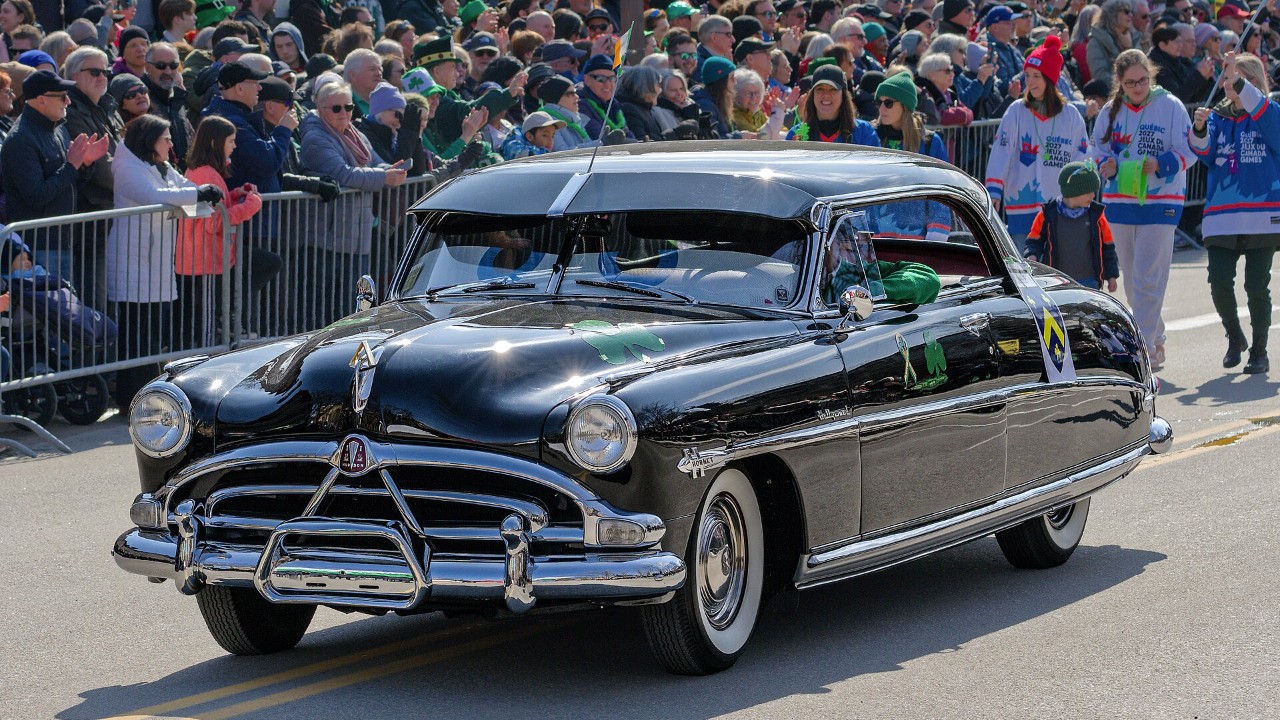
Hudson’s Twin H-Power swapped one two-barrel carburetor for two single-barrel carburetors on the Hornet’s 308-cubic-inch six. It was a simple change to a flathead engine. Even so, it gave Hudson more power at a time when its rivals were moving to V8s.
The setup started as a dealer kit in 1951 and became a factory option for 1952. It also fed the engine that Hudson took racing in NASCAR’s early years.
Here is what the 308 was, why its single carburetor held it back and what the second one changed.
The Hornet’s 308 six
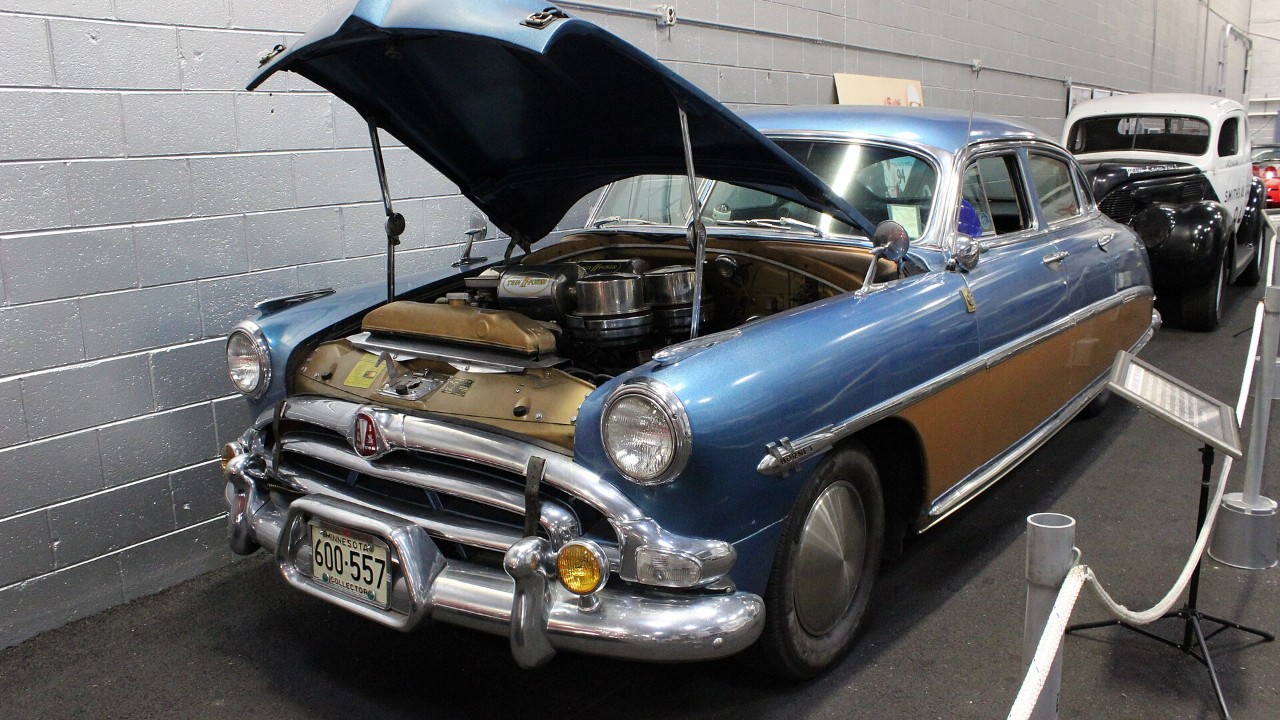
The Hornet arrived for 1951. Its L-head straight six was the 262-cubic-inch Commodore engine enlarged to 308 cubic inches, according to Hagerty. In base form it made 145 hp from a two-barrel carburetor, with an aluminum cylinder head and high compression. Hagerty goes so far as to call it “the biggest and most powerful six in the world.”
The engine was big for a six. Mac’s Motor City Garage gives a 3.8125-inch bore and a 4.500-inch stroke. That made it slightly larger than the 303-cubic-inch Oldsmobile Rocket V8, its main NASCAR rival. In fact, Mac’s notes the 1951 Rocket was rated at 135 hp, against the Hornet’s 145 hp.
The 308 belonged to Hudson’s “Wide Block” family, which also included 232- and 262-cubic-inch sixes. Hudson used high-chromium iron alloy castings, Mac’s says, in keeping with a “when in doubt, build it stout” approach.
Why one carburetor held the six back
An L-head, or flathead, puts its valves in the block beside the cylinders instead of above them. On an inline six, the intake also has to feed six cylinders spread along a long block. According to Mac’s, fuel and air distribution was a known weakness of inline sixes.
The standard 1951 Hornet used a single Carter WGD two-barrel carburetor, Mac’s reports. As a result, the cylinders shared one source of fuel and air through one manifold. Twin H-Power went after that weakness directly.
How Twin H-Power was set up
The package replaced the two-barrel with two Carter WA-1 single-barrel carburetors and two large air cleaners, according to Mac’s. Hagerty describes the setup as two interconnected manifolds feeding dual single-barrel carburetors. The goal, Mac’s says, was better airflow, better fuel flow and more even fuel-air distribution.
Hudson first sold it through dealers. Conceptcarz lists Twin H-Power as a mid-1951 dealer-installed option at $85.60, with twin one-barrel Carter carburetors and a larger throat area. Then, for 1952, buyers could order it from the factory.
Notably, the 308 underneath kept its flathead layout and its bore and stroke. Mac’s describes the package as new carburetors and air cleaners on the same six, and it lists the torque rating as unchanged.
How much power Twin H-Power added
Sources differ on the output. Hagerty says Twin-H raised the Hornet from 145 hp to 170 hp. Similarly, SlashGear gives 170 hp in factory form for the 1952 Twin-H 308.
Mac’s Motor City Garage, however, rates Twin-H at 160 hp at 4,000 rpm. Conceptcarz, for its part, lists 170 hp by 1954. Either way, the two carburetors added between 15 and 25 hp over the base engine, depending on the source.
Twin H-Power and the 7-X
Racing pushed the engine further. Driver Marshall Teague’s visit to Detroit prompted Hudson to back the Hornet’s racing, according to Mac’s. Racing representative Vince Piggins supported the effort, and Hudson then sold heavy-duty parts and the 7-X engine package through its dealers.
The 7-X used a hotter camshaft, 2.00-inch intake and 1.687-inch exhaust valves, and a split exhaust manifold, Mac’s says. SlashGear adds hand assembly and a higher compression ratio to that list. Even so, Hudson never published an official output figure for it, Mac’s says. By comparison, Hagerty and SlashGear quote 210 hp, while Mac’s estimates 220 to 270 hp. Conceptcarz adds that 7-X parts cost $385 through Hudson dealers in 1953.
On the track, the results were clear. Hagerty, Mac’s and SlashGear all record that Hudson won 27 of 34 NASCAR races in 1952.
What it meant for Hudson
Racing wins did not turn into showroom sales. Hagerty says buyers wanted a big V8, and Hudson’s finances were in severe decline as a merger with Nash took shape.
The production figures show it. Conceptcarz counts 43,666 Hornets built for 1951, then 35,921 for 1952 and 24,833 for 1954. By 1957, SlashGear notes, Hudson had stopped making cars altogether.
More from Fast Lane Only
- Unboxing the WWII Jeep in a Crate
- 15 rare Chevys collectors are quietly buying
- 10 underrated V8s still worth hunting down
- Police notice this before you even roll window down
This article was created with the help of AI and was reviewed and edited by Fast Lane Only editors before publication.