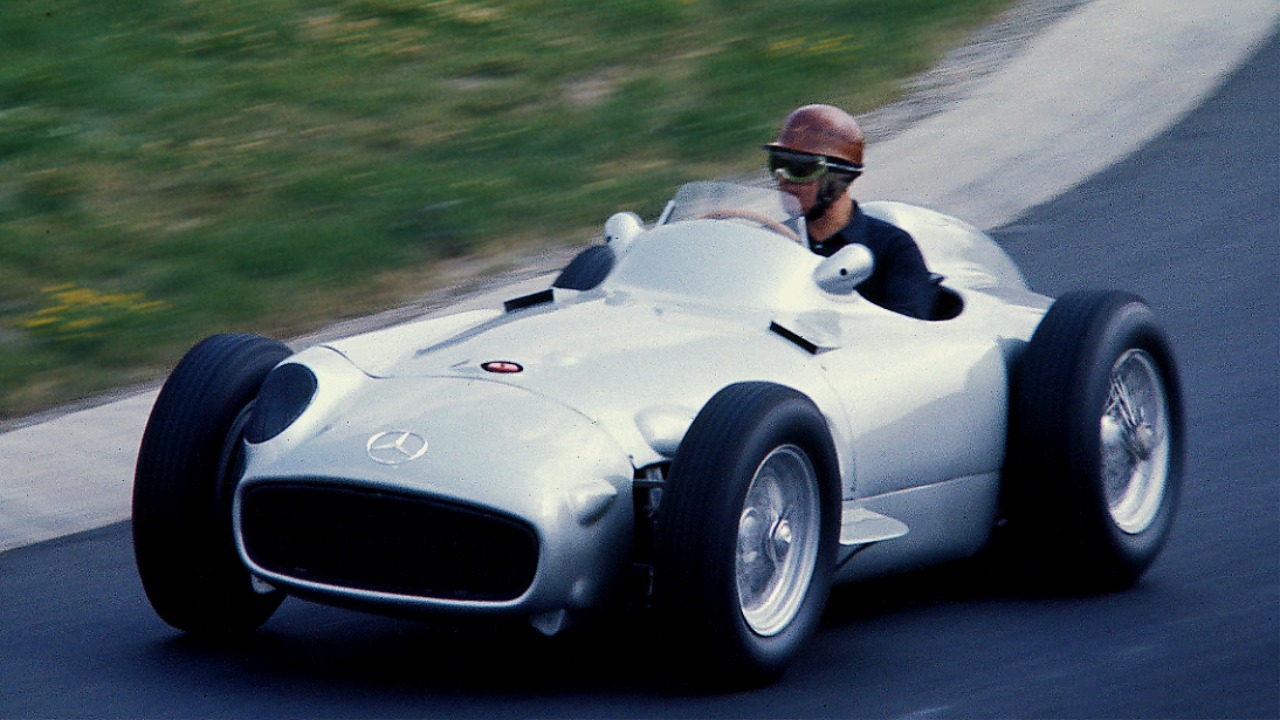
Mercedes-Benz started its first Formula 1 World Championship race at Reims on July 4, 1954, and won it. The Mercedes W196, wrapped in a silver streamlined body that covered its wheels, carried Juan Manuel Fangio and Karl Kling to a one-two in the French Grand Prix. At the flag, a tenth of a second split them.
Just as striking, the car was brand new. Reims was its first race, and Fangio had driven for Maserati in the first three rounds of the season. By the evening of July 4, he was a Mercedes winner.
Here is what made the streamliner different, how the 61 laps played out, and what the car did next.
A new formula and a new Mercedes W196
From 1954, a new formula limited naturally aspirated engines to 2.5 liters and supercharged engines to 750 cc, according to the Mercedes-Benz Classic archive. The sport’s governing body, the CSI, had made those rules binding in October 1952. Before that, the limits were 1.5 liters supercharged and 4.5 liters without a supercharger.
Mercedes answered with the M 196 engine. It was a short-stroke in-line eight-cylinder, built from two four-cylinder blocks, with the drive taken from the center. Instead of valve springs, a desmodromic system closed the valves as well as opened them. As a result, the engine could spin to almost 9,000 rpm.
The archive also lists direct petrol injection, two spark plugs per cylinder and a Hirth crankshaft on roller bearings. Output was 257 hp at 8,250 rpm. In fact, Motor Sport noted that the Mercedes and the HWM were the only cars at Reims using fuel injection, while the rest used Weber carburetors.
Underneath sat a light tubular frame and a five-speed transaxle, which combined the gearbox and differential. At the back, Mercedes used a single-joint swing axle with a low pivot point.
Why the W196 wore a streamlined body
Mercedes presented the streamlined body in mid-February 1954 and intended it for very fast circuits, the archive says. Reims was exactly that kind of track. In practice, Fangio lapped in 2 min 29.4 sec, about 200.042 km/h, according to Motor Sport’s August 1954 report.
The magazine recorded it as the first lap over 200 km/h, and the prize was 50 bottles of champagne. Kling managed 2 min 30.4 sec. Meanwhile, Alberto Ascari’s Maserati and José Froilán González’s Ferrari were both within about a second of Fangio.
So the front row read Fangio, Kling and Ascari. González and Onofre Marimón lined up behind them.
61 laps on the Reims straights
Fangio and Kling pulled away at the start. Ascari’s Maserati lasted one lap before its transmission failed, Motor Sport reported. González then led briefly, but his Ferrari’s engine failed on lap 13.
The third Mercedes, driven by Hans Herrmann, set the fastest lap. However, it retired with engine damage, according to the Mercedes archive. The official classification shows Herrmann out after 16 laps.
After that, the two silver cars ran together at the front. In the closing laps they went side by side. On the final straight, Kling tried to pass but “failed by a matter of yards,” in Motor Sport’s words.
The official result
The official Formula 1 result shows Fangio winning in 2:42:47.900 after 61 laps. Kling finished 0.100 seconds behind him. Robert Manzon took third in a Ferrari, a lap down, and Prince Bira was fourth for Maserati.
Only six cars were classified. Luigi Villoresi finished fifth for Maserati and Jean Behra sixth for Gordini. On the points table, Fangio scored 8, Kling 6 and Herrmann 1, the point for his fastest lap.
The Mercedes-AMG F1 team still counts Reims as race one of its Formula 1 history. It calls the day “a perfect start to life in Formula 1” for the W196.
What the Mercedes W196 streamliner did next
The streamlined body had a weakness on twisty tracks. At Silverstone on July 17, 1954, Fangio finished fourth and Kling seventh, and the archive says the bodywork was at a disadvantage there. Then, 14 days later at the Nürburgring, Mercedes raced an open-wheel version of the W196 for the first time.
Even so, the streamliner had more to give. Later in 1954, at Berlin’s AVUS circuit, the streamlined cars finished first, second and third in a non-championship race: Kling, then Fangio, then Herrmann. In all, Mercedes raced the streamlined body four times that year, the archive says.
The Reims win also counted toward Fangio’s season. According to the Mercedes-AMG F1 team, it helped him claim his second World Drivers’ title in 1954. He then won a third in 1955, driving for Mercedes in every race. The margin that opened the Mercedes W196’s career, though, stays in the official record at one tenth of a second.
More from Fast Lane Only
- Unboxing the WWII Jeep in a Crate
- 15 rare Chevys collectors are quietly buying
- 10 underrated V8s still worth hunting down
- Police notice this before you even roll window down
This article was created with the help of AI and was reviewed and edited by Fast Lane Only editors before publication.