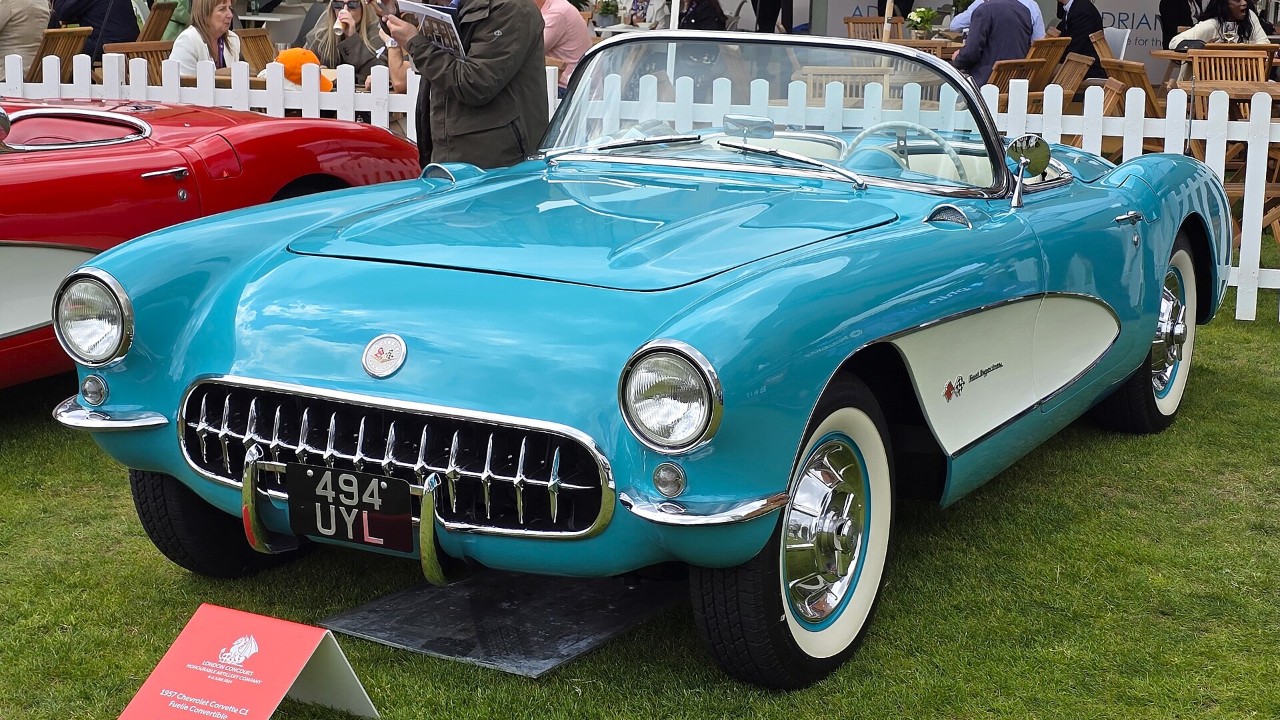
In 1957, Chevrolet bolted a mechanical fuel system onto its 283-cubic-inch small-block V8 and rated the result at 283 horsepower. The Ramjet fuel injection had no computer, no sensors and no injectors that clicked open and shut. Instead, it sprayed fuel into every port all the time and simply changed how much.
That sounds crude next to a modern engine. Yet it was clever, and it put an even one horsepower per cubic inch on a Chevrolet order form. Here’s how the plumbing worked, who built it and why it faded after 1965.
The short version is that air did the thinking. Engine vacuum told the system how hard the engine was working, and a set of diaphragms and levers turned that signal into fuel pressure.
Who built the Ramjet fuel injection
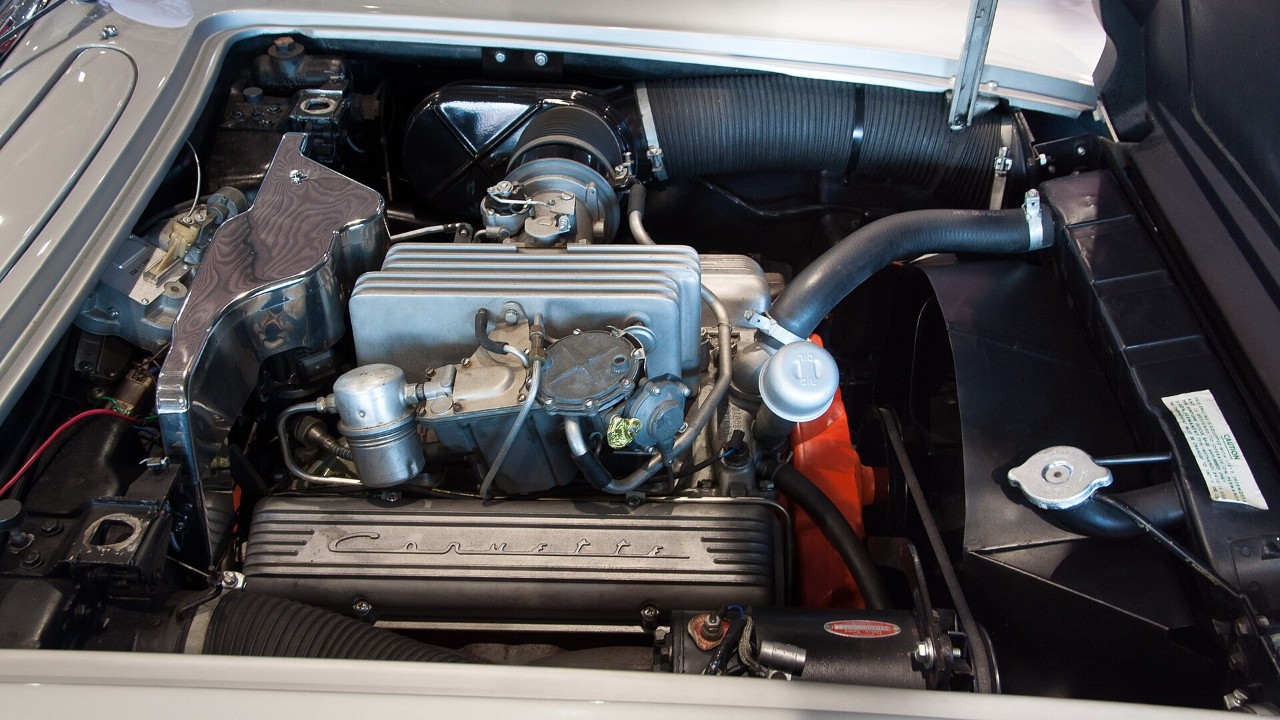
According to the Auto History Preservation Society, four engineers developed the system: John Dolza, E.A. Kehoe, Donald Stoltman and Corvette chief engineer Zora Arkus-Duntov. GM’s Rochester carburetor division manufactured it. That’s why collectors often call it Rochester fuel injection, while Chevrolet sold it as Ramjet.
GM had two designs on the table. The society’s account says the “A” type used continuous flow, with a nozzle spraying into each intake port. By contrast, the “B” type used timed injection and came from GM’s Diesel Equipment Division and research staff. GM picked the A system for the earliest release “primarily from a standpoint of simplicity and cost.”
In other words, the headline feature was a choice. Chevrolet skipped timed injectors on purpose, because the simpler setup could reach showrooms sooner.
The air meter: reading the engine’s load
The system had three main parts: an air meter, a fuel meter and a two-piece intake manifold. Chevy Hardcore’s technical history by Nick Adams places the air meter on the driver’s side of the manifold. It held a large throttle blade linked to the gas pedal and a choke butterfly for cold starts.
Inside sat a diffuser cone. As air rushed past it, the cone created vacuum signals that the fuel meter used as its instructions. So the more air the engine pulled in, the stronger the signal, and the more fuel the meter delivered.
The fuel meter: pressure instead of timing
The fuel meter sat on the passenger side. First, an ordinary block-mounted mechanical pump, like the one on a carbureted V8, filled a float bowl inside it. Then a spur-gear high-pressure pump, submerged in that bowl, took over. Chevy Hardcore says the distributor drove it through a short cable, turning it at half engine speed.
Next came the clever part, a spill plunger that worked as a return valve. Closing it raised pressure and flow, while opening it sent fuel back and lowered both. Meanwhile, vacuum from the air meter acted on diaphragms in the fuel meter, and those diaphragms moved a lever and pivot that positioned the plunger.
As a result, fuel pressure tracked engine demand. According to the same history, late in production that pressure ran from almost zero at idle to more than 500 psi at high rpm and wide-open throttle.
Why the nozzles were never timed
Each cylinder had a brass nozzle in a tower-shaped port, aimed at the back of the intake valve. However, those nozzles weren’t valves at all. Chevy Hardcore describes the system as “constant flow,” with fuel spraying continuously. One high-pressure pump fed all eight nozzles at equal pressure.
Because the spray never stopped, the only way to change the mixture was to change the pressure. That’s exactly what the spill plunger did. The history gives the targets as roughly 15.5:1 air to fuel for light-load cruising, about 14.5:1 at idle and about 12.5:1 at full throttle.
For comparison, a modern injector opens and closes for each intake stroke, under a computer’s command. The Ramjet got by with vacuum, springs and levers.
The numbers on the 1957 order form
The National Corvette Museum’s page “Introducing Sensational New Fuel Injection” lists the top engine at “283 h.p. at 6200 r.p.m.” with Ramjet fuel injection. It also gives the 283’s bore and stroke as 3.88 by 3.0 inches. Above all, it plays up the headline figure: “ONE H.P. For Every Cubic Inch.”
That said, Chevrolet wasn’t alone. As Jalopnik pointed out in August 2026, Chrysler’s 1956 300B offered an optional 354-cubic-inch Hemi rated at 355 hp. The same piece credits the 1957 DeSoto Adventurer with 345 hp from 345 cubic inches.
The fuel injection wasn’t cheap, either. Chevy Hardcore lists the 1957 option at $484.20, compared with $182.95 for the 270-hp dual-carburetor 283. That works out to $301.25 more for 13 extra horsepower.
Where it went and why it faded
The Ramjet wasn’t only a Corvette part. Chevy Hardcore says Corvettes offered it from 1957 to 1965, while full-size Chevrolets such as the Bel Air got it from 1957 to 1959. Pontiac also sold a similar Rochester system for 1957 and 1958.
Still, the system earned a reputation as fickle and costly to fix. Many mechanics and service departments struggled to tune it, according to the same history, so plenty of owners swapped in carburetors. Then the big-block arrived. For 1965, the 425-hp 396 cost $292.70, while the 375-hp fuel-injected 327 cost $538.00.
Buyers voted with their checkbooks. That year, only 771 Corvette buyers chose the fuel-injected small-block, against 2,157 who took the big-block. As a result, 1965 was the last year for Ramjet fuel injection, and Chevy Hardcore notes that the small-block didn’t get fuel injection again until 1982.
More from Fast Lane Only