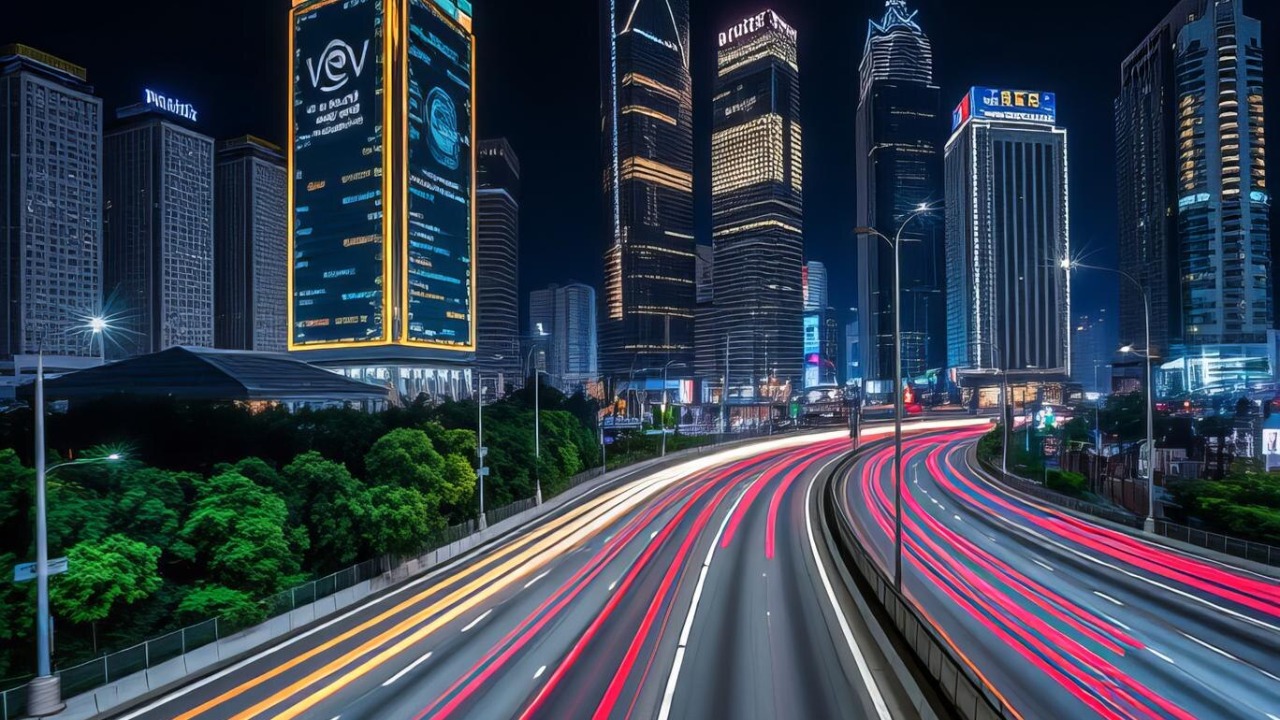
On a handful of long, isolated expressways in China, drivers cruising through pitch-dark stretches are suddenly engulfed in corridors of bright, multicolored laser light. Green, red and blue beams sweep across the pavement and roadside barriers, creating a tunnel effect that lasts a few hundred meters before the road returns to darkness.
Chinese highway authorities have branded these installations “anti-fatigue laser zones,” and they have been placed at strategic points — before toll plazas, service areas and highway exits — where drowsy driving crashes tend to cluster. The concept is simple: shock a fatigued brain back to attention with an abrupt, high-contrast visual environment, then give the driver a clear opportunity to pull over at the next rest stop.
Footage of the systems, much of it filmed on the Qingdao-Yinchuan Expressway (G20), has circulated widely on Chinese and international social media since 2023, drawing a mix of fascination and pointed skepticism. As of early 2026, no Chinese government agency has published crash-reduction data from the corridors, leaving a core question unanswered: are the lasers a genuine safety innovation, or an expensive light show?
How the laser zones are designed
The systems typically mount laser projectors on overhead gantries or roadside poles that already carry cameras and electronic tolling equipment. According to descriptions from Today Online and multiple Chinese-language highway management notices, the beams are angled so they strike the road surface and barriers rather than shining directly through windshields. Drivers see a wash of moving color around and beneath their vehicle, not a beam aimed at their eyes.
The installations are not continuous. They appear in designated “alert zones” that typically run a few hundred meters, placed where engineers have identified elevated fatigue risk — long, monotonous segments with few visual landmarks, or the approach to a toll booth where a lapse in attention could cause a rear-end collision. Some versions increase beam density as drivers get closer to the stopping point, creating a visual crescendo meant to sharpen focus right when it matters most.
Banish drowsiness and stay alert!
— Shenzhen Channel (@sz_mediagroup) March 31, 2026
On expressways in Shandong, a province in eastern China, laser lights have been installed at intervals along the route to help keep drivers alert at night, effectively reducing the risk of drowsy driving.@ChineseEmbinUS @faxianshandong… pic.twitter.com/BCWyxIccOd
The drowsy driving problem the lasers aim to solve
China’s expressway network, the world’s longest at over 180,000 kilometers, includes vast stretches through sparsely populated terrain where drivers may go an hour or more without encountering a town, a curve or any meaningful change in scenery. Fatigue is a leading factor in highway fatalities there. China’s Ministry of Public Security has repeatedly identified drowsy and distracted driving as top causes of serious expressway crashes, and a 2020 study published in the International Journal of Environmental Research and Public Health found that monotonous road environments significantly increased physiological markers of driver fatigue.
Conventional countermeasures — rumble strips, “drowsy driving” warning signs, mandatory rest stops every few hours for commercial vehicles — have not eliminated the problem. The laser zones represent an attempt to add a tool that is harder to ignore than a sign and does not require the driver to take any action, like pulling over, that a fatigued person might skip.
What supporters say
Drivers who have posted about passing through the zones frequently describe the experience as jarring in a positive way. The most common comparison is to driving from a dark rural road into a brightly lit city center: the sudden increase in visual complexity forces the brain to process new information, temporarily overriding the drowsy autopilot that sets in on featureless highways.
Proponents also note that the zones are placed just before locations where drivers can stop. The logic is not that lasers will keep someone alert for hours, but that a well-timed jolt might keep them awake for the 30 seconds it takes to reach a service area entrance and make the decision to pull in.
China is not the only country experimenting with visual stimulation on roads. Brightly colored pavement has been used in the Netherlands and Japan to signal lane changes and speed zones, and South Korea has tested LED-lit crosswalks to catch the attention of distracted pedestrians. The laser corridors push that concept further by adding motion and intensity.
The case for skepticism
Critics raise several concerns, and as of March 2026, none have been convincingly addressed by published data.
No public crash data. The most fundamental problem is the absence of transparent before-and-after accident statistics from any corridor using the system. Without that evidence, the “anti-fatigue” label is a marketing claim, not a proven safety benefit. Chinese highway authorities have not, to date, released controlled studies or even aggregate crash figures comparing laser-equipped segments to comparable unequipped ones.
Distraction risk. The spectacle that makes the lasers attention-grabbing could also make them dangerous. Online commenters have pointed out that drivers may slow down abruptly, swerve slightly or reach for a phone to record the scene — all behaviors that introduce new hazards. A TechEBlog report on the viral footage noted that viewer reactions were split between admiration and concern that the installations could cause the very crashes they claim to prevent.
Glare and weather. Laser light reflecting off wet asphalt in rain or fog could reduce visibility rather than enhance alertness. Drivers with photosensitive conditions, including epilepsy, could be at particular risk if the beams produce rapid flickering — a point that no publicly available description of the systems has addressed.
Habituation. A first encounter with a laser zone is startling. A 50th encounter, for a truck driver who runs the same route nightly, may not be. If the alertness benefit fades with familiarity while the distraction potential remains, the net safety effect could turn negative over time. Research on rumble strips and other alerting devices has shown that habituation is a real and measurable phenomenon in road safety interventions.
China’s broader experiments with visual road design
The laser corridors are part of a wider pattern of Chinese road authorities using bold visual design to influence driver behavior. In Xianju County in Zhejiang Province, a six-kilometer stretch of provincial road S322 was painted vivid pink to clearly separate non-motorized lanes from motor traffic, with local officials reporting that the unusual color helped drivers stay more attentive in the area. Elsewhere, some urban roads have adopted 3D crosswalk paintings that create an optical illusion of raised barriers, slowing drivers through visual trickery rather than physical infrastructure.
The laser systems take that philosophy and amplify it with technology that can be switched on at night, adjusted in intensity and turned off during the day when fatigue risk is lower. That flexibility is an advantage over permanent paint, but it also means the systems depend on maintenance, power supply and correct calibration — failure modes that painted lines do not have.
What comes next
The laser alert zones have succeeded, at minimum, in generating global conversation about drowsy driving and the limits of conventional road safety tools. Whether they succeed as engineering is a question that only data can answer.
For now, the installations remain concentrated on a small number of Chinese expressways, and no other country has announced plans to adopt the technology. If Chinese authorities publish credible crash-reduction figures, the concept could spread quickly — the hardware is relatively simple, and the visual impact is undeniable. If the data never materializes, the laser corridors may end up as a memorable curiosity: proof that China is willing to try almost anything to keep its drivers awake, even if the evidence has not caught up with the ambition.
More from Fast Lane Only
- Unboxing the WWII Jeep in a Crate
- 15 rare Chevys collectors are quietly buying
- 10 underrated V8s still worth hunting down
- Police notice this before you even roll window down
*Research for this article included AI assistance, with all final content reviewed by human editors.