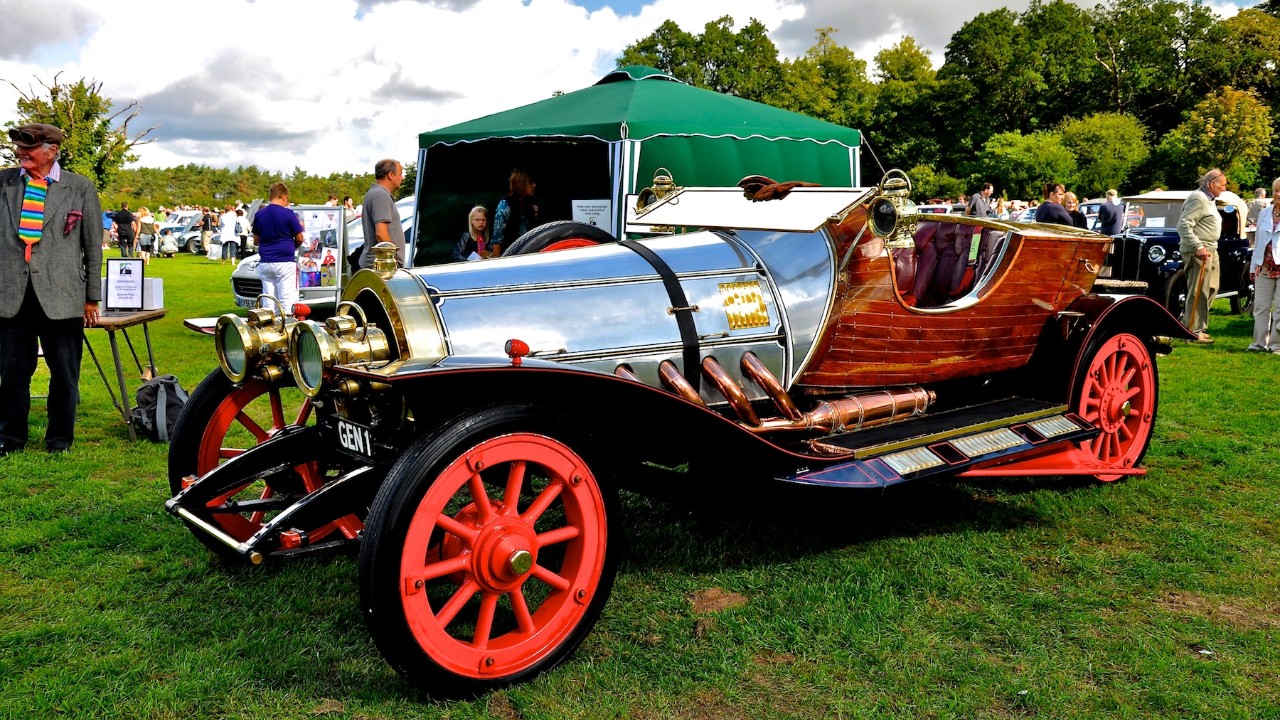
The Chitty Chitty Bang Bang car that Dick Van Dyke drove on screen was a real, running machine. Alan Mann Racing built the road-going version in Hertfordshire in 1967. Under its boat-shaped body sits a Ford V6, and the car carried proper road registration.
That is a strange résumé for a film star. It looks like a fantasy from before the First World War, yet a 1960s Ford engine drives it. It also had to work for a living, because the production needed at least one Chitty that could actually be driven.
The name is older than the film, too. Ian Fleming wrote the children’s book after watching real racing cars as a young man. Those racers and the 1968 movie car share a name, a sense of fun and very little else.
Who built the Chitty Chitty Bang Bang car
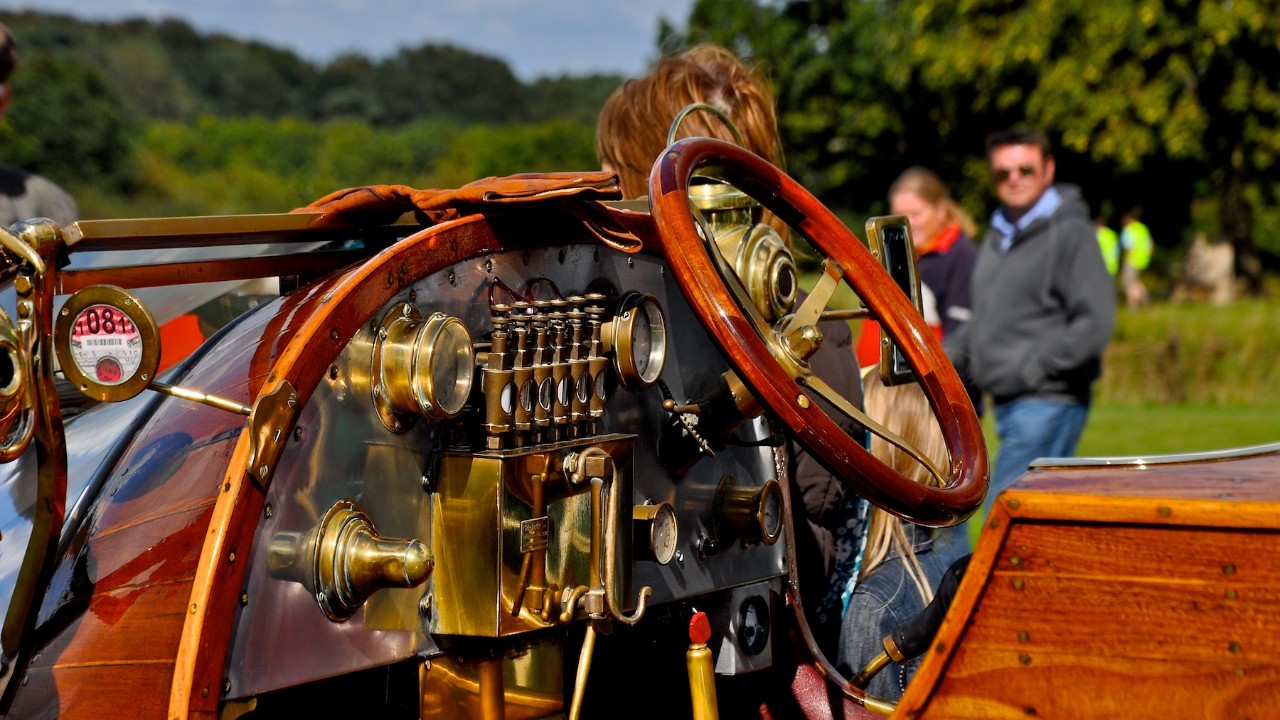
Production designer Ken Adam drew the car, with help from Rowland Emett. Then, according to conceptcarz’s history of the film car, Alan Mann Racing built it in Hertfordshire in 1967. A 2011 report from Pursuitist describes the builders as the Ford racing team headed by Alan Mann. It also says the finished car rolled out of the workshop in June 1967.
The film needed more than one Chitty, however. Motorious says the production used six versions, and only one of them actually ran. The others served as props for close-ups, water scenes and flying shots. In fact, conceptcarz notes that an engineless car used for close-ups wore the registration GEM 11.
The Ford V6 under the bonnet
Power came from Ford’s 3.0-liter Essex V6, the engine conceptcarz names for the road car. It drove through an automatic transmission. Meanwhile, Lancaster Insurance’s look back at the car identifies the gearbox as a Borg Warner unit.
That pairing made sense for a movie car. An automatic let a driver keep the car moving smoothly for the camera, with no clutch to manage between takes. In our view, it was the right call for a car that spent its days stopping and starting on set.
The car is also big. Pursuitist puts it at about 2 tons and 17 1/2 feet long, on a custom ladder-frame chassis. By comparison, a 1968 newspaper report quoted by Lancaster gave it as 17 ft 7 in long, 5 ft 9 in wide and 6 ft 3 in high. That same report said it could reach 100 mph.
Mann had to think about grip as well. According to Lancaster, he asked Goodyear to make tyres from its latest racing compound. The car had to look vintage, but it also had to cope with hard work on set and on location.
Details that make the Chitty Chitty Bang Bang car special
The materials read like a boatyard order. Pursuitist lists a polished aluminum bonnet and a deck of red and white cedar. Conceptcarz adds that shipbuilders made the wooden boat-tail body. Both Motorious and Paul Fraser Collectibles also say the dashboard plate came from a World War I British fighter plane.
Even the number plate has a story. The GEN 11 registration came straight from Fleming’s novel. According to Pursuitist, this is the only car to carry those plates legitimately.
Because the car was fully road legal, it could leave the studio behind. Motorious says it later appeared at automotive events around the UK. That is a rare second life for a car built for one film.
The racers that gave the car its name
The original Chitty Bang Bang was a real race car. Count Louis Zborowski built four of them, according to the Aston Martin Heritage Trust. The first used a 300 hp Maybach engine and made its debut at Brooklands in 1920.
A young Ian Fleming watched those cars run at Brooklands, the trust says. Years later, he wrote a children’s book and put the name in its title. Zborowski also backed a young Aston Martin, investing in the company in 1922.
So the movie car is a tribute, not a copy. The 1920 racer was a hand-built special around a big Maybach engine. By contrast, the 1967 car pairs a Ford V6 and an automatic with a body built to look like a storybook.
Where the road-going car went
Pierre Picton worked on the car during the 1967–68 production, Pursuitist reports. He later owned it, and Motorious dates his ownership from 1970 to 2011. During those years, he showed it at events across the UK.
Then, in 2011, the car changed hands. Motorious reports that the sale ended with a winning bid of $805,000 from filmmaker Peter Jackson. That ended roughly four decades with one keeper, on Motorious’s dates.
The car now lives in New Zealand, according to Motorious, and Jackson has used it to raise money for charity. There it wears a slightly altered plate, GEN 1I, as conceptcarz records.
More from Fast Lane Only