California Highway Patrol officers detained 85 cyclists and seized their bikes after a group attempted to ride onto the San Francisco Bay Bridge, turning a weekend outing into a high-profile clash over safety and protest tactics. The riders were stopped before they reached the bridge deck, but the scale of the response and the number of citations issued have already ignited debate across Bay Area cycling and commuter communities.
Authorities describe the intervention as a necessary move to prevent gridlock and potential injuries on one of California’s busiest spans. Riders and civil liberties advocates, meanwhile, are now parsing what it means when a loosely organized bike group is treated like a takeover threat. The episode underscores how quickly a social ride can be reframed as a public safety emergency when it intersects with critical infrastructure.
How a group ride became a Bay Bridge operation
According to multiple law enforcement accounts, the confrontation began when a large pack of cyclists gathered in San Francisco with the apparent goal of reaching the Bay Bridge. The California Highway Patrol and the San Francisco Police Department were already on alert after officers received word that a sizable group intended to head toward the bridge and possibly occupy lanes normally reserved for motor vehicles. The Bay Bridge, which links San Francisco and Alameda counties, is one of the region’s most vital links for commuters, freight and transit.
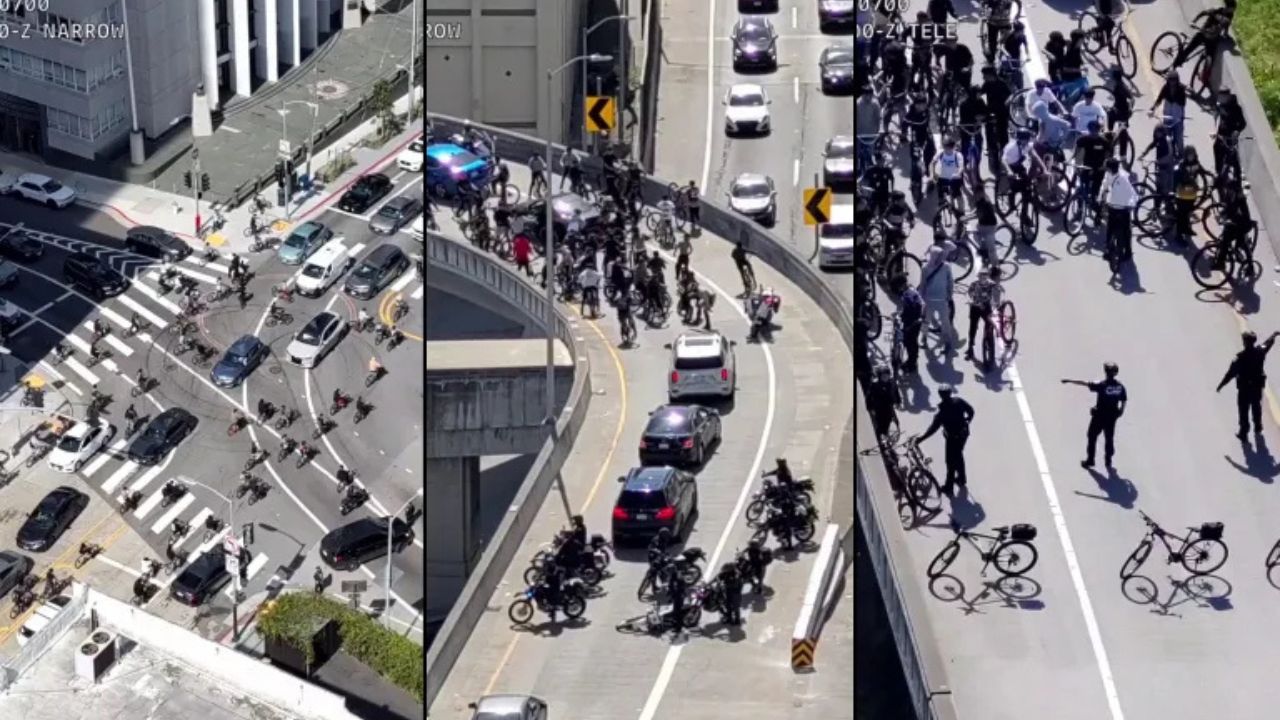
Authorities say the cyclists moved through city streets and then tried to access the bridge via the Harrison Street approach. San Francisco officers monitored the group as it rode the wrong way up the Harrison Street off-ramp, a maneuver that put riders directly against the intended traffic flow and raised immediate concerns about collisions with cars entering or exiting the freeway. That wrong-way movement toward the bridge is at the center of the public safety rationale officers now cite for the mass detention.
California Highway Patrol units, already stationed near bridge access points, coordinated with San Francisco officers to intercept the group before it could enter the bridge proper. The joint response was framed as a preemptive action that stopped the ride from spilling onto the span, where lane blockages could have backed up traffic for miles in both directions.
The joint CHP and SFPD playbook
The California Highway Patrol, which has primary jurisdiction over the bridge and surrounding freeways, credits a close partnership with the San Francisco Police Department for the quick response. Earlier alerts from the San Francisco Police Department about the gathering riders allowed CHP officers to stage in advance and limit the group’s options as it approached the on-ramp. The California Highway Patrol has described this as a coordinated freeway safety operation rather than a spontaneous crackdown.
Officials say the joint strategy relied on a mix of ground units and aerial support. San Francisco police used drones to track the cyclists’ movements through city streets and up the Harrison Street route toward the bridge. That aerial view gave officers a real-time picture of the group’s size and direction, allowing CHP units on the ground to position patrol cars at key choke points where riders could be safely stopped without forcing a confrontation in the middle of live freeway lanes.
On social media, CHP and SFPD accounts highlighted the collaboration, with one post describing a JOINT effort in which CHP and SFPD officers worked together in an OPERATION that STOPS cyclists from taking over the bridge. The emphasis on partnership reflects a broader shift in how local police and state highway patrols coordinate around large, mobile events that can cross jurisdictional boundaries in a matter of minutes.
Detentions, citations and 85 seized bikes
Once officers blocked the approach, the ride ended not with a short warning but with mass detentions. Authorities say 85 cyclists were detained and their bikes were seized at the scene. Riders were lined up, identified and cited, then released without physical confrontation. Officials have stressed that All individuals were detained without incident, a point they present as evidence that heavy enforcement can be carried out without escalation when officers have the advantage of preparation and numbers.
Those 85 bikes are now at the center of the enforcement story. California Highway Patrol statements indicate that the bicycles were taken as part of the citation process and held as evidence tied to alleged violations. Riders were reportedly issued citations for infractions related to entering or attempting to enter freeway infrastructure on bicycles, and for riding the wrong way on an off-ramp. In some accounts, officers have also mentioned potential reckless riding and failure to obey traffic controls, although specific charge lists for each rider have not been published. Unverified based on available sources.
Authorities have framed the seizures as a deterrent. By taking the bikes rather than issuing warnings and allowing riders to pedal away, the agencies signaled that future attempts to occupy freeway lanes or bridge decks could carry real financial and logistical consequences for participants. For many cyclists, the loss of a primary mode of transportation, whether a high-end road bike or a basic commuter, is a significant penalty in itself.
Inside the attempted “takeover”
Law enforcement statements repeatedly refer to the ride as an attempted takeover of the Bay Bridge. That term, more commonly associated with sideshows and illegal car gatherings, has now migrated into how agencies describe large, loosely organized bike rides that target prominent routes. In this case, officers say they believed the cyclists intended to ride across the bridge deck in a large group, potentially filling multiple lanes and forcing drivers to slow behind them or stop entirely.
Footage captured by a California Highway Patrol helicopter showed vehicles slowly driving past the cyclists as they rode up the approach, a visual that officials cite as evidence that the group was already affecting traffic flow before it even reached the main span. The video has circulated widely online, feeding a polarized reaction among viewers who either see a dangerous stunt or a creative form of protest and group expression.
Social media posts from local accounts described CHP and SFPD officers stopping nearly 100 bicyclists from taking over the bridge, language that frames the event as a near miss rather than a fully realized blockade. One clip from Mar shows the riders clustered near the Harrison Street on-ramp as officers move in to halt their progress. Another reel, also from Mar, states that SFPD shut down a planned Bay Bridge takeover involving a large bicyclist group and reiterates that 85 bikes were seized.
How the operation unfolded on the ground
Witness accounts and official descriptions suggest a tactical approach designed to avoid a chaotic confrontation in live traffic. Officers did not wait for the riders to reach the bridge deck. Instead, they used patrol cars to create a barrier near the on-ramp, then directed cyclists to dismount and move to the side of the roadway. The use of drones and helicopter footage meant that by the time the group reached that choke point, police already had a clear estimate of its size and formation.
Some riders reportedly tried to turn around or exit onto side streets as the scale of the police presence became clear, but officers had already positioned units to block easy escape routes. The result was a contained scene in which cyclists were effectively funneled into a controlled area where detentions and citations could be processed. Officials have emphasized that there were no reported injuries to riders, officers or motorists during the operation.
One social media post from Mar that praised the outcome credited SFPD and CHP for acting quickly to stop dangerous activity before it could escalate. That framing aligns with the agencies’ argument that the intervention prevented a more serious incident on the bridge itself, where a collision between a fast-moving car and a dense pack of cyclists could have had far more severe consequences.
Public reaction and online fallout
Within hours, clips of the stopped ride and images of officers loading bikes into trucks circulated widely. An Instagram reel from sfgate showing the operation drew 2838 likes and 302 comments, a snapshot of how intensely Bay Area residents engage with any story involving the Bay Bridge and traffic disruption. Another reel from Mar, posted by danielluriesf, logged 9106 likes and 782 comments, indicating that the debate extended beyond the immediate cycling community.
Commenters split sharply. Some applauded CHP and SFPD for preventing what they saw as a reckless stunt that could have endangered families driving across the bridge. Others argued that treating a group bike ride as a takeover and seizing 85 bikes represented an overreach that criminalized nonviolent protest and group mobility. The language of “takeover” itself drew scrutiny, with critics suggesting that it inflamed public perception and justified a heavier response than the situation required.
Cycling advocates have also raised concerns about the long-term impact on riders who use bikes as their primary transportation. Losing a bike can mean losing access to work, school or essential errands, particularly for lower-income residents who cannot easily replace a seized bicycle. Some have called for clearer guidelines on when and how agencies can confiscate bikes in connection with traffic infractions.
What authorities say about safety and intent
In public statements, the California Highway Patrol and San Francisco Police Department have focused on safety and the unique risks of mixing large, slow-moving groups of cyclists with high-speed freeway traffic. Officials point to the Harrison Street off-ramp, which is designed for vehicles accelerating or decelerating around curves, as a particularly hazardous place for bikes traveling in the wrong direction. They argue that once the group committed to that path, intervention became unavoidable.
California Highway Patrol leaders have also linked the operation to a broader effort to crack down on freeway takeovers, whether by cars, motorcycles or bicycles. They cite previous incidents in California Atlanta Chicago Philadelphia where unsanctioned gatherings on major roads led to serious crashes, injuries and long traffic shutdowns. By acting early in this case, they say, the agencies sent a clear message that similar attempts on the Bay Bridge will not be tolerated.
San Francisco officials, for their part, have framed the operation as an example of proactive policing that uses technology and interagency coordination to prevent harm. One statement from Mar highlighted that SFPD and CHP worked together over the weekend to shut down a planned Bay Bridge takeover by a large bicyclist group, with the goal of stopping dangerous activity before it could escalate. That message positions the operation as a model for how the city and state can manage large, mobile events that intersect with critical infrastructure.
Cycling culture, protest and the Bay Bridge
The Bay Bridge has long been a symbol of both connection and division in the Bay Area, and it sits at the intersection of several powerful currents: commuter frustration, environmental advocacy and the push for more bike-friendly infrastructure. The bridge’s design leaves limited room for bikes, and for many riders, that exclusion has become a point of contention in a region that otherwise promotes cycling as a key part of its transportation future.
More from Fast Lane Only