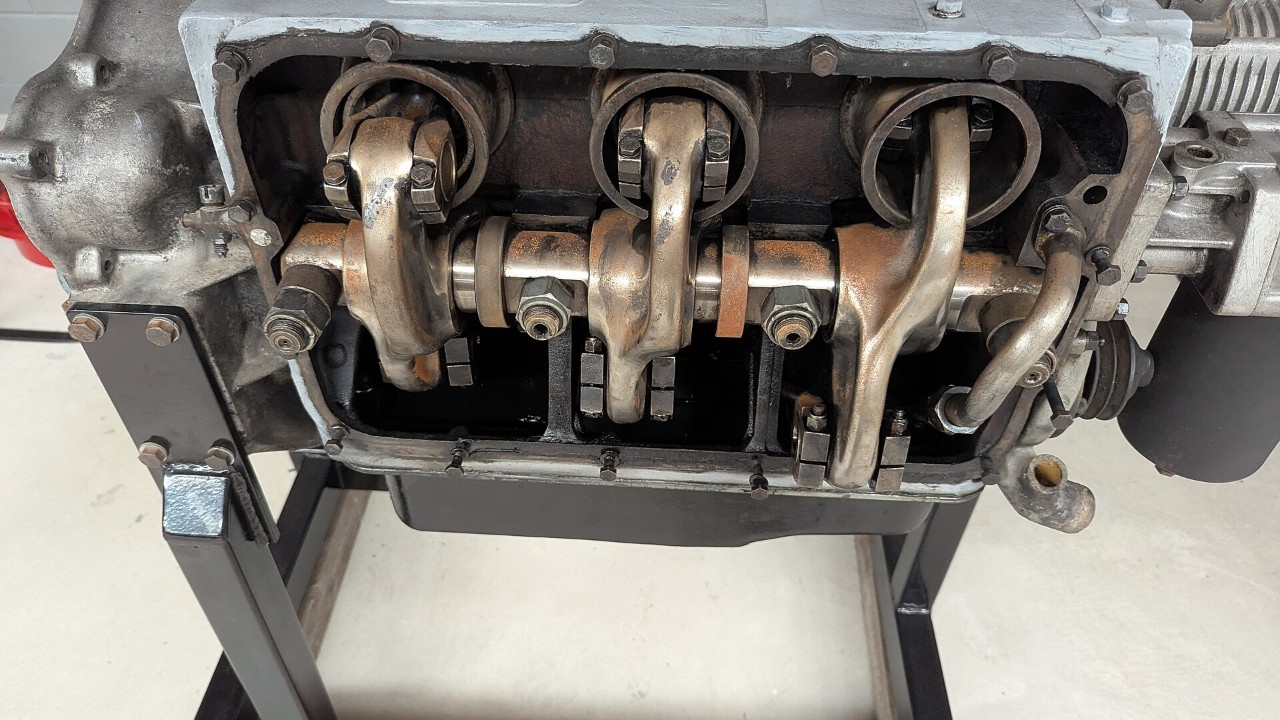
The Commer TS3 diesel had three cylinders and six pistons, and it made 270 lb-ft of torque from just 3.25 liters. Two pistons shared each cylinder, driving toward each other from opposite ends. That odd layout let a small British truck engine pull like a much bigger one.
Truck drivers in some markets called it the “Commer Knocker,” and the name stuck. It was a two-stroke, supercharged, opposed-piston diesel with no cylinder head at all.
Here is how the Commer TS3 worked, why Rootes built it and what finally killed it.
Why Rootes built the Commer TS3
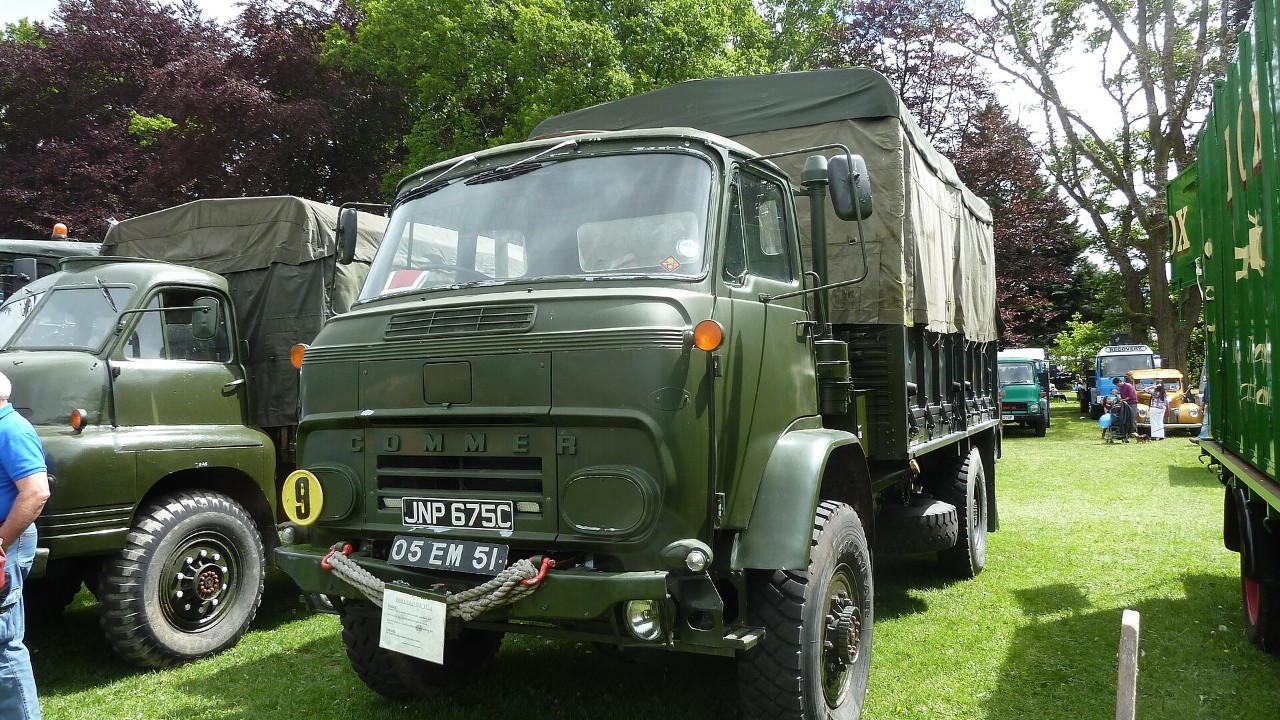
Commer was a Luton truck maker with a long history. According to The Autopian, it began in 1905 as Commercial Cars. Humber bought it in 1926 and renamed it Commer. Then the Rootes Group took 60 percent control in 1931.
Development of the diesel began around 1946, the site says, with a team of three at Humber. Humber’s chief engineer, Eric Coy, led the work. Over time the group grew to 13 people and became the Rootes Diesel Engineering Division.
The goal was a compact engine with big-engine pulling power. In fact, Engine Builder says its output compared with much larger engines of its day. Sources differ on exactly when it entered service, but both place it in Commer trucks from the mid-1950s.
Six pistons, three cylinders, one crankshaft
First, each of the three cylinders held two pistons, with their crowns facing each other. As a result, the pair squeezed the air charge between them instead of against a cylinder head. Engine Builder explains that this left no need for a head in the usual sense.
Most opposed-piston engines use two crankshafts, one at each end. By contrast, the TS3 used only one, mounted below the cylinders. Engine Builder describes how each piston connects to a rod, then to a rocker, then to a second rod that reaches the crank. Each cylinder also has its own crankpin.
As a result, that arrangement removed a lot of parts. The Autopian notes that the engine had no cylinder heads, head gaskets, valves, camshafts or pushrods. Similarly, Jalopnik points out that the intake and exhaust ran through ports in the cylinder walls.
Balance came almost for free. Because the opposed pistons offset each other, The Autopian says, the crankshaft needed no counterweights.
How the two-stroke cycle worked
A two-stroke diesel has no separate intake stroke, so it needs help to breathe. For that reason, the TS3 used a large rotating-lobe blower to push air into the intake manifold, according to Engine Builder. The Autopian puts the boost at about 6 psi.
Meanwhile, each piston in a pair had its own job. Engine Builder calls one the exhaust piston and the other the air piston, each uncovering its own port. The exhaust piston runs slightly ahead, so its port opens first and lets spent gas escape.
Next, the air port opens as both pistons reach outer dead center. Fresh air from the blower rushes in, Engine Builder says. Then the pistons drive back together.
Just before the crowns meet, the injector sprays in diesel fuel. Heat and pressure light it, and the pistons fly apart again. Since there are three cylinders, The Autopian notes, there are only three injectors, each feeding the middle of its cylinder.
The numbers behind the Knocker
Engine Builder lists the TS3 at 3.25 liters, about 105 hp and 270 lb-ft of torque. The Autopian gives the same 105 hp and 270 lb-ft as the common rating. It also says a later version grew to 3.5 liters with a mild power gain.
Packaging was the other win for the Commer TS3. The flat, low engine fit under the cab of Commer and Karrier trucks, The Autopian says. That left room for three people to sit side by side up front. Jalopnik also notes the three-abreast seating in the cab-over Commers.
The nickname, however, had a mechanical cause. Export engines used an undamped compressor, which let the timing gears clack, according to The Autopian. Wear made it worse, and New Zealand owners named the trucks “Commer Knockers.” Jalopnik traces the name to the same metallic rattle.
The old design even held up in a modern comparison. The Autopian cites a 2001 Transport Engineer test of a 37-year-old TS3 against newer trucks. At 50 km/h, the Commer recorded 78.4 dBA of drive-by noise, versus 84 dBA for a MAN 18.224. However, it produced far more particulates, at 55 mg per cubic meter against the MAN’s 7.
The TS4 and the Chrysler takeover
Rootes had a successor ready. Engine Builder says the company developed a four-cylinder TS4 in the 1960s, with more power and a more modern design. The Autopian adds that it had eight pistons, and that one test engine logged 1.2 million miles.
In the end, ownership ended both engines. Chrysler bought Rootes in 1968, according to The Autopian, and it preferred conventional diesels. That decision killed the TS4 and finished the TS3 as well. Later, the Commer name itself gave way to Dodge-branded trucks.
The TS3 did not have the opposed-piston idea to itself. The Autopian lists the Junkers Jumo 204 aircraft diesel of 1929 and the Napier Deltic among earlier examples. Still, Engine Builder notes that most such engines used two crankshafts, while the Commer did the job with one. The record holds the TS3 at 3.25 liters, six pistons and 270 lb-ft.
More from Fast Lane Only