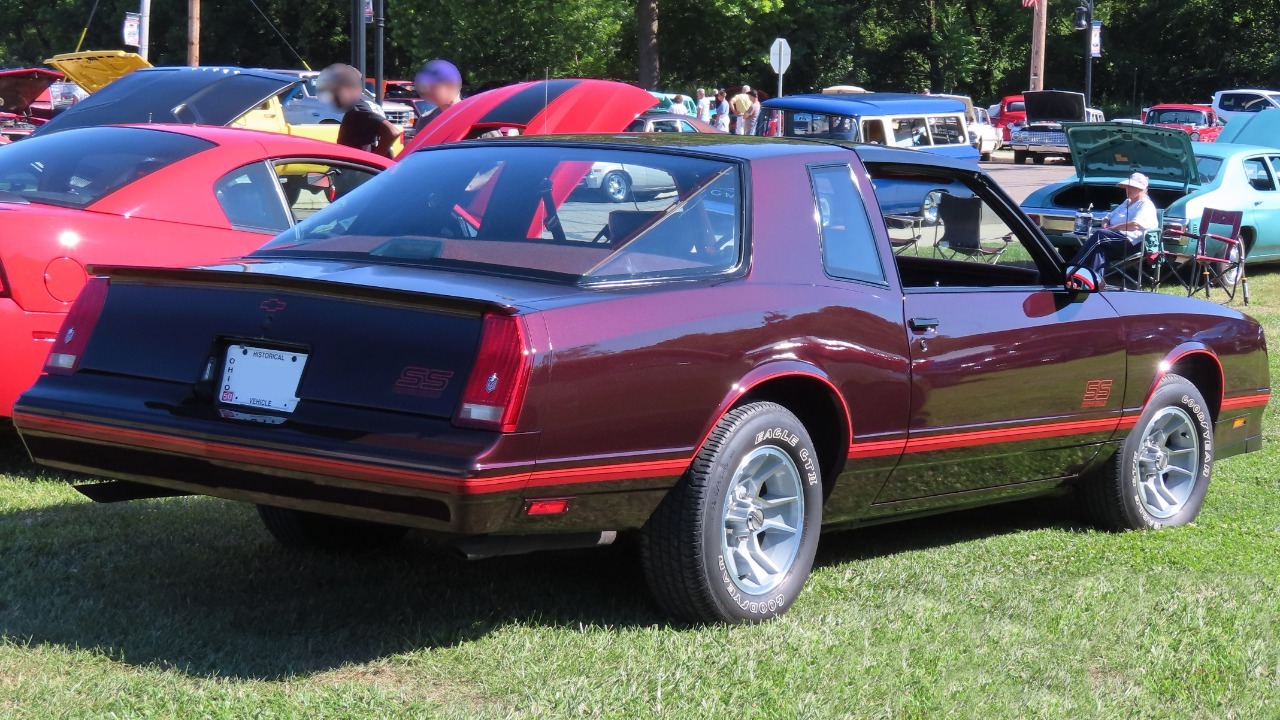
Twenty-five degrees is the slope of the rear glass on the Monte Carlo SS Aerocoupe, and Chevrolet drew that angle for stock car racing rather than for the street. For 1986, only 200 of these coupes reached dealers. A year later, the same roof became a regular option, and 6,052 buyers ordered one.
That racing purpose shaped the whole car, from the glass to the trunk lid. It also explains why the 1986 cars are so hard to find today. Chevrolet built just enough of them to put the shape on the road, then went back to selling the regular SS.
The story starts three years earlier. Chevrolet had brought back the SS badge for 1983 with a sloped nose aimed at NASCAR’s big tracks. However, the coupe behind that nose still wore a formal, upright back window, the kind you’d expect on a personal-luxury car.
Why Chevrolet reshaped the Monte Carlo SS Aerocoupe roof
Bill Elliott’s Ford Thunderbird was the rival Chevrolet had in mind. In its buyer’s guide to the 1983–88 SS, Hagerty says Chevy’s engineers went back to the wind tunnel to keep the Monte ahead of that Ford. Their answer was convex rear glass that stretched back into the decklid’s space. As a result, the notchback became a fastback.
The new window needed room, so Chevrolet also fitted a smaller trunk lid, according to Old Cars Weekly. Hagerty puts the Aerocoupe in the same family as the 1969–70 Dodge Daytona, Plymouth Superbird and Ford Talladega. In other words, it was an aero special, built so the race cars could carry the shape.
The Monte Carlo had plenty to defend, too. Hagerty notes that Winston Cup titles went to Monte Carlo drivers Terry Labonte in 1984, Darrell Waltrip in 1985 and Dale Earnhardt in both 1986 and 1987. Pontiac followed with its Grand Prix 2+2, which used an even more radical rear window.
Two hundred cars for the Southeast
The first batch was tiny. Hagerty says Chevrolet sold only 200 Aerocoupes in 1986 under RPO B5T, and dealers in the Southeast received them in the spring. Old Cars Weekly adds that Cars and Concepts of Brighton, Michigan, finished the 1986 cars. Every one of them was white with a burgundy interior.
So the 1986 car is easy to describe and hard to locate. Out of 41,164 Monte Carlo SS models Hagerty counts for that year, the Aerocoupe accounted for about one in every 206. Meanwhile, Car and Driver tested one in August 1986, and its example cost $16,325.
1987: the Aerocoupe goes mainstream
For 1987, the code changed to Z16, and the car became widely available. Buyers took 6,052 of them, according to both sources. That year Old Cars Weekly says the cars came off the regular Pontiac line from start to finish, unlike the 1986 batch.
The color choice also grew to white, black, gray and burgundy. Price was another difference. Old Cars Weekly lists a 1987 SS at $13,463 and an Aerocoupe at $14,838 with no extras. Hagerty counts 33,204 Monte Carlo SS models for 1987, so roughly 18 percent of them had the long glass.
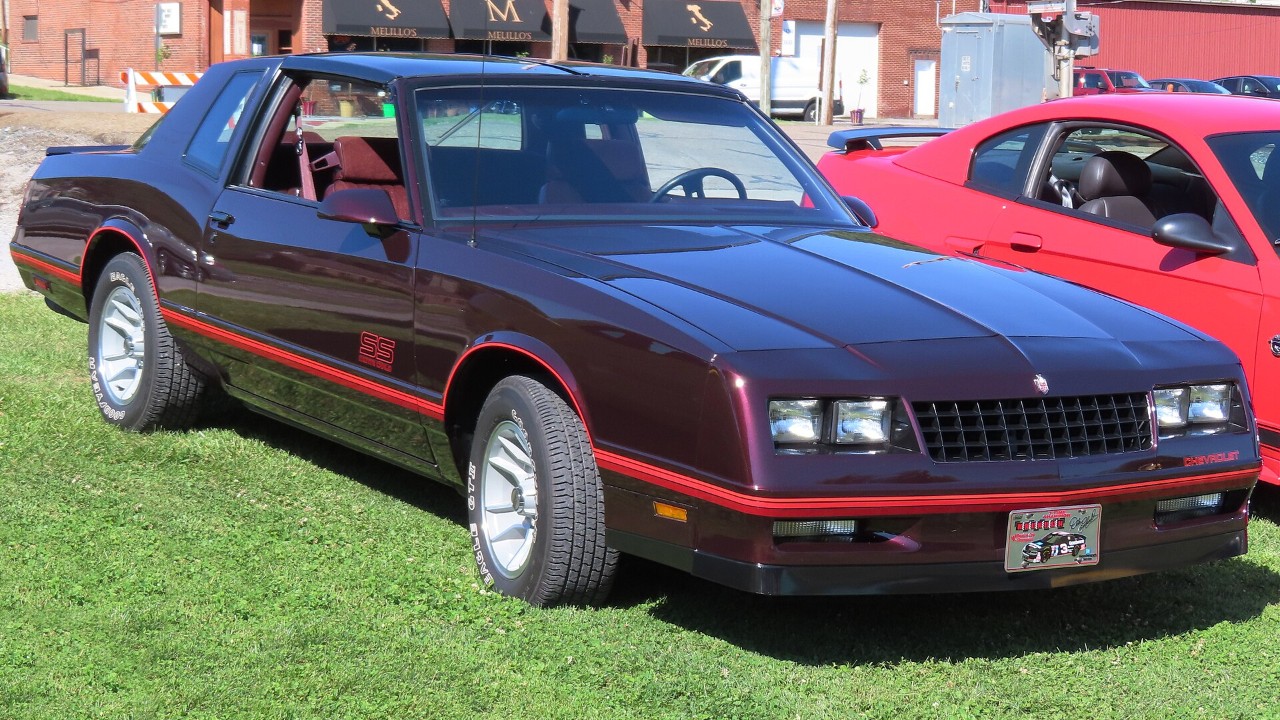
Spotting a 1986 car next to a 1987 one takes a close look. According to Old Cars Weekly, the main visual change was where the decals sat on the front doors.
What sits under the sloped glass
Under the hood, the Aerocoupe used the high-output 5.0-liter, 305-cubic-inch small-block V8. It ran a carburetor and carried a rating of 180 net horsepower. A four-speed overdrive automatic sent that power to the rear wheels.
Most of that drivetrain was already familiar to SS buyers. According to Hagerty, the TH200-4R four-speed overdrive automatic became standard on the SS for 1985, and the rear axle ratio changed from 3.42 to 3.73 at the same time. Before that, output had risen to 180 hp for 1984, and it then stayed there.
The rest of the hardware was period General Motors. Old Cars Weekly describes body-on-frame construction on a 108-inch wheelbase, front disc brakes, rear drums and a curb weight of 3,528 pounds. Magazine tests at the time ran the quarter-mile only in the high 16s. In short, the street car wore a racing shape without racing power.
That gap between looks and speed hasn’t hurt it with owners. One Aerocoupe owner told Old Cars Weekly the car “was specifically built for NASCAR.” For him, it offered a way into that heritage after Daytonas and Superbirds had climbed out of reach.
What an Aerocoupe is worth now
Hagerty calls the Aerocoupe the most valuable Monte Carlo SS. Its buyer’s guide puts the average at $15,200 and concours examples at $27,800. Fair-condition cars under $10,000 still turn up, but Hagerty says that is “getting harder every day.”
Before buying, though, check the paperwork. Hagerty advises that the eighth VIN digit on any real SS should be a “G.” It should also match the sticker on the trunklid and the driver’s door. In addition, RPO codes B4V, Z56 and F41 should be present, or the car is likely a clone.
The run itself was short. Old Cars Weekly records that Aerocoupe production ended on Dec. 11, 1987, and the option never appeared on the list for the short-run 1988 models.
More from Fast Lane Only