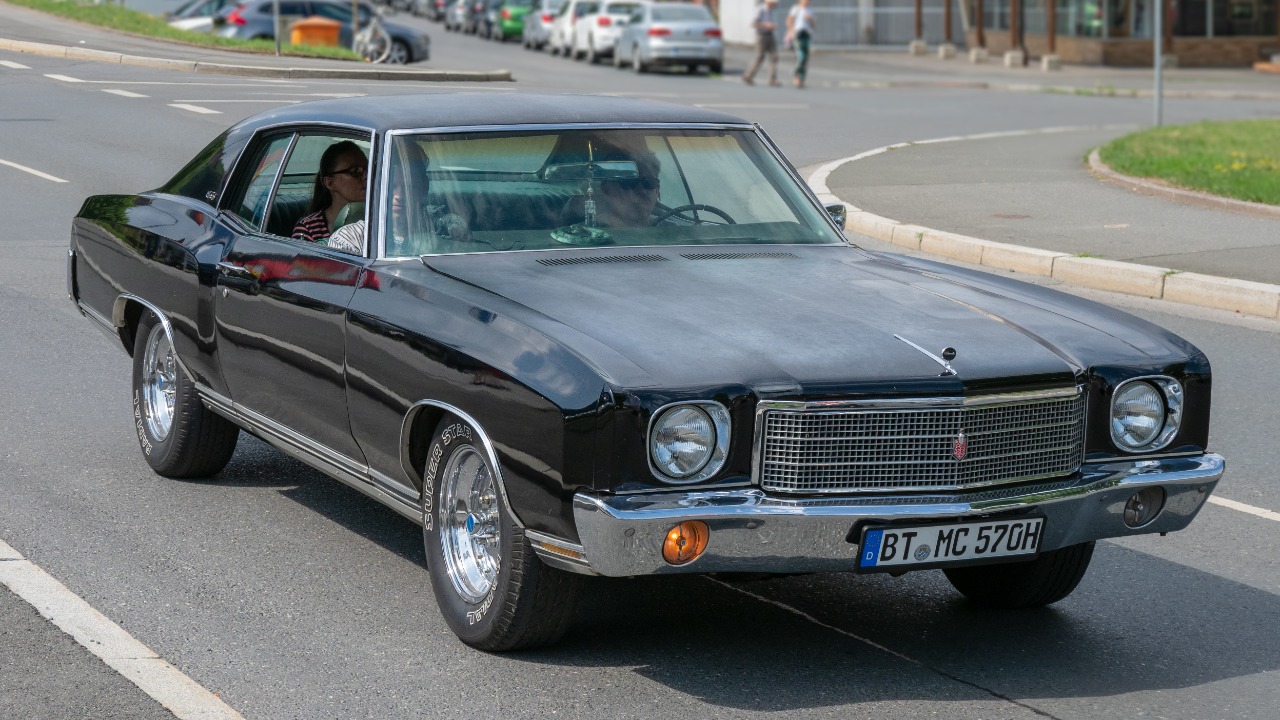
Most first-generation Monte Carlos left the factory as comfortable V8 coupes with nothing exotic under the hood. About 2 percent did not. Across the 1970 and 1971 model years, Chevrolet built 258,574 Monte Carlos. Only 5,742 of them left as a Monte Carlo SS 454, with the big-block as standard.
That small share drives almost everything about the car today, from how owners prove one is real to what one brings at auction. Yet the SS 454 was never a stripped drag special. Instead, it was a personal-luxury coupe with the largest engine on its order sheet.
Chevrolet’s timing helped explain the car. Pontiac had redesigned its Grand Prix for 1969, and Chevrolet’s own long-hood coupe followed a year later.
A long hood on a stretched Chevelle frame
The Monte Carlo arrived for 1970 as Chevrolet’s personal-luxury coupe, following the 1969 Grand Prix redesign, according to Hagerty. It rode on an extended Chevelle frame. That extra wheelbase gave the designers room for a short decklid and a very long hood and front fenders. Hidden wipers, 15-inch wheels and an upscale interior completed the picture.
Supercars.net’s car profile calls it a brainchild of GM’s Pete Estes. It also notes that the car shared a platform with the 1969 Grand Prix. That source lists a base price of $3,123, against roughly $5,000 for a Thunderbird. Engines ran from a 350 through a 400 to the 454. GM also lost ground that first year, because a 1970 labor strike at its Flint, Michigan, plant reportedly cost about 100,000 sales.
Even the regular car could be ordered well equipped. Supercars.net lists options such as Strato bucket seats, a center console, a tachometer and extra gauges, Four Season air conditioning, power windows and power seats. A rear anti-sway bar and a black vinyl top were also on the sheet. As a result, a Monte Carlo SS 454 could carry big-block power and a full set of comfort options at the same time.
What the Monte Carlo SS 454 package added
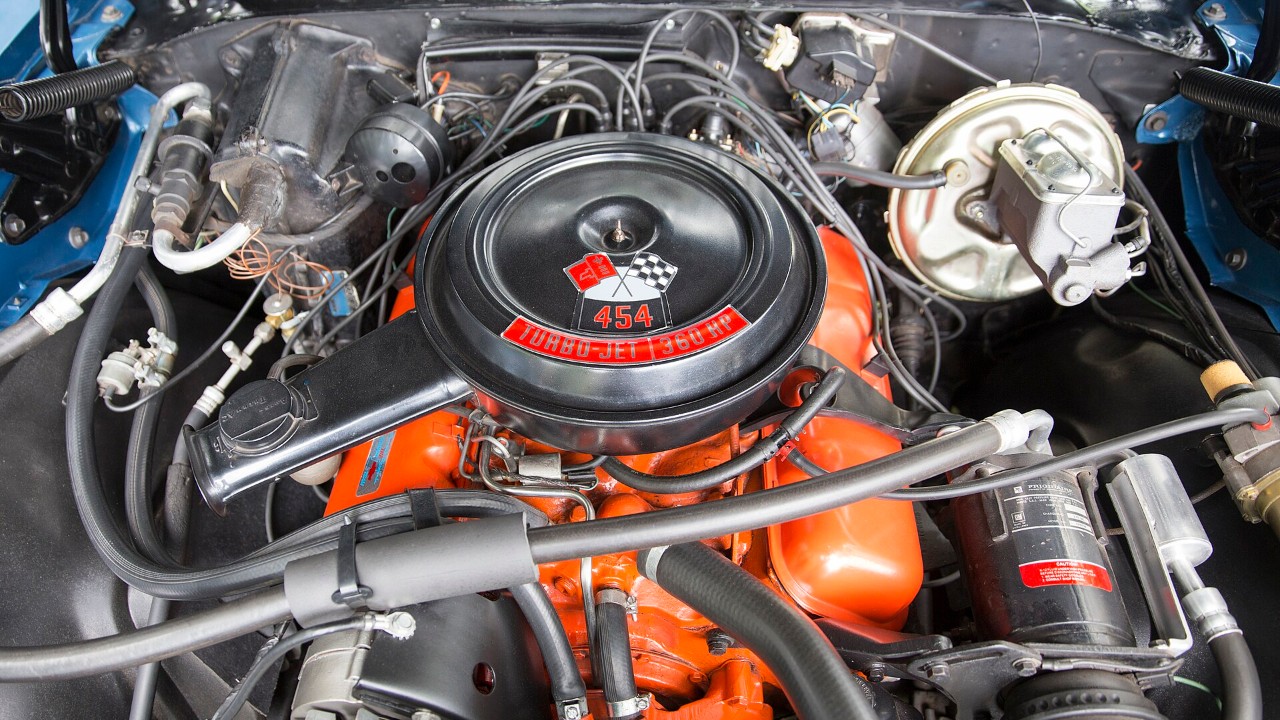
The SS package made the LS5 454-cubic-inch V8 standard. Hagerty lists it at 360 horsepower for 1970 and 365 horsepower for 1971. Chevrolet never offered the 450-hp LS6 in a Monte Carlo from the factory. Still, Hagerty adds that “at least one dealer-installed example is known to exist.”
Buyers also couldn’t pair the 454 with a four-speed, according to GM sales brochures cited by Hagerty. So these cars used an automatic. Hagerty puts the starting price of an LS5 Monte Carlo SS at around $3,500 in 1970. By comparison, an LS6 Chevelle SS cost about $3,400 that year.
A documented survivor shows how the package was spelled out on paper. Barrett-Jackson’s 2024 listing for a 1970 car names the Z20 SS package, F41 heavy-duty suspension and auto-leveling. Behind its matching-numbers engine sits a Turbo 400 three-speed automatic.
How the 5,742 split by year
Hagerty doesn’t break its total down by model year. However, Supercars.net says 3,823 SS 454s sold in 1970. If both figures hold, that would leave 1,919 for 1971, about half the 1970 total. Treat that split as an estimate, since it combines two sources.
Either way, the share stays tiny. Out of every 100 Monte Carlos built in those two years, roughly two carried the 454 package. That is why original paperwork, such as a Protect-O-Plate, matters so much when one changes hands.
One survivor’s paper trail
The Barrett-Jackson car crossed the block as Lot 454 at Palm Beach in 2024 and sold, though the listing gives no price. Meanwhile, it is finished in Mist Green with a dark green vinyl top and a dark green interior. According to the listing, the factory built it in April 1970, and its first owner bought it on June 1, 1970.
The record is unusually complete. The car has had two owners, and the listing says it “never left Clearwater its whole life.” It also went back for service to the dealer that sold it. By sale day it showed 80,640 miles, with one repaint in the factory color, bucket seats, Rally wheels and dual exhaust.
What a Monte Carlo SS 454 brings now
For years, the Monte Carlo sat in the Chevelle’s shadow. Hagerty’s market look found that recent SS sales had reached nearly double its price guide values. Its quote data also showed Gen X buyers accounted for 41 percent of Monte Carlo insurance quotes. Meanwhile, baby boomers made up 40 percent of quotes on the 1968–72 Chevelle.
Hagerty also reported that pristine examples had sold for $40,000 to $50,000. By comparison, concours-level Chevelles with automatics and LS5 engines brought closer to $80,000.
Even so, the best Monte Carlos went well past that range. A 1970 car that had won an AACA Senior Grand National award sold for $100,100 at Mecum’s Kissimmee sale that January. A week later, a lightly altered 1971 sold for $90,200 at Mecum’s Muscle Car City sale.
More from Fast Lane Only