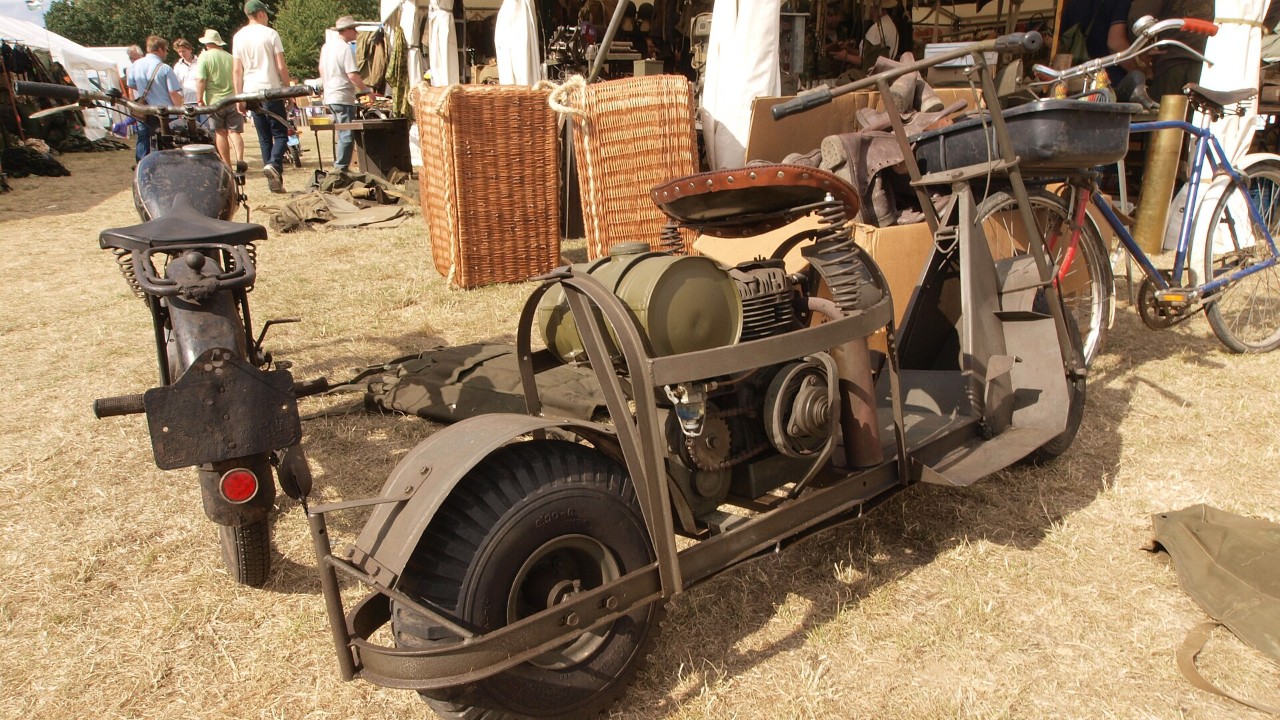
The Cushman Model 53 was a small motor scooter with a big job. In 1944, the U.S. Army needed a light machine that could fall from an airplane under a parachute and land near the troops who jumped with it. Cushman, a Nebraska maker of farm engines and civilian scooters, built one. Once on the ground, it ran errands for men who had nothing else with wheels.
The Army called it the G683, and the soldiers who rode it knew it as the Airborne scooter. It was small and light, yet it could tow a gun cart, cross shallow streams and climb steep grades. As a result, it became one of the oddest vehicles in the American inventory of the Second World War.
Here is how a lawn-and-garden engine company ended up building parachute scooters, how the drop actually worked and where you can see one now.
From Lincoln, Nebraska to the war effort
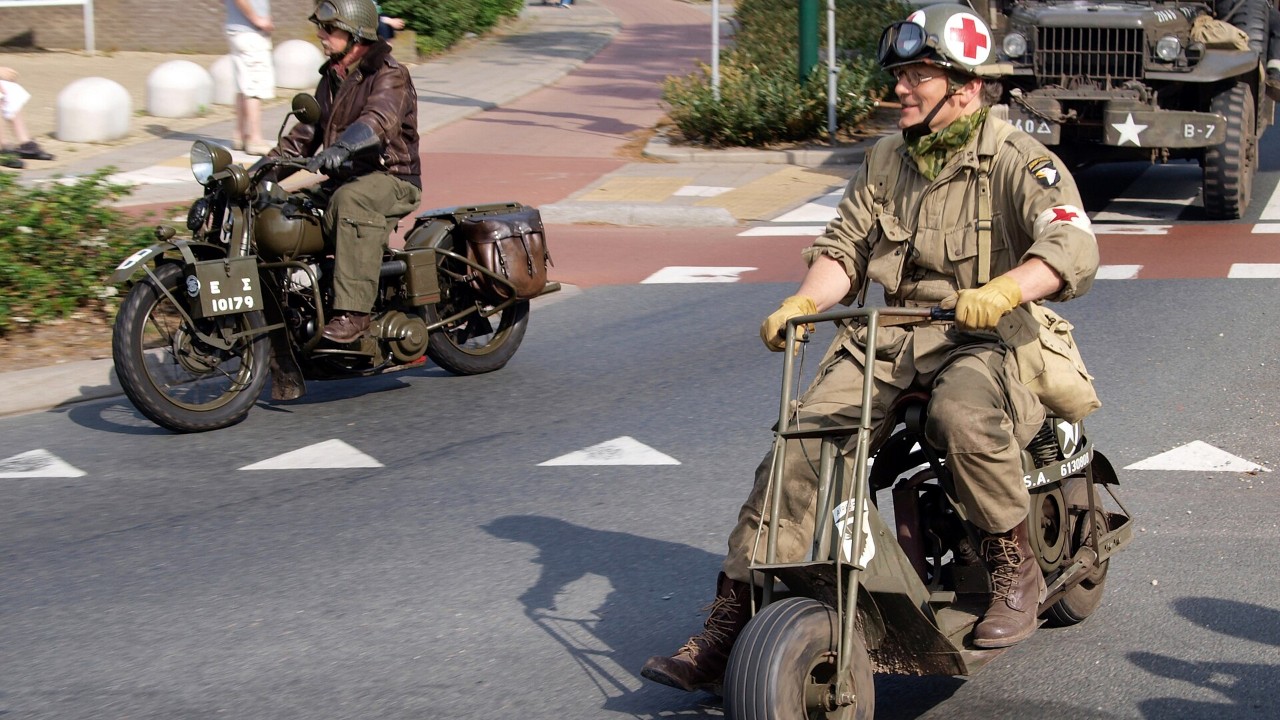
Cushman began in Lincoln, Nebraska, in 1903, when brothers Everett and Clinton Cushman founded what became Cushman Motor Works. According to a 2024 history by John Norris in Military Trader, the firm built its Husky engine from 1922 and launched the Auto-Glide scooter in 1936. Those two products set up everything that followed.
When war came, the military bought Cushman scooters for bases first. Norris counts 606 Model 39 package delivery scooters and 495 scooters with sidecars built between 1943 and 1944. He also notes that, from 1942 to 1945, Cushman won four Army contracts and four Navy contracts. Those Navy deals alone were worth over $1.7 million, he writes.
However, the biggest order was the Model 53. Norris puts production at 4,233 scooters in 1944 and 501 in 1945, for a wartime total of 4,734. The National Museum of the United States Air Force rounds that to “nearly 5,000” built for the military from 1944.
What the Cushman Model 53 carried under the seat
The power came from Cushman’s own farm-engine line. In its lot description, RM Sotheby’s lists a Husky 16M71 engine: a 14.9-cubic-inch, side-valve, air-cooled single rated at 4.6 horsepower. It drove through a two-speed gearbox. Meanwhile, braking was mechanical and worked on the rear wheel only.
Those numbers sound tiny, but the scooter was tiny too. The Air Force museum’s fact sheet gives a weight of 255 pounds and a top speed of 40 mph. It also says the Model 53 could travel through a foot of water, climb a 25% grade and cover about 100 miles. Norris adds a fuel figure of 50 miles per gallon.
The Cushman Model 53 also had a hitch at the back. According to the museum, it could pull an M3A4 utility cart, which troops could rig to carry a .30-caliber or .50-caliber machine gun or an 81mm mortar. In fact, the museum admits the scooter often couldn’t pull a heavy load. The museum’s own M3A4 cart keeps its original hand ropes, so up to four men could drag it instead.
How you drop a scooter out of an airplane
Getting the scooter to the fight was the hard part. Norris explains that the Army ruled out a crate because unpacking would take too long on a drop zone. It also rejected a padded container like the one used for Britain’s folding Welbike, because the container added too much weight.
Instead, the answer was simple. Cushman fitted parachute clip points to the frame, and an air dispatcher pushed the scooter out of a C-46 or C-47 transport. RM Sotheby’s describes the same hardware as “parachute attaching rings.” The scooter could also ride into battle aboard a glider, according to both Norris and the Air Force museum.
There was a price for skipping the padding, though. Norris writes that hard landings bent front forks and frames. For that reason, troops treated the machine as a tool, not a treasure. RM Sotheby’s notes it was considered disposable if the situation called for it.
Errands in the European Theater
Once on the ground, the scooter did unglamorous work. The Air Force museum lists its jobs as keeping contact between units, adding mobility and hauling small loads. In other words, it was a messenger and a mule in one.
RM Sotheby’s says the Model 53 entered service in March 1944. Portugal’s Museu do Caramulo, which has one in its collection, goes further. It says scooters dropped over France supported the 101st and 82nd Airborne Divisions in the early phase of Operation Overlord. Norris, for his part, points to photographs of airborne troops with G683s near Bastogne in late 1944.
The Caramulo museum also reports that a few dozen went on loan to British forces, who used them the same way. Even so, the numbers were modest next to conventional motorcycles. Norris notes that Harley-Davidson built more than 90,000 military bikes. Britain, meanwhile, made more than 7,600 Welbikes for its own airborne units.
Surplus, survivors and a museum home
After the war, the Army no longer needed a flying scooter. According to Norris and the Caramulo museum, unissued machines went on sale to civilians as the Model 53A. The Portuguese museum adds that buyers liked them mainly for their very low fuel use.
Today, the military originals turn up at auctions and in collections. RM Sotheby’s sold a 1944 Cushman 53 for $5,000 as part of its sale of the National Military History Center collection. Norris writes that good examples start at several thousand dollars.
If you would rather see one in person, head to Dayton, Ohio. There, the National Museum of the United States Air Force displays a Cushman Airborne scooter with its M3A4 hand cart. Lt. Col. (Ret.) Frederick M. Serfass of Douglasville, Pennsylvania, donated the pair to the museum in 2003.
More from Fast Lane Only