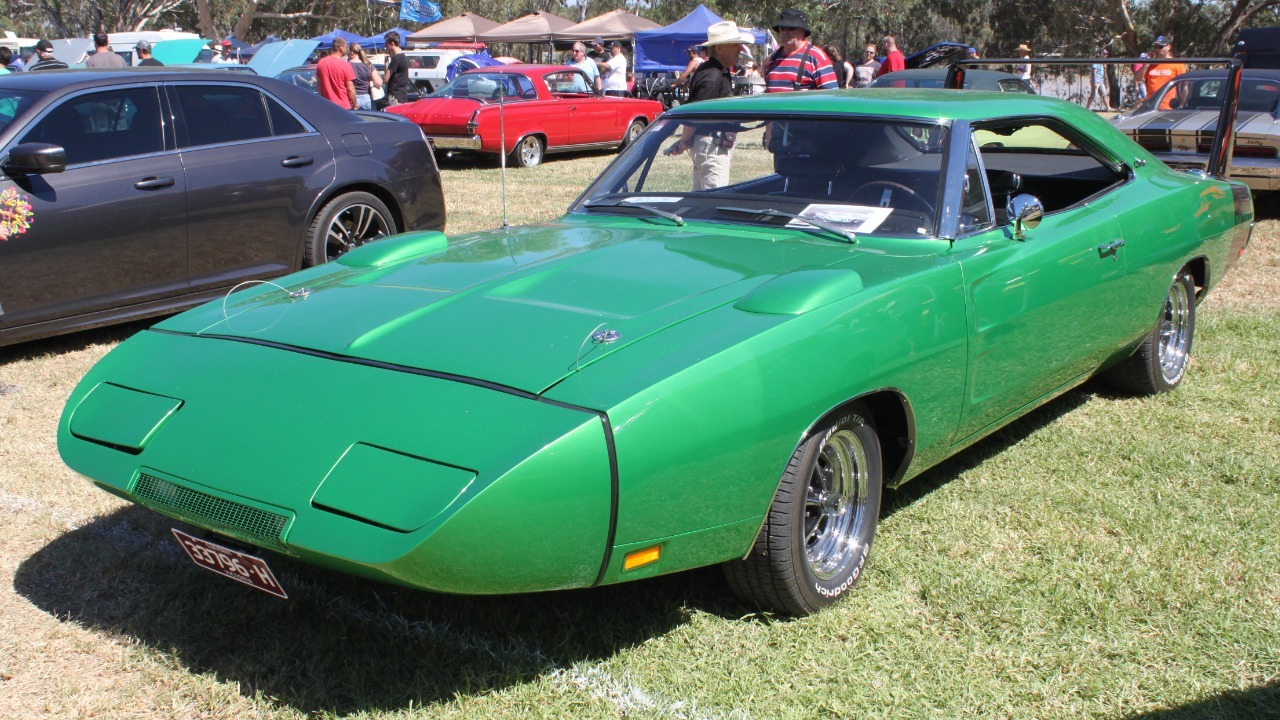
The Dodge Charger Daytona arrived as a single-minded weapon. Dodge built it to win on NASCAR’s fastest ovals, and in the process created a car so extreme that it reset speed records and forced the rulebook to catch up.
What began as a desperate response to defeat became one of American racing’s most famous machines, a purpose-built Charger that traded showroom style for wind tunnel logic and dominated whenever the track demanded raw speed.
From a boulevard cruiser to a problem that needed solving
By the late 1960s, the standard Dodge Charger looked the part of a winner but struggled in the air. The sleek fastback that turned heads on the street created lift and drag at superspeedways, where long straights punished anything less than a clean shape. Dodge had already tried a limited Charger 500, yet rivals were still quicker in NASCAR competition.
Inside the company, engineers were told to forget styling constraints and fix the problem. One account of the Dodge Charger Daytona describes how this new variant broke sharply from the regular Dodge Charger, signaling that it existed for one job rather than broad showroom appeal.
The task was simple to state and hard to execute: build a stock car that could run at 200 m on the biggest ovals, stay planted through the corners, and survive NASCAR’s scrutiny. Everything that followed flowed from that single objective.
Wind tunnel logic: nose cone, tail and that 23-inch wing
The car that emerged for 1969 looked like science fiction parked next to a regular Charger. At the front, a pointed nose cone replaced the open grille, stretching the body and slicing the air. At the rear, a tall stabilizer towered over the trunk. One detailed description of the Dodge Charger Daytona highlights its massive 23 inch rear wing and the way it distinguished the car from a standard 1969 model.
That wing did far more than shock spectators. Mounted high in clean airflow, it pushed the rear tires into the track at speed and calmed the car in yaw when a driver turned into a corner or corrected a slide. The tall uprights allowed the trunk to open normally, a reminder that NASCAR still required a connection to street use even as the car’s shape drifted toward pure racing function.
Underneath, the body was sealed and tweaked to reduce turbulence. Reports on how Dodge wanted to describe the Daytona as a product of wind tunnel work, with the nose cone and big wing chosen for measurable aerodynamic advantages rather than looks. The result was a Charger that finally matched its muscular stance with efficient airflow.
The Hemi heart and NASCAR’s 500 car rule
A radical body alone would not win races. The Daytona paired its aero shell with serious power. One museum profile notes that The Dodge Charger Daytona debuted with a 426 Hemi V8 engine that delivered over 425 horsepower, and states that Its performance was nothing short of startling. That 426 Hemi gave the car the thrust it needed to exploit its low drag shape.
NASCAR rules still demanded that race cars remain recognizably tied to production, which meant Dodge had to build a batch for public sale. A history of the Dodge Daytona explains that 500 plus cars were produced strictly to satisfy the NASCAR requirement for a minimum 500 production models. That figure turned what might have been a pure prototype into a limited but real street machine.
On the showroom floor, some buyers saw a strange, nose-heavy Charger with a billboard wing. On the track, competitors saw a purpose-built missile that finally aligned engineering with Dodge’s racing ambitions.
Talladega: debut under a cloud and instant payoff
The Daytona’s first major test came at the new Talladega superspeedway, a track so fast that it exposed tire weaknesses and rattled drivers. A detailed recounting of the inaugural Talladega 500 describes how leading names such as Richard Petty, David Pearson, Cale Yarborough, Wendell Scott and Buddy Baker boycotted the event over safety concerns, leaving NASCAR founder Bill France to recruit replacements from other series so the race could proceed.
Amid that controversy, a brand new car rolled onto the high banks. Dodge had designed the Charger Daytona to do one thing, win NASCAR races. In its Talladega 500 premiere, Richard Brickhouse drove his Daytona to victory, delivering exactly the response Dodge needed after the disappointment of the earlier Charger 500 and the sting of losing Richard Petty to a rival brand.
That win did more than add a trophy. It proved that the radical aero package and the production investment behind it had a direct payoff at the track that mattered most for top speed.
Breaking 200: Buddy Baker and the record that changed everything
The Daytona’s defining moment came not in a crowded race but in a controlled assault on the sport’s speed ceiling. Buddy Baker climbed into a Dodge Charger Daytona prepared for a record attempt and pushed it to an officially timed lap that broke through the 200 m barrier for a stock car.
An exhibit on Buddy Baker describes his record breaking Dodge Charger Daytona and notes that the car now sits in the NASCAR Hall of Fame as part of a NASCAR 75 Moment display. That recognition underlines how deeply the run reshaped expectations of what a stock car could do.
Other accounts echo the same benchmark. A video history of the Dodge Charger Daytona calls it the first stock car to break 200 m and frames the achievement as a turning point in NASCAR history. Another discussion of how Dodge engineers chased a 200 m goal in 1969 portrays the project as a direct response to the challenge of taking a street based car into territory that had previously belonged to purpose built racers.
One social media recap of the Daytona’s competition debut at Talladega states that In September, the Dodge Charger Daytona hit a record speed of 200.4 m. That 200.4 m figure reinforces how quickly the car translated its design into measurable performance.
Built to dominate, and it did
Contemporary descriptions do not hide Dodge’s intent. One sales-oriented overview states plainly that the car was built by Dodge to dominate NASCAR and that the Daytona became the first stock car to break the 200 m barrier, which earned the 1969 Dodge Charger Daytona its legend as a machine engineered for ultimate speed and stability. That Built by Dodge description captures the straight line from design brief to on-track outcome.
Another retrospective on muscle car racing history notes that of all the competition machines of the era, perhaps none looked as radical as the 1969 Charger-based Daytona. That assessment of Dodge emphasizes how far the company was willing to go in pursuit of speed, even at the cost of conventional styling.
For Dodge, the payoff came in wins, records, and a sudden aura of technical daring. For NASCAR, the Daytona and its rivals opened an uncomfortable question about how close a stock car should remain to a showroom vehicle when manufacturers were willing to treat the rulebook as an engineering challenge.
The unknown story: how one car shaped NASCAR’s future
Behind the highlight reels lies a more subtle impact. One reflection on the Dodge Charger describes an Unknown Story that credits the car with a surprising role in shaping NASCAR history. The argument is simple: once the Daytona proved how far aerodynamic specialization could go within the rules, it pushed the sanctioning body to rethink the balance between innovation and parity.
Another account of the Dodge Charger Daytona explains that the car was not originally intended as a styling exercise at all, but as a direct response to NASCAR competition pressure. That origin story underlines how closely the model’s existence was tied to one racing series, and how little it owed to broader market trends.
Video essays on the Daytona’s legacy go further. One presentation imagines a machine so powerful and so ahead of its time that it forced NASCAR to rewrite the rulebook and labels the Dodge effort as a catalyst for later restrictions on extreme aero features. Another recounting of a mechanic’s “weird” trick that helped the 1969 Dodge reach 200 m illustrates how creative problem-solving at the team level interacted with the car’s baseline capability.
In each telling, the throughline is consistent. The Daytona did not simply win races. It exposed how quickly a determined manufacturer could exploit loosely written rules, and it pushed NASCAR toward tighter definitions of what a stock car could be.
A car that still feels thunderous
The Charger Daytona’s story continues to resonate because it captures a particular moment in American motorsports. One video history of American racing describes how few moments were as thunderous as when Dodge decided in 1969 that enough was enough and committed to an all-out aero car. That framing reflects how the Daytona has become shorthand for a factory deciding to prioritize the stopwatch over everything else.
Modern retrospectives often place the 1969 Daytona alongside the 1970 Plymouth Superbird and other so-called winged warriors, but the Charger variant retains a special status. A Facebook community post on Old Cars Enthusiast circles back to the 1969 Dodge Charger as the foundation for this transformation, highlighting how the familiar body became a canvas for radical aerodynamic surgery.
Even in casual discussions, enthusiasts still single out the Daytona’s tall rear foil as the ultimate expression of function over form. One summary of the car’s features refers to the rear wing as the Winged Warrior, a nickname that captures both its visual drama and its competitive intent.
From a banned weapon to a heritage badge
As the Daytona and similar cars pushed speeds higher, NASCAR responded with new rules that effectively ended the era of towering wings and pointed noses. Later commentary on the NASCAR ban portrays the Charger Daytona as a victim of its own success, a car so effective that regulators had to rein it in to preserve competition and safety.
Yet the name refused to fade. A modern review of the 2017 Dodge Charger Daytona notes that, back in the late ’60s, Dodge unleashed the Charger Daytona, a winged warrior built for NASCAR domination, and that the contemporary version tried to blend that race car attitude with modern technology and comfort. Back in the reference shows how Dodge now treats the original Daytona as a heritage anchor for its performance branding.
For collectors, the limited production run that once satisfied a NASCAR rule has become a prize. Enthusiast groups trade stories and sales listings that emphasize the car’s origin as a purpose-built racer and its status as the first of its kind to reach 200 m. The contradiction that once made the Daytona a tough sell on the street, its extreme appearance, is now exactly what makes it desirable.
More from Fast Lane Only