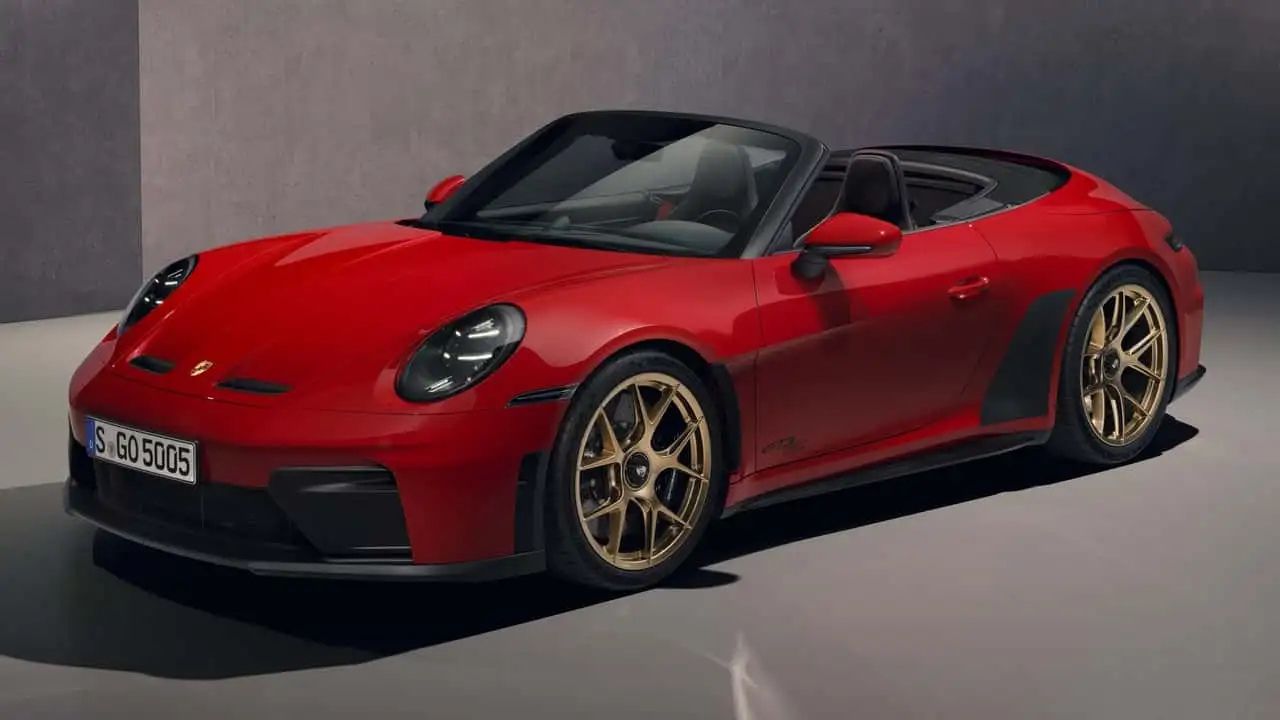
Porsche has pulled the wraps off the 911 GT3 S/C, a new open-top variant that pairs a naturally aspirated flat-six with a six-speed manual and a $275,000 base price. The car effectively brings GT3 hardware to a convertible body for the first time, trading lap-time obsession for a more visceral, road-focused experience. With limited production and a price that can climb to supercar territory when optioned, it is aimed squarely at collectors and purists.
Arriving as a rare blend of track-derived engineering and old-school driver engagement, the 911 GT3 S/C invites owners to drop the roof and listen to the engine work. It is not the fastest 911 on paper and it is not the cheapest, but it may be the most theatrical way yet to experience Porsche’s naturally aspirated GT motor.
What happened
The 911 GT3 S/C is built around Porsche’s familiar 4.0 liter naturally aspirated flat-six, tuned here to produce 502 horsepower and 346 pound-feet of torque. That output matches the current 911 GT3 coupe and sends power exclusively through a six-speed manual gearbox to the rear wheels. There is no PDK option, no all-wheel drive, and no hybrid assistance. The car is deliberately analog in its drivetrain, with a focus on driver involvement rather than outright numbers, as highlighted in early technical breakdowns of the 4.0 liter flat-six.
Top speed is quoted at 193 miles per hour, with a 0 to 60 miles per hour time in the low 3 second range when driven with commitment. The S/C uses a shorter final drive than the GT3 coupe, which slightly softens the top speed but sharpens in-gear acceleration and makes the engine feel more alive at typical road speeds. Porsche engineers have also revised the intake and exhaust for a richer sound signature, particularly at the top of the rev range where the engine spins to around 9,000 rpm.
Underneath, the car rides on a version of the GT3’s double-wishbone front suspension and multi-link rear setup, with adaptive dampers and rear-axle steering. Spring and damper rates have been retuned to account for the loss of a fixed roof and the different mission of the S/C. The structure gains additional bracing in the sills and underbody, along with reinforced mounting points for the suspension to preserve stiffness. According to early drives, the result is a chassis that feels slightly more compliant than a standard GT3 but still communicates clearly through the steering and seat.
Visually, the S/C blends GT3 cues with a more understated convertible silhouette. It uses a fabric roof that folds away in roughly 12 seconds at speeds up to about 31 miles per hour, similar to other 911 Cabriolet models. The most controversial change is at the rear, where the towering swan-neck wing of the GT3 coupe is replaced by a lower, more integrated spoiler and an active rear wing element. Some of the first photo galleries of the GT3 cabriolet body show a car that looks cleaner and more classic, even if it gives up some downforce compared with the track car.
The front end retains the GT3’s aggressive bumper with large cooling intakes and a functional front splitter, while the hood features the familiar air outlets that help manage airflow over the car. Standard wheels measure 20 inches at the front and 21 inches at the rear, wrapped in Michelin Pilot Sport Cup 2 tires, with optional Cup 2 R rubber for owners who still plan to see track time. Carbon ceramic brakes are available, though steel rotors remain standard to keep the base price from climbing even higher.
Inside, the S/C largely mirrors the GT3 coupe, with a small-diameter steering wheel, heavily bolstered seats, and minimal sound deadening. Porsche offers several seat options, from adjustable sport seats to fixed-back carbon buckets, and a Clubsport package that adds a rear roll bar and six-point harnesses in some markets. Infotainment and driver assistance systems are carried over from the broader 992 lineup, including a central touchscreen and configurable digital gauges, but the focus remains on the mechanical experience rather than screens.
The headline number is the price. Porsche has set a starting figure of $275,000 for the 911 GT3 S/C in the United States, before delivery fees or options. That places it well above a standard 911 GT3 coupe and into the territory of more exotic machinery. Detailed pricing breakdowns suggest that a fully optioned example, loaded with items like carbon ceramic brakes, extensive carbon fiber trim, and bespoke paint, can approach around $400,000, a figure confirmed by early configuration analyses of a fully loaded GT3.
The S/C will be produced in limited numbers, although Porsche has not attached a specific cap in all markets. Allocations are expected to be tight, with priority given to existing GT customers and long-time brand loyalists. Early order books reportedly filled quickly in major markets, driven by the combination of manual transmission, open roof, and GT badge.
Why it matters
The 911 GT3 S/C occupies a unique niche in Porsche’s lineup. For decades, GT3 models have been coupes, developed with a focus on track performance, lap times, and motorsport credibility. By adapting that formula to a convertible body and insisting on a manual-only configuration, Porsche is signaling that there is still room in its portfolio for cars that prioritize sensation over stopwatch figures. Coverage of the manual-only convertible has emphasized how unusual that choice is in a market dominated by dual-clutch transmissions.
From a performance standpoint, the S/C will not be the quickest 911 around a circuit. The lack of a fixed roof affects torsional rigidity and aerodynamics, and the more subtle rear spoiler cannot match the downforce of the GT3 coupe’s large wing. Yet Porsche clearly expects that many buyers will rarely, if ever, take this car to a track. Instead, the S/C is aimed at drivers who want the character of the GT3 engine and chassis on mountain roads, coastal highways, and everyday drives, with the added drama of an open cabin.
The manual-only decision is particularly telling. In recent years, many high-performance brands have moved almost entirely to automatic and dual-clutch gearboxes, citing performance and emissions benefits. Porsche itself offers PDK on most GT models, including the GT3 and GT3 RS, and the take rate is high. By removing that option here, the company is effectively filtering its customer base to those who actively want to shift for themselves. Early commentary on the manual transmission choice suggests that this car is meant as a statement piece for enthusiasts.
Pricing also carries a message. At $275,000 to start, the S/C is not simply a GT3 with the roof cut off. It is positioned as a halo model for the naturally aspirated side of the 911 family, sitting above the GT3 coupe and alongside or even beyond the Turbo S Cabriolet in price. Some market analyses of the hugely expensive GT3 point out that the car costs significantly more than a base 911 Turbo in several regions, even before options.
That price strategy reflects both the cost of engineering a GT-grade convertible and the reality of demand. Limited-run Porsche models with manual transmissions and naturally aspirated engines have shown strong appreciation on the secondary market. Cars such as the 911 R and certain 911 GT3 Touring variants have traded above list price, driven by collectors who see them as the last of their kind. The S/C taps into that same sentiment, combining the final-generation 4.0 liter engine with a body style that has never before carried the GT3 badge in series production.
From a brand perspective, the S/C helps Porsche balance its increasingly electrified future with a clear nod to traditional sports car values. The company has already launched the Taycan and is preparing hybrid versions of the 911, and regulatory pressure in major markets is pushing manufacturers toward lower emissions and greater efficiency. Against that backdrop, a high-revving, naturally aspirated, manual-only convertible looks almost defiant. The official product announcement for the 2027 911 GT3 positions the car as a celebration of pure driving at a time when such experiences are becoming rarer.
The S/C also has implications for the internal hierarchy of the 911 range. Traditionally, buyers seeking open-top performance gravitated toward the 911 Turbo Cabriolet or GTS Cabriolet, which blend strong power with comfort and all-weather usability. The GT3 S/C offers a more focused alternative, with less emphasis on luxury and more on feedback and sound. That could shift some enthusiast buyers away from the Turbo line, especially those who live in climates where roof-down driving is possible for much of the year.
On the engineering side, the car demonstrates that Porsche can maintain high levels of structural stiffness and dynamic precision even without a fixed roof. This is not entirely new for the brand, which has long produced capable convertible sports cars, but applying that approach to the GT3 platform required additional work. Reports that analyze the first convertible GT3 highlight the extent of structural reinforcement and tuning changes needed to keep the S/C aligned with GT expectations.
The car also speaks to a broader trend among high-end manufacturers to offer more personalized, experience-driven models. Buyers in this price bracket are often less concerned with raw performance metrics and more interested in how a car makes them feel and how exclusive it is. The S/C, with its limited availability, distinctive specification, and emotional appeal, fits squarely into that pattern.
What to watch next
The immediate question is how quickly the 911 GT3 S/C will sell out and how the secondary market will respond. Given the combination of manual transmission, open roof, and GT badge, demand is expected to outstrip supply. Early indications from allocation reports suggest that many cars are already spoken for, particularly in North America and Europe, where enthusiast communities are strong. Market watchers will be tracking how soon lightly used examples appear at a premium and whether the car follows the trajectory of past special 911s.
Another area to watch is how owners actually use the S/C. The car’s specification encourages road driving, yet its GT3 hardware means it can still perform on track. Some early coverage of the manual-only GT3 convertible suggests that a subset of owners will take it to circuit days, if only to experience the engine at full song without a roof. However, the high price and limited numbers may push many buyers to treat it as a collectible, driven sparingly and kept in climate-controlled garages.
How Porsche evolves the GT3 S/C concept will also be telling. The company has not yet confirmed whether future GT3 generations will continue to offer a convertible variant or if the S/C is a one-off celebration of the 4.0 liter era. If demand proves strong and the car earns a cult following, it would not be surprising to see a successor, potentially with hybrid assistance or other emissions-focused technologies. For now, though, the S/C stands as a relatively pure expression of the current GT3 formula.
More from Fast Lane Only