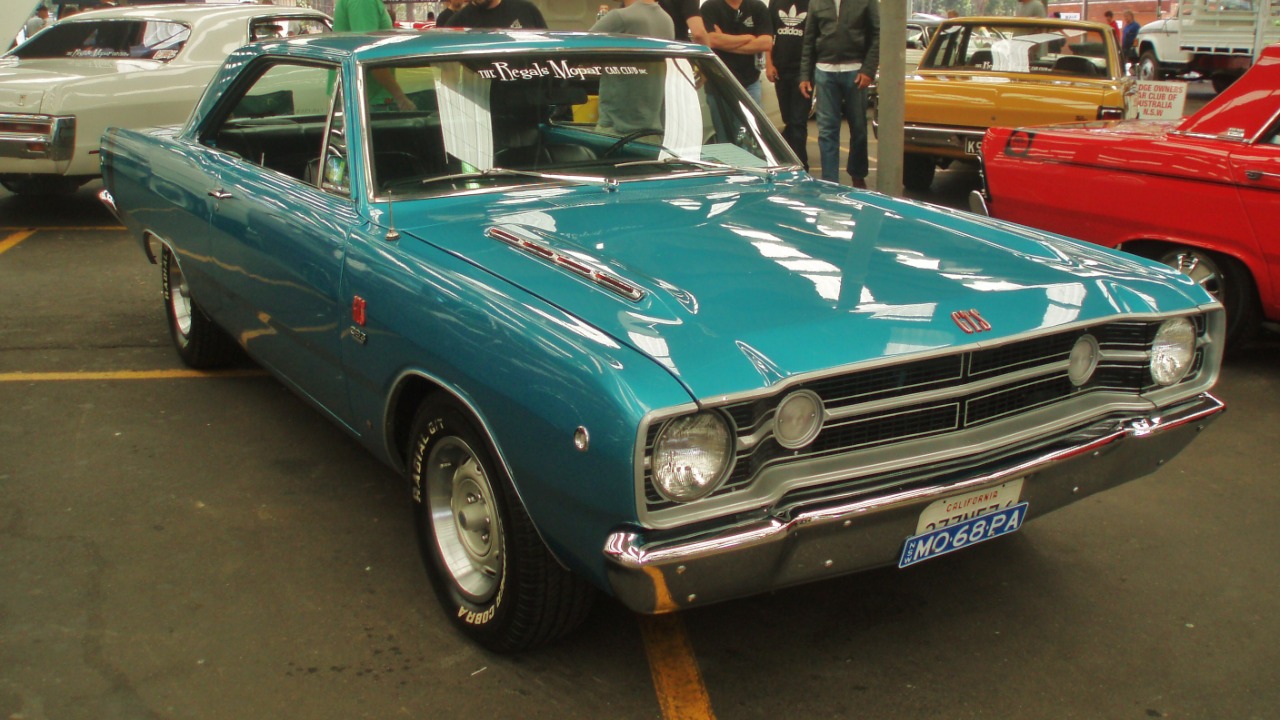
The Dodge Dart GTS 383 was the kind of muscle car that made its own maker nervous, a compact body wrapped around big-block power that felt closer to a factory hot rod than a sensible showroom model. You get a small A-body shell, a heavy breathing V8, and a driving experience that could be thrilling, tiring, and occasionally terrifying, sometimes all in the same on-ramp. If you want to understand why it still looms so large in enthusiast memory, you have to look at how far Dodge was willing to push its own limits, and how quickly it realized it might have gone a step too far.
The wild idea: big-block power in a small A-body
At the heart of the story is a simple but audacious engineering decision: take Chrysler’s big-block and wedge it into the compact Dart. Engineers were literally Stuffing Chrysler’s 383-cubic-inch engine into Dodge’s A-body Dart and Plymouth Barracuda, a combination that was never meant to coexist on the original drawing board. The result was a front end packed so tightly that even routing the exhaust and leaving room for the steering gear became a packaging puzzle, the kind of compromise you only accept when the payoff is straight-line speed.
That payoff was real. When the 383 came back in the Dart GTS, it was rated at 300 horses thanks to revised heads, and later tuning pushed that figure higher as Dodge kept refining the combination. Period coverage notes that the big-block’s actual output could exceed the brochure numbers quite a few, which helps explain why the car felt so unruly compared with more balanced small-block Darts.
Why the GTS 383 unnerved Dodge itself
From a brand perspective, you were looking at a car that blurred the line between street machine and bracket racer, and that is where the nerves started to show. One of the key tradeoffs of putting such a big mill in a small shell was the loss of power steering, something One of the engineering notes calls out as a direct consequence of the tight engine bay. Another analysis of the earlier 383 A-body program points out that the lack of assist was not about drag strip optimization at all, but simply because the modified steering gear left no room for the pump, which also affected the availability of air conditioning, a detail laid out in an Aug report.
Inside Chrysler, some voices later described the Dodge Dart GTS as a car that “shouldn’t have existed,” a reflection of how extreme it looked in hindsight. A video deep dive on the Oct history of the car notes that it captured everything right and wrong about American excess in one compact package, and that Chrysler had to convince itself that such a combination was worth selling. When your own engineers later talk about a model in those terms, you can see why the GTS 383 has a reputation as a car that pushed its maker right up to the edge of what it was comfortable putting on public roads.
On the street: a compact that drove like a rocket
If you had bought one new, you would have discovered quickly that the spec sheet only hinted at how intense the car felt in real use. A first hand account from a Dart GTS owner describes a friend’s 68 Dart GTS hardtop with a 383 and 4 speed as “a real rocket,” the kind of car you agree to drive “reluctantly” because you know it will demand your full attention. That mix of excitement and apprehension is exactly what you feel when a short wheelbase, nose heavy chassis tries to put big torque through modest rear tires on imperfect pavement.
Modern coverage of the car’s behavior backs that up. A feature on the Dodge big block A-body calls out the “compromises inherent with the shoehorning,” from tight clearances to heat and weight distribution. When you watch a host in Jul walk around a 1968 Dodge Dart and describe it as a “big engine, a lot of horsepower, a lot of torque” that is still fun for exit ramps and errands, you get a sense of how the car straddles daily usability and raw, old school muscle.
Power figures, small-block rivals, and the 1969 recalibration
By the time you reach the 1969 model year, Dodge was already trying to tame and rationalize what it had created. A detailed profile of the 1969 Dodge Dart notes that the 383 in that car was rated at a realistic 300 bhp, a figure that aligns with the earlier 300 horse rating and avoids the inflated claims that sometimes surrounded big blocks. Crucially, the same source points out that the 340 small block actually produced 340 or more horsepower while weighing 90 pounds less than the 383, which meant the lighter engine could actually deliver a more balanced and arguably quicker real world package.
Other period and modern write ups echo that recalibration. A feature on a 69 Dart GTS notes that a revised cam and induction setup raised horsepower to 300, while also pointing out that the original exhaust manifolds were fairly restrictive until improved pieces arrived later. That same story highlights how Power steering became an option again, even though that particular car did without it, a sign that Dodge was trying to make the big block Dart more livable without walking away from its drag strip image.
How the GTS 383 fits into the Mopar muscle hierarchy
When you zoom out, the Dart GTS 383 sits in a crowded Mopar family tree that includes icons like the Charger and Challenger. A community breakdown of Key Models lists The Dodge Charger, Dodge Challenger, and Dodge Dart as core players in the brand’s muscle era, with big engines like the 440 Magnum and 426 HEMI grabbing most of the spotlight. In that company, the GTS 383 looks almost modest on paper, but its compact footprint and relatively low production numbers make it feel more like a specialist’s choice, the car you pick when you want something a little more unhinged than a full size B body.
That specialist appeal has only grown with time. A feature on a survivor 1969 Dodge Dart describes how owners today juggle the car’s heavy steering and packaging quirks with its raw charm, often using it for relaxed ice cream runs despite its drag strip roots. Another profile of a Dodge Dart GT 383 owner in Florida shows how enthusiasts now treat the car as both a hardcore drag piece and a casual cruiser, proof that the same traits that once made the GTS 383 feel like too much car for its own brand are exactly what keep you fascinated with it today.
More from Fast Lane Only