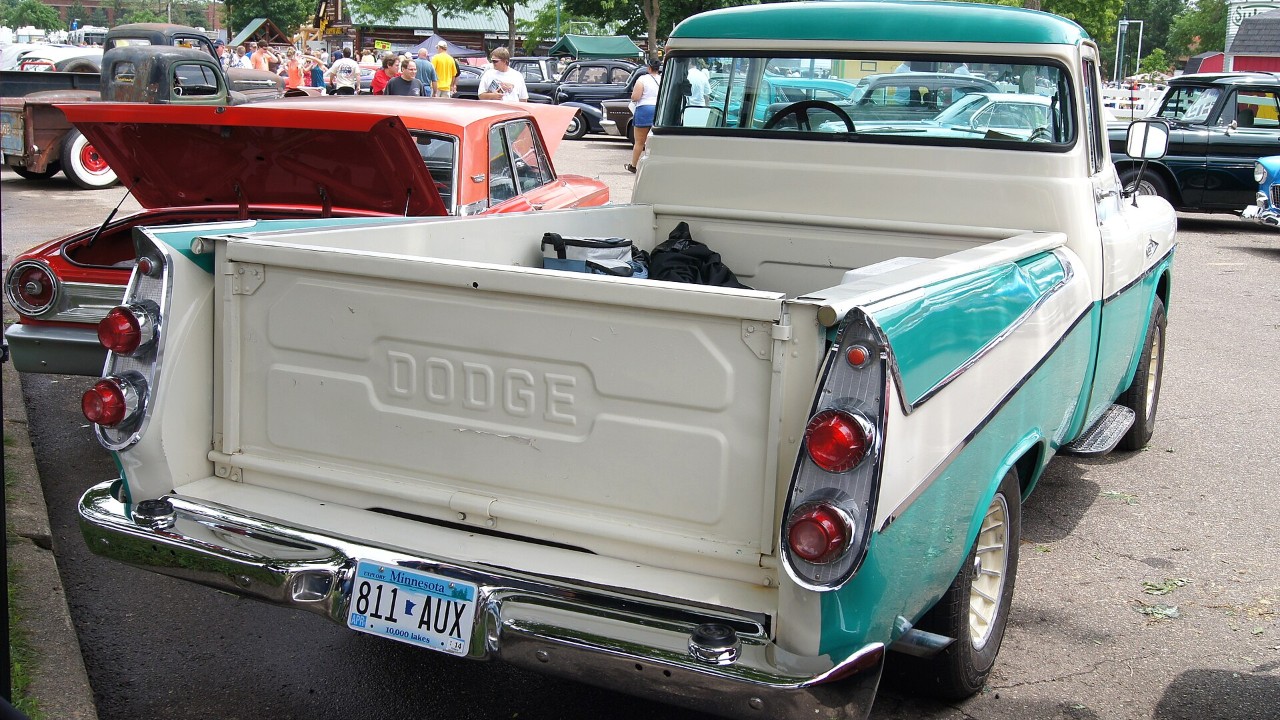
The Dodge Sweptside was a 1957 half-ton pickup wearing the finned rear fenders of a 1957 Dodge two-door station wagon. Workers welded those panels onto the bed by hand, which made the truck slow and costly to build. Dodge built it from 1957 until it dropped the truck in January 1959.
Today the Sweptside is one of the oddest trucks of the tailfin era. It was a parts-bin answer to a styling problem, and nobody in Chrysler’s design studio drew it. Instead, it came from the department that handled special orders.
That origin explains almost everything about it, from the price to the missing paperwork. It also explains why nobody can say for sure how many Dodge made.
Why Dodge needed a dressed-up pickup
By the mid-1950s, rivals had started giving pickups car-like style. Chevrolet had its Cameo Carrier, and Ford launched the Ranchero for 1957. Next to them, Dodge’s trucks “were starting to look a bit dowdy,” as Ronnie Schreiber wrote in The Truth About Cars.
Meanwhile, Chrysler’s cars had grown big fins under Virgil Exner’s Forward Look. However, Exner was not behind the truck. Old Cars Weekly says he “was not the one who came up with the stylish Sweptside pickup.” The Truth About Cars goes further, saying the Sweptside “had nothing to do with Chrysler’s design team.”
Who built the Dodge Sweptside
The credit goes to Joe Berr, manager of special equipment sales at Dodge Truck. According to Old Cars Weekly, Berr “re-used the rear quarter panels from a 1957 Dodge two-door station wagon and the wagon’s rear bumper.” Then a Special Equipment Group employee, Burt Nagos, welded those pieces to a Dodge truck bed.
The base truck was a long-wheelbase 1957 D100. As The Autopian describes it, the bed sides were cut out, and the wagon’s quarters and bumper went on in their place. According to The Truth About Cars, workers also modified the tailgate to clear the new fenders.
How the wagon fenders went on by hand
None of this happened on the main assembly line. Old Cars Weekly says workers modified the boxes “by hand in a special area of the factory.” It calls the job “a relatively long and laborious process that also made them expensive.”
The finished Dodge Sweptside looked like a car from the doors back. Every truck came with wheel covers, chrome bumpers and whitewall tires, according to Old Cars Weekly. In addition, the truck wore two-tone paint, and buyers could pick from more colors than Chevrolet offered on the Cameo. Glacier White and Tropical Coral were among them.
Hagerty’s write-up adds that the conversion also brought reworked side moldings and a wood cargo bed. At the same time, it notes the project was a mid-year 1957 addition aimed straight at the Cameo.
Price and engines
All that handwork showed up on the window sticker. The Autopian puts the Sweptside’s price at $2,124 when it reached dealers in mid-1957. By comparison, a base D100 cost $1,653.
Under the hood, buyers had two choices. The Autopian lists a 230-cubic-inch flathead six with 120 horsepower and a 315-cubic-inch V8 with 204 horsepower. Hagerty gives the same two engines and notes that V8 buyers could add a three-speed push-button automatic.
Options went further than most pickups of the day. Buyers could order power steering and power brakes, according to Hagerty. There was also a DeLuxe cab with a wrap-around rear window.
How many were built
Here the record runs out. Old Cars Weekly says flatly that “no production records exist” from the Sweptside’s 1957–1959 run. As a result, every number in circulation is an estimate, and the estimates do not agree.
The Autopian says it is “believed fewer than 200 were built in 1957.” It also cites roughly 975 Sweptsides among about 10,266 D100s believed sold in 1958, and perhaps 100 in 1959. Its total is “fewer than 1,500.” The Truth About Cars instead puts the run at about 2,000 Sweptsides and Fargos combined. Hagerty notes that Mecum has used “less than 200” while Barrett-Jackson has used 1,050.
Survivor counts are just as loose. The Autopian puts the survivors at fewer than 200. Meanwhile, The Truth About Cars reports an enthusiast estimate of about 165, roughly half of them 1957 models. For 1958, Dodge also offered the package in Fargo trim for Canada, where reports put Canadian production at only about 11 trucks.
What a Sweptside is worth now
The truck that “sold in dribs and drabs,” as Old Cars Weekly put it, now draws real money. The Autopian says decent examples hang around $30,000, while pristine ones reach “well into the six figures.” Hagerty’s guide figures in its write-up put a concours-condition truck at about $55,000 and an excellent one at just over $40,000.
Auction results have gone higher still. According to Hagerty, a Dodge Sweptside sold for $150,000 at Mecum’s 2017 Kissimmee sale. Another brought $90,200 at Barrett-Jackson’s 2018 Palm Beach auction.
More from Fast Lane Only