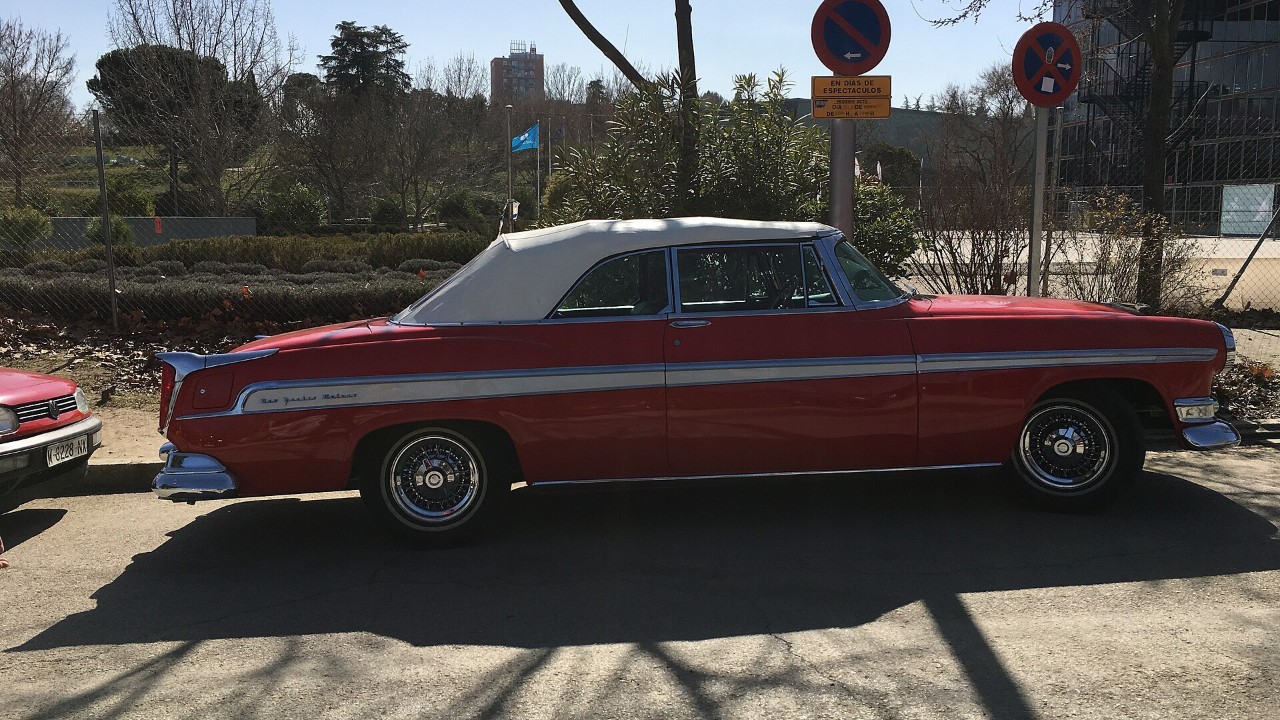
Ernest Hemingway won the Nobel Prize in Literature for 1954, and he marked it with a new car. The Hemingway Chrysler New Yorker was a 1955 Deluxe convertible painted in two tones, Navajo Orange and Desert Sand. It cost $3,924, and the latest published accounts place it in Cuba, at the museum in his former home outside Havana.
The story of that car runs from a Miami dock to a Havana bar, then through decades of ownership changes. Later, it vanished, turned up wrecked in a damp garage and became the target of a long restoration effort.
However, that effort has not reached the finish line. Below is what the record shows about the car, where it went and where it stands.
A reward to himself after the Nobel
Hemingway ordered the convertible as a reward after the 1954 Nobel Prize, according to writer Christopher P. Baker’s account for OnCuba News. Baker also reports that it was one of only 59 New Yorkers built for export that year.
In addition, his notes on the car go further. According to Baker’s page for his book on the car, Chrysler delivered it to Miami on February 28, 1955. From there, it shipped to Autos Comiac S.A. in Havana.
At the time, Hemingway lived at Finca Vigía, his estate outside the Cuban capital. So the export order made sense: the car went straight to the island he called home.
What Chrysler built for him
As for the design, Hagerty credits Hemingway’s car to Virgil Exner. Under the hood sat a 331-cubic-inch FirePower V8 with a four-barrel carburetor, rated at 250 horsepower, per Baker.
The paint is what people remember, though. Navajo Orange over Desert Sand was hardly a subtle choice. Indeed, Chris Paquin, who later worked on the car’s restoration, summed it up for OnCuba: “a fast, racy, powerful, macho car for a powerful, racy, macho kind of guy.”
The Hemingway Chrysler New Yorker in Havana
The car had a regular route. According to Hagerty’s look at the cars of famous writers, he drove it from Finca Vigía into Havana and the Floridita bar. Hagerty, citing writer David Frey, says Hemingway called the Floridita “the best bar in the world” for daiquiris. He also mentioned the Chrysler in his novel Islands in the Stream, Hagerty notes.
The Chrysler was not his first notable car, either. Hagerty lists a green 1929 Rolls-Royce Phantom II that he drove around the United States after A Farewell to Arms came out. Better yet, that car had a minibar and cubbies for hunting and golf gear.
Meanwhile, Buicks and Lincolns filled his garages in Key West and Cuba. For his fourth wife, Mary, he bought a yellow Plymouth convertible with wire wheels, according to Hagerty.
Lost for decades, found in a garage
After Hemingway’s death in 1961, the Cuban government took over Finca Vigía, OnCuba reports. Meanwhile, the car went to his doctor, José Luis Herrera Sotolongo. OnCuba says Hemingway willed it to him. By contrast, Hagerty says Mary Hemingway gave it to the doctor. Either way, it later passed to the doctor’s son and other family members.
In 1982, a Cuban policeman named Agustín Núñez Gutiérrez bought it, OnCuba reports. Then, in 1994, he left Cuba on a raft for Miami, and the car dropped from sight. For years afterward, rumors claimed he had buried it or smuggled it out.
In the end, the truth was less dramatic. In March 2011, Cuban officials located the car in the leaky, humid garage of Leopoldo Núñez Gutiérrez, Agustín’s uncle. Hagerty credits the search to Ada Rosa Alfonso, then director of the Hemingway museum.
In fact, the car they found was a wreck. According to OnCuba, the top and leather interior were gone. Worse, someone had fitted parts from a GAZ, a Lada and a Dodge.
A restoration that stalled
Alfonso commissioned a restoration, and an unlikely team formed around it. Actor David Soul, best known as “Hutch” from Starsky and Hutch, joined Danny Hopkins, editor of Practical Classics, along with Paquin. In Havana, panel beater Pedro Pino and a mechanic named Humberto did the hands-on work.
First, Humberto rebuilt the transmission and the V8, OnCuba reports. However, the car also needed a dynamo, a starter motor and a water pump. Many parts were held up by U.S. embargo rules and Cuban red tape, and some arrived unusable.
Soul tried to work around the rules. According to Street Muscle, he imported parts for the restoration on his British passport. He also fought the U.S. embargo in hopes of bringing the car back to the States.
Then the project lost its key people. Alfonso was fired, and Pino suffered a stroke. As a result, new parts, paint and chrome deteriorated in storage. When Baker checked in 2017, he found rust and peeling chrome.
In addition, Soul had planned a documentary, Cuban Soul, about the work. He died in 2024, according to Baker’s book page, which states plainly: “The restoration remains unrealized.”
Where the car is now
The Museo Ernest Hemingway, which occupies Finca Vigía outside Havana, holds the Chrysler. On Baker’s visit, it sat on cement blocks under a tarp. There, Alfonso showed him its VIN plate and the documents tying it to the car Hemingway ordered in 1955.
For the record, Baker’s book page dates the museum’s recovery of the wrecked convertible to 2011, 56 years after it left the Miami dock.
More from Fast Lane Only